Parvati marries Bhuvan Chowdhury
DevdasParvati’s marriage to Bhuvan Chowdhury closes the possibility her family once entertained of her marrying Devdas and places her instead at the center of a large, bereaved household. The wedding is deliberately simple, but its consequences are substantial: Parvati leaves her parents’ home, becomes a stepmother to Bhuvan’s children, and assumes authority in a mansion whose wealth cannot conceal its emptiness. For Devdas, her departure makes a missed future newly irreversible.
Background and the Unchosen Match
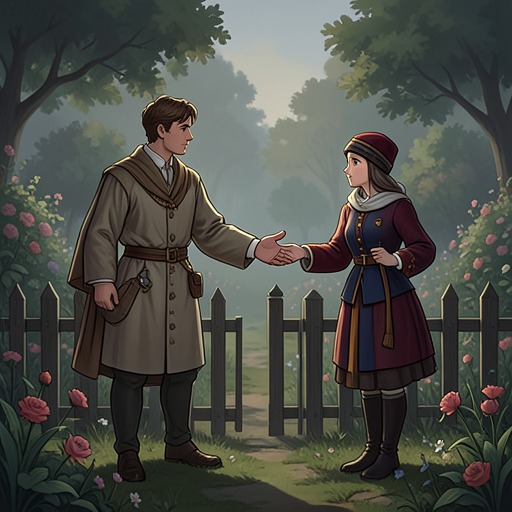
Parvati’s mother had privately hoped that her daughter might marry Devdas. The two had grown up together, and Parvati’s grandmother tried to turn that familiarity into an opening by telling Devdas’s mother how close the children were. Devdas’s mother answered that they had grown up like brother and sister; the exchange shows how differently the families read the same childhood bond. The marriage to Bhuvan therefore follows not a confirmed engagement to Devdas, but the collapse of a possibility that Parvati’s family had allowed itself to imagine.
The Chakravartys were not wealthy, and the marriage customs described in the story made a daughter’s wedding a different concern from a son’s. A bride-price was traditionally taken for a girl and paid for a boy. Nilkantha Chakravarty rejected the practice, despite its precedent in his own family, because he would not sell Parvati for money. That stance gives the wedding’s material details a particular context: the narrative later shows ornaments arriving for the bride, but does not present them as a bride-price or as a payment to her father.
The Wedding and Departure
The injury Parvati had received to her forehead was not deep; after she explained it as a fall on the steps, it healed within a week. Nearly ten days later, Bhuvan arrived at the Chakravartys’ house in the groom’s finery. It was his second marriage, and the ceremony was kept simple rather than made into a spectacle. He was well over forty, fair and stout, with a salt-and-pepper moustache and a receding hairline. The difference between the middle-aged groom and his young bride unsettled the customary wedding mood: some onlookers laughed quietly, while the women withheld their usual teasing.
At the first moment when bride and groom were to look at one another, Parvati stared steadily at Bhuvan with a small smile. He lowered his eyes with conspicuous modesty, and the neighbourhood women burst into giggles. The scene gives the wedding a brief, public lightness without turning it into romantic courtship. Nilkantha hurried about supervising the arrangements, while Devdas’s father, Narayan Mukherjee, hosted the occasion and ensured that the ceremony passed without a hitch.
The next morning Bhuvan handed Nilkantha a box of ornaments, which were soon glittering on Parvati. Her mother quietly wiped her eyes with the end of her sari; Bhuvan’s wife stood beside her and gently told her not to spoil the day with tears. Later, Manorama blessed Parvati and reassured her that she might yet be happy. Before leaving, Parvati said she wanted to touch Devdas’s feet one last time. She and Manorama embraced and wept together. At dusk, Parvati’s grandmother called them out, and that night Parvati left for her husband’s house.
A New Household and Its Duties
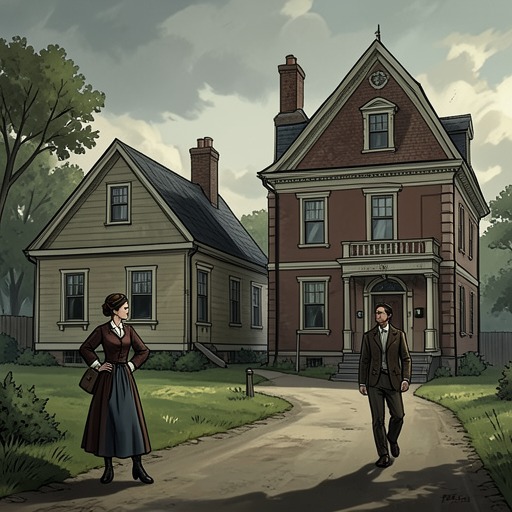
Bhuvan’s home in Hatipota is a huge old mansion, built on inherited wealth, with outer courtyards, inner chambers, rooms for worship and visitors, guest apartments, offices, and many servants. Parvati had known that her husband was wealthy, but not the scale of the household. Its lack was not space or property but people: the inner rooms seemed to echo with emptiness, and, apart from an old aunt, servants, and maids, the new bride found few family members to welcome her. She was immediately treated as the lady of the house, a title that brought responsibility rather than simple display.
Just before dusk, a handsome young man of about twenty approached and touched Parvati’s feet. He identified himself as her eldest son and asked for her blessing. He explained that his mother had died two years earlier and that life had been difficult since; he hoped Parvati’s arrival would bring happiness back to the family. Parvati lifted her veil to her brow, called him to come closer, and addressed him as her son. Her immediate acceptance establishes the maternal role her marriage requires. The young man is Mahendra, and Parvati soon asks him where her other children are.
That role extends beyond the first formal greeting. When Parvati’s father visits, she tells him that the house is in disarray and that she will come home later. After he leaves, she asks Mahendra to fetch his eldest sister, Yashoda, though he hesitates because he expects Yashoda to refuse. The following day he goes alone, and Yashoda arrives four days later. Wearing the priceless jewels Bhuvan had obtained in Calcutta, Parvati takes the young woman by the hand into her room, seats her, and fans her while asking whether she is angry with her new mother. When Yashoda is mortified, Parvati removes her own ornaments one by one and begins putting them on her stepdaughter. The gesture turns the bride’s display of wealth into an act of welcome and care.
Consequences and Significance
Parvati’s departure has a parallel consequence for Devdas. That night he spends time alone on a bench in Eden Gardens in Calcutta. He does not initially experience the loss as ordinary grief; instead, he senses a cold foreboding and struggles to comprehend that the familiar place Parvati occupied in his life is no longer his to claim. The wedding thus changes more than Parvati’s address: it converts Devdas’s failure to act into a separation he cannot reverse by anger or regret.
The separation does not erase Parvati from his thoughts. After his father’s death, Devdas remains at home for six months, then becomes restless, finding no peace or joy and thinking increasingly often of her. His mother, who is also unhappy after her husband’s death, later reflects that it might have been better if Devdas had married Parvati when the opportunity arose. These later reflections frame the wedding as a turning point whose personal consequences persist long after the ceremony: Parvati builds a place for herself among Bhuvan’s children, while Devdas is left to feel the weight of the life he failed to choose.