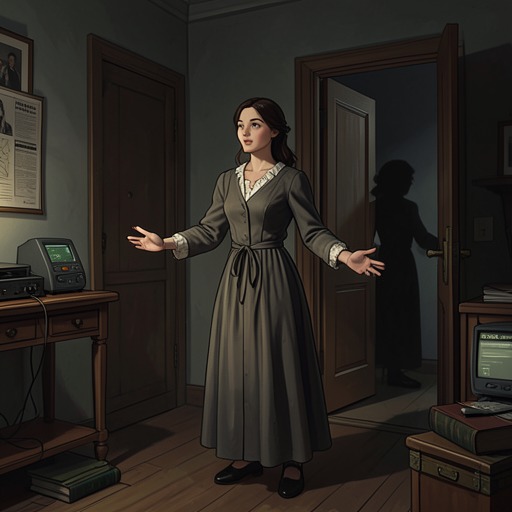
Parvati rushes to see Devdas after learning of his death
DevdasParvati rushes to see Devdas after learning that the man found dead was Devdas Mukherjee, her childhood love. Recognition comes through the small, verifiable marks he carried, but it comes too late to give her a final meeting: by the time she runs from the house, he has already been taken away. The episode turns identification into an urgent but thwarted attempt at reunion, ending in collapse and silence.
The News and the Signs of Recognition
Parvati first asks whether anyone has discovered who the dead man was. The maid cannot tell her much, but says Mahendra knows, so Parvati sends for him. His answer—that the man was Devdas Mukherjee, from Parvati’s own village—changes the exchange at once. She comes close and questions how he can know. The scene makes her need for confirmation visible: a name is not enough until the details that belong to Devdas have been accounted for.
Mahendra gives her those details one by one. Two letters were in Devdas’s pocket: one from his elder brother, Dwijodas Mukherjee, and one from his mother, Harimati Devi of Varanasi. Parvati confirms each relationship before Mahendra has finished explaining. The letters connect the unidentified dead man to a family, while her immediate recognition shows that she already knows who those relatives are to Devdas. His identification is not an inference she receives passively; she follows each clue and supplies what it means.
The remaining objects make the recognition more intimate. Mahendra reports that Devdas had his initial tattooed on his wrist. Parvati recalls that he had it done when he first went to Calcutta. A blue stone set in a ring provides another confirmation: she knows his uncle gave it to him at his thread ceremony. The clues progress from letters that name his family to marks and possessions tied to particular moments in his life. By the time Parvati identifies the ring’s origin, the question of who has died has become personal knowledge rather than mere report.
The Attempt to Reach Devdas
Parvati’s response to recognition is immediate movement. She says she must go and dashes down the stairs. When Mahendra asks where she is going, she answers that she is going to Devdas. Her words set the purpose of the action plainly: she is trying to reach him, not simply to learn more about his identity. But Mahendra tells her that Devdas is no longer there; they have taken him away. The fact that he has already been removed turns her rush into a race against an absence that has already been established.
Parvati sobs and runs anyway. Mahendra darts forward and blocks her, asking where she can go and whether she has lost her mind. She indignantly rejects the idea that she is mad and demands to be allowed through. The interruption makes the practical barrier to her attempt explicit: she is not only too late to find Devdas where his body had been, but is physically stopped as she tries to continue. Her urgency is answered by other people’s efforts to restrain and redirect her, not by access to the person she seeks.
The household’s alarm intensifies when Bhuvan Chowdhury hears that Parvati is going to see Devdas. He cries out that everyone has lost their minds and orders them to fetch her, calling her mad. The response frames her action as disorderly, but the narrative has shown what it is responding to: the confirmation of Devdas’s identity, the news that he has been taken away, and her insistence that she must go to him. As the maids and servants gather around, Parvati falls into a faint. They catch her and carry her back into the house. The attempt ends not in a meeting but in her removal from the path she had tried to take.
Aftermath and the Unanswered Night
Parvati regains consciousness the next day, but does not speak. She calls one maid and asks whether he came in the night, adding that it was all night long; then she falls silent again. The question does not establish that Devdas visited her. Instead, it leaves her final understanding unconfirmed: after failing to reach him, she asks whether he came to her, but the account supplies no answer. Her silence after asking makes the question the last piece of speech attached to the episode.
The narrator later admits not knowing what became of Parvati after so many years and says there is no wish to find out. That uncertainty keeps the aftermath from resolving into a further account of her life. The narrator’s closing appeal asks readers to pray that a person like Devdas should not die without a loving touch or a caring face to say goodbye. Set beside Parvati’s desperate but unsuccessful attempt, that wish sharpens the episode’s central deprivation: she identifies him, runs for him, and is told he is gone, while the story gives no scene in which they meet again. The final question about the night cannot undo that separation; it preserves it as an unanswered possibility.