Margaret's room
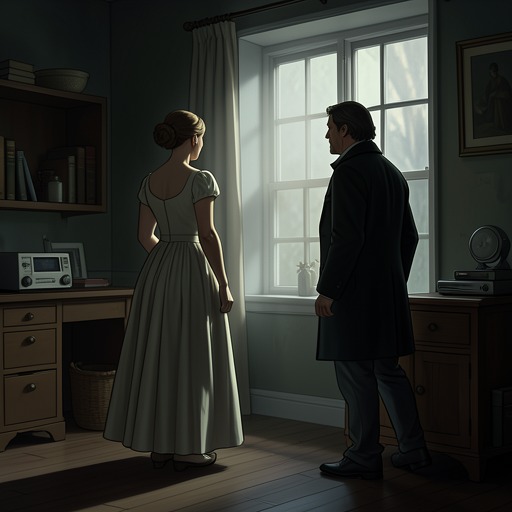
FaustMargaret’s Room is a modest domestic interior whose neatness, remembered family life, and familiar household objects make it more than a backdrop: it gives visible form to Margaret’s ordered world, then holds the private signs of its disturbance. Faust reads the chamber as a place of contentment and care; Margaret later encounters the jewelry hidden in its press, and returns to the spinning wheel alone, singing of a peace she has lost.
Setting and Domestic Order
The scene is identified as a small, neatly kept chamber. Its dimensions and care matter together: this is a narrow private space, but Faust sees no corresponding narrowness in its emotional life. Looking around, he dwells on its quiet, order, and contentment, and imagines the bounty that can exist within poverty. The room’s arrangement becomes, in his interpretation, evidence of the care that shapes it.
Faust’s attention turns from the room as a whole to its everyday furnishings. He throws himself into a leather armchair beside the bed and imagines children gathered around the place where their father once sat. He pictures Margaret as a child receiving Christmas gifts and kissing her grandfather’s hand. These are his conjectures, not confirmed memories narrated by the play; their importance lies in what they reveal about the way he reads the chamber. Its furniture prompts him to supply an imagined family past and to understand domestic order as a kind of tenderness.
He also attributes that order to Margaret herself. In his imagining, her influence is present in the smooth cloth on the table and the whitened sand beneath his feet; he describes her hand as capable of turning a hut into a lower heaven. The room thus registers two perspectives at once: its practical neatness and Faust’s idealizing response to it. The domestic scene encourages him to attach a dream of contentment to Margaret’s surroundings, although that ideal remains his interpretation rather than a neutral account of her inner life.
The Press and the Jewelry
The chamber’s press shifts the emphasis from general order to a particular hidden object. Margaret opens it to arrange her clothes and finds a casket of jewels. She is certain that she locked the press, and wonders whether the casket might have been left as a pledge for a loan her mother made. This practical explanation briefly places the discovery within household routines, but the key hanging there invites her to open it.
Inside, Margaret finds rich ornaments of a kind she has never seen, including a pearl chain that she imagines might suit her hair. She does not know who owns the treasure or how it came into the press. The jewels therefore enter the room as both a material surprise and an unresolved question. When she adorns herself and steps before the mirror, the scene moves from the concealed casket to her own reflected appearance: the private chamber becomes the place where she tries on an unfamiliar form of adornment, while the object's unexplained arrival remains unsettled.
The scene makes the room’s ordinary storage space consequential. The press is part of the neat domestic interior, yet what it contains exceeds Margaret’s knowledge of her own household. Her questions about the locked door, the key, and the casket establish the gap between the appearance of an orderly private world and the unaccounted-for object now inside it. The jewelry’s presence connects this chamber to the larger courtship plot without making the room itself the source of its origin.
The Spinning Wheel and Lost Peace
The chamber recurs as Margaret’s Room in a later scene, where Margaret is alone at the spinning wheel. The contrast with Faust’s earlier visit is stark: he had filled the room with imagined children and family continuity, while the later stage direction presents Margaret by herself, occupied with a familiar domestic task. The spinning wheel locates her emotion within the same everyday world that Faust had read as peaceful and complete.
Her song begins with the declaration that her peace is gone and her heart is sore. She says she will never find that peace again unless Faust is near, then turns to images of a grave and a world made bitter. The song does not merely repeat Faust’s earlier ideal of the room as a lower heaven; it overturns it. The ordered domestic setting remains, but Margaret’s own words identify the absence of ease within it and bind her hope of relief to Faust’s presence.
The room’s most revealing recurrence is therefore not a change in its furnishings but a change in the emotional meaning attached to them. First, its neatness supports Faust’s fantasy of family life; then its press yields jewelry Margaret cannot explain; later, its spinning wheel accompanies a song of attachment and distress. These episodes make the chamber a private measure of the courtship’s effects: outward order persists even as Margaret’s sense of peace gives way to longing and bitterness.
Dramatic Significance
The chamber’s meaning emerges through the play’s return to a specific domestic interior rather than through a narrated history of the space. An armchair, bed, table, sanded floor, press, mirror, and spinning wheel anchor different moments in the same room. Each object directs attention toward a distinct relation between privacy and knowledge: Faust projects a family past onto the furniture; Margaret encounters an unexplained casket in household storage; and her solitary work becomes the setting for a song that discloses her emotional dependence on Faust.
This sequence also places Faust’s idealization beside Margaret’s own expression. His response turns neatness into an image of contentment and elevates the hut into an imagined domestic heaven. Margaret’s song, by contrast, names the loss that this picturesque reading cannot contain. The chamber consequently functions not as proof that she possesses the happiness Faust imagines, but as a domestic setting in which his ideal and her distress become legible in contrast.