Charlie’s “Bad Thing” prohibition
FirestarterCharlie’s “Bad Thing” prohibition is the rule that she must not use her firestarting ability, a prohibition shaped by her parents’ efforts to protect her and reinforced by the frightening consequences of fire. It is both a practical safeguard against a power Charlie cannot reliably control and a psychological restraint that complicates her attempts to survive. The Shop’s pursuit makes the rule more than a family warning: Charlie fears that using her abilities could reveal her presence, while the pressure of danger may force her father to reconsider how strictly she should be restrained.
The rule and its origins
Charlie understands the prohibition as an instruction repeated since early childhood: she must not release the power she calls the Bad Thing. Its danger is not merely that she might start one fire. She fears that once released, the power could spread beyond her control, hurting herself, one person, or many. The prospect of an effect that goes everywhere makes the rule inseparable from her fear of consequences she cannot contain.
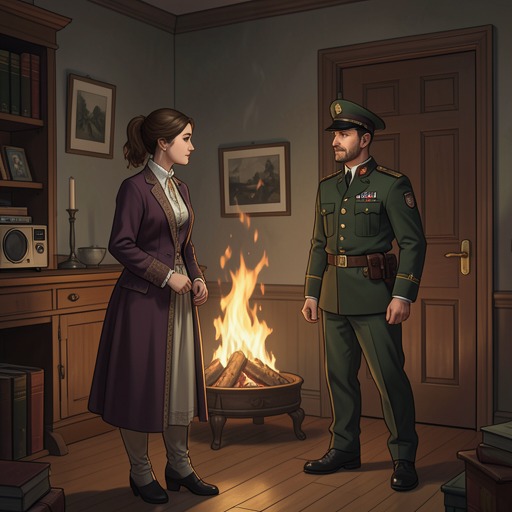
The prohibition has a personal history. Charlie remembers having made her mother scream and associates the episode with pain, bandages, and a promise never to do it again. The memory is too painful for her to dwell on fully, but it explains why the rule is felt as terror and guilt rather than as an abstract instruction. In another childhood incident, her father shows her Teddy, a stuffed bear left scalded and blackened by fire. He makes the danger immediate by connecting the burned toy to the possibility that she could burn either parent. He waits until she is sobbing before picking her up and comforting her. The scene joins physical evidence of what her power can do to an intense parental warning, then ends in the comfort of her father’s embrace.
A safeguard made through fear
The fire prohibition grew out of a household in which Charlie’s ability appeared before she could understand or govern it. Joseph Wanless describes incidents recorded from her infancy: a stuffed animal in the crib catching fire, clothes burning in a hamper, and Charlie standing in her crib with her hair on fire. The McGees responded with a fire extinguisher and smoke detector in every room. These details give the rule a concrete basis: for her parents, teaching Charlie not to kindle fire was a matter of preventing potentially grave injuries, not simply controlling a child’s behavior.
Wanless calls their response fire-training and compares it to toilet-training. In his account, both processes establish a lasting association between an act and an unacceptable consequence; the crucial difference is the potential harm if a child with Charlie’s ability learns too slowly. He surmises that the McGees began teaching the rule unusually early, perhaps before she could crawl, and describes their method as repeatedly marking fire as something the baby must not do. His comparison treats the prohibition as a deliberately formed complex: protection is achieved by making the dangerous act frightening.
Wanless nevertheless regards Charlie’s parents with high esteem for getting her through childhood. He argues that a fear imposed early need not be permanent, particularly because Charlie is young and her father is still present. In his psychological theory, the father’s authority makes him uniquely capable of removing a block he helped establish. This is Wanless’s interpretation, not a simple declaration that the rule has been erased: his point is that Charlie may be able to overcome it, and that her father’s presence matters to that possibility.
The push, secrecy, and survival
Charlie’s firestarting ability is distinct from the push her father, Andrew McGee, has taught her about. She can make objects move with the push, and she can do so more forcefully than he can without suffering the headaches he experiences. But she associates her use of the push with fires that sometimes follow. The abilities therefore do not feel safely separate to her: even a form of power she understands as movement carries the frightening possibility of fire.
The prohibition also has a strategic purpose. Andrew warns Charlie that The Shop must not discover more about her. Her push differs from his because she cannot make people change their minds, but she can move things; if observers notice a pattern and connect it to her, their danger will increase. Charlie’s restraint is consequently partly self-imposed under the threat of surveillance. The rule says not only that her power is dangerous, but that displaying what she can do could help her pursuers identify and capture her.
That conflict becomes immediate when Charlie is injured and needs to find money while her father rests. She knows that the men from The Shop may be coming and that Andrew’s pain makes it difficult for him to think. At a bank of pay phones, she approaches an action she has repeatedly been told not to take. The urgency of finding money for a quiet, warm place presses against the prohibition; she also recognizes that taking money would be stealing, another thing she has been taught is bad. Her decision-making is thus constrained by overlapping rules even as danger makes obedience harder to sustain.
Meaning and dramatic consequence
Wanless warns Cap Hollister that The Shop’s pursuit may worsen the danger the prohibition was designed to prevent. Charlie is frightened, on the run, and facing a survival situation; Andrew is frightened too. If the Shop forces him to change how he teaches her, Wanless argues, it may force him to alter her understanding of the power inside her and to make her use it. His warning turns the rule into a point of conflict between family protection and institutional coercion: pressure intended to control Charlie could instead help produce the conditions for her power to be used.
The prohibition is therefore protective without being simple. Its origin lies in real danger, and the blackened Teddy and the household’s fire precautions give that danger material form. Yet the method of protection leaves Charlie afraid of her own capacity, while the pursuit by The Shop makes concealment and immediate survival compete with obedience. The rule’s central tension is that Charlie must learn to live with an ability that can cause harm without being able to treat fear alone as control.