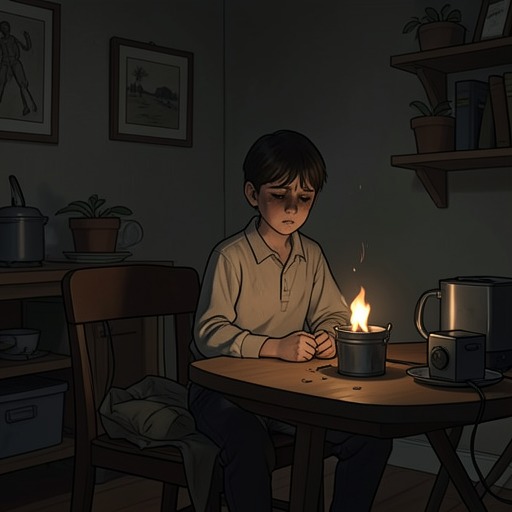
Charlie’s Vow Never to Use Her Firestarting Ability Again
FirestarterCharlie McGee’s vow never to use her firestarting ability again is an effort to contain a power that, during the farm attack, escaped her control and endangered people she loved. First spoken to Irv Manders and repeated in secret, then restated to Andy McGee beside a stream, the vow records both Charlie’s fear of what she can do and the emotional cost of being asked to do it. It is not shown as a settled resolution: Andy later recalls it as a possibility that may be best, while the circumstances around it leave open whether she can keep it.
Formation in the farm’s aftermath
After Andy carries Charlie to Irv, who is sitting against the barn door, Irv tells her that the men meant to kill her father and that she had understood their danger before either he or Andy did. Charlie confirms this, but her attention turns to what happened when she tried to act. She says the fire had become impossible to contain, burned some of Irv’s chickens, and nearly reached Andy. The event thus joins protection and harm: Charlie had recognized a threat to her father, but responding to it brought the power close to injuring him.
Andy tells her that he is fine, though he remembers the sensation of being enclosed by the heat. That recollection gives the danger a second perspective: Charlie is not the only one carrying the episode afterward. She declares that she will never use the ability again. Andy accepts her words and puts a hand on her shoulder, offering comfort without challenging the decision. When she repeats the vow, Irv cautions her against shutting herself off with an absolute promise. His advice is practical rather than dismissive: she should do what circumstances require and do the best she can, because a person cannot know in advance what will be necessary.
Charlie does not accept the caution. After Irv asks Norma Manders for a stick and Norma tells him to rest, Andy alone hears Charlie repeat the word almost inaudibly, as if making a private vow. The contrast matters: Irv addresses the danger of an unbreakable rule, while Charlie makes the rule more inward and less open to discussion. Her silence does not signal that the fear has passed; it makes the commitment harder for others to answer.
The vow becomes a plea to Andy
The vow returns in a separate, intimate exchange after Andy drives the Willys away from the gravel lot and into a copse beside a stream. He and Charlie sit by the water, and she begins to cry. Andy holds her and tries to comfort her. In that moment, she asks him not to make her use the power again. She says that if he asked, she would comply, but fears that afterward she might kill herself; she asks him to promise.
The exchange changes the vow’s emphasis. At the farm, Charlie presents it as a decision about her own actions. Beside the stream, it becomes a request that Andy not place the burden of using the power on her. Her fear is not simply that another uncontrolled fire may occur: she anticipates that obeying a request from her father could leave her unable to live with the act. Andy tells her that he loves her and rejects her talk of suicide as irrational, but the passage does not establish that he gives the promise she asks for. The unanswered request leaves the tension between parental need and Charlie’s limit unresolved.
Andy’s later recollection
Later, Andy revisits the attack while thinking about the Shop’s pursuit. He realizes that its agents were chiefly interested in Charlie and had intended to kill him. In that same period of reflection, he remembers that she said she would not make fires anymore, and considers that this might be for the best. His thought is tentative, not a declaration that the vow has been secured or tested. It registers how seriously he takes the danger after experiencing the heat himself, while his recognition that Charlie was the target places her ability and her vulnerability at the center of the pursuit.
The memory also returns through Andy’s dreams, which repeatedly bring back the farm fire and his experience of being surrounded by heat. The vow therefore remains attached to a specific episode rather than becoming an abstract rule. Its repetition links Charlie’s distress to Andy’s continuing recollection: she tries to prevent a recurrence, while he cannot simply set aside what happened. The narrative presents the promise as a lasting response to the event, even as its future force remains uncertain.
Significance and limits
The vow is defined by the conflict between an absolute prohibition and a power that may be needed to protect someone. Irv warns Charlie that she cannot know what she will have to do; Charlie, unable to accept that uncertainty after nearly harming Andy, insists on never using the ability again. The difference is not a disagreement over whether the episode was dangerous. It is a disagreement over whether safety can be guaranteed through a promise made in the aftermath of danger.
The two repetitions also give the vow distinct relational meanings. In front of Irv, Charlie’s repeated word becomes a secret commitment despite his warning. With Andy, the commitment becomes a plea for his restraint as well as her own: she fears that she will obey him even when doing so could destroy her. Andy’s later thought that nonuse might be best shows the vow’s force on him, but does not resolve whether Charlie can or should maintain it. Its significance lies in that unresolved limit: love may motivate her to act, while the memory of what her power did makes action frightening.