Water’s Constraint on Charlie’s Fire Power
FirestarterWater is not a simple antidote to Charlie McGee’s fire power: it is the outlet she believes she needs to direct and contain it, and even that outlet can be overwhelmed. The constraint makes her ability a problem of control and preparation as well as force. Without enough water, the fire may spread; with water, Charlie can redirect it, but the water can boil and surrounding fixtures can be destroyed in the process.
The Rule and Its Limits
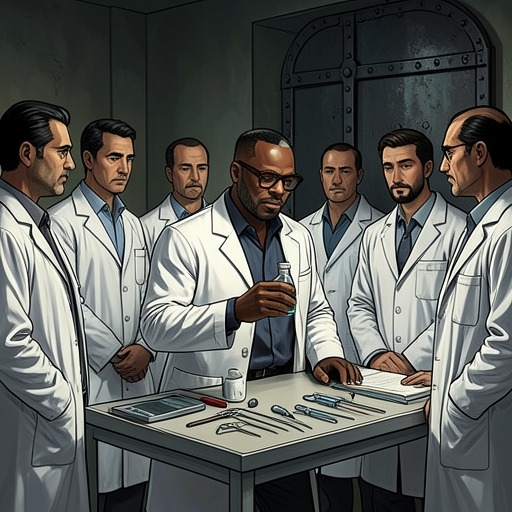
Before a Shop test, Charlie tries to explain the danger of the plastic camera: if it becomes hot enough, it could explode and scatter pieces. More urgently, there is no water. Her parents taught her that once a fire starts, she has to push it at water to put it out. The warning is practical, not abstract: she fears that the test has placed her in a room without the means she needs to manage what she may unleash.
Her distress compounds the warning. Charlie bursts into tears; she has not slept, wants John Rainbird and her father, and does not want to be there. Patrick Hockstetter interprets her emotional upset as evidence that she is prepared to go through with the test. The gap between his reading and her expressed fear makes the water requirement especially consequential: the people overseeing the experiment see readiness where Charlie is describing a safety condition.
Water, however, does not simply extinguish the force without consequence. In the test, Charlie directs the fire at a tub. Within five seconds its cool contents become a steaming, rolling boil. The nearby thermometer, after rising from seventy to eighty degrees and pausing, climbs past ninety to ninety-four; the steel wall develops a dark ripple, and the room grows explosively hot. The water receives the force, but it is transformed by it. The incident demonstrates both the usefulness and the insufficiency of the outlet: Charlie can redirect the fire, yet the heat remains powerful enough to alter the room and rapidly overwhelm the water.
Water in the Shop’s Tests
The tub test gives the Shop an unusually visible demonstration of Charlie’s developing ability. The technician has left the testing-room door ajar. In the observation room, Patrick Hockstetter bellows, Cap Hollister stares through the window, and steam fogs the one-way glass. John Rainbird alone remains calm, watching with a slight smile. Their different reactions frame the event as both a dangerous loss of ordinary scale and a result Rainbird can interpret as a successful display of control.
That control is important to Charlie’s own account afterward. She tells Rainbird that her power is much stronger than before, but says she was more in control of it during the test than she had ever been. She contrasts the tub with the fire at the Manders farm, where the force got away from her and spread everywhere. In the test, she could make it a small fire and send it out in a single straight line. Water thus belongs to a change in how she handles the ability: rather than allowing it to run loose, she can direct it toward a destination.
When Rainbird asks whether she pulled the fire back into herself, Charlie rejects that possibility. She had put it into the water, she explains; if she drew it back inside, she thinks she would burn up. The distinction defines the limit from her perspective. She can send the fire outward, but taking it back into her own body is not a safe means of stopping it. After the test she concludes that the next one needs more water, turning her experience into a concrete requirement for any further attempt.
Escalation and Growing Control
The later incident in the stable tests that rule under more extreme conditions. A half-full bucket does not merely steam: its water comes to an immediate, furious boil. The chrome faucet above it twists, spins, and breaks free from the pipe, flying across the stable and striking the far wall. Water gushes from the broken pipe, but it soon turns to steam; a hanging green hose fuses into loops of plastic. The surroundings register the force of Charlie’s power in a sequence of failures, from boiling water to a projectile fixture and melted hose.
Even in that escalation, Charlie begins to regain control and pull the power down. She recognizes that a year earlier she would not have been able to do so; the fire would have had to run its destructive course. Her capacity has improved, but the increased strength of the ability raises the difficulty of controlling it. Water remains a means of redirecting the force, not a guarantee that the consequences will stay contained.
Narrative Significance
Across these incidents, water marks the difference between an uncontrolled fire and an attempt to give the fire a direction. The tub offers Charlie a destination for the power; the stable’s half-full bucket and broken plumbing show how quickly that destination can fail to contain its effects. Her recommendation for more water follows from what she has witnessed, while the boiling bucket and vanished faucet make clear that preparation alone cannot make the power harmless.
The constraint also gives Charlie’s development a specific measure. At the Manders farm, the fire escaped her and spread; in the test, she directs it into the tub; later, in the stable, she can begin to pull it down despite the damage already done. These are not interchangeable demonstrations of strength. They distinguish force from control, and show why water is central to her efforts to manage an ability that she cannot safely draw back into herself.