Shop's secrecy and cover-up policy
FirestarterThe Shop's secrecy and cover-up policy is an evolving system for controlling what participants, witnesses, and the public can know about its work. It begins with restricted information around Lot Six and becomes a campaign to disguise the destruction at Longmont, silence the Manderses, and find Charlie McGee after she escapes. The policy can shape a public story and pressure people into silence, but it cannot guarantee that the truth will stay contained.
Classification and Controlled Knowledge
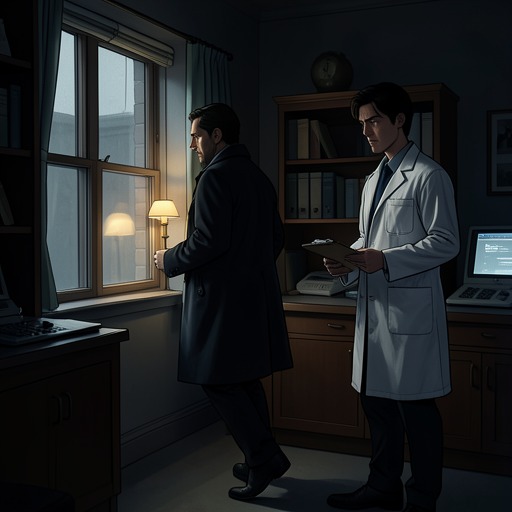
At the Lot Six briefing, Dr. Joseph Wanless describes the compound as classified and presents the experiment as a double-blind procedure. Twelve young participants are to receive injections: six of water and six of water mixed with a small amount of Lot Six. The participants and researchers are not to know who received which dose until later, and everyone will be supervised for forty-eight hours. The arrangement controls more than access to the chemical’s exact nature: it also limits what participants and researchers can know about the experiment as it unfolds.
The briefing gives the procedure a formal, scientific appearance while making clear that important information is withheld. Questions about the compound’s composition receive no useful answer, and the word classified itself intensifies the participants’ curiosity. The novel thus introduces secrecy not only as a response to a later disaster but as part of the experiment’s original structure: information is deliberately divided and access is controlled by the institution conducting the research.
Manufacturing the Public Account
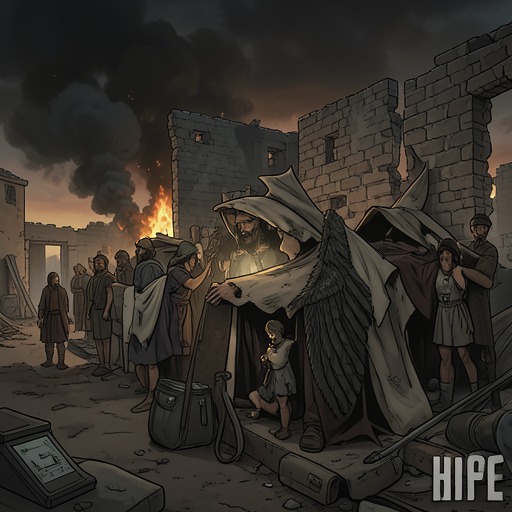
After the firebombing at the Shop’s top-secret scientific think tank in Longmont, Virginia, the news reaches the public in fragments on Wednesday night. By the following morning, broadcasters present a coordinated account with a beginning, a middle, and an ending. It describes a terrorist attack and reports that several groups have claimed responsibility, while identifying John Rainbird as a double agent who planted the bombs. Reports offer competing explanations for his death at the burning stable, including that he was overcome by heat and smoke while trying to rescue the horses. The coverage also reports twenty dead and forty-five injured, with ten of the injured in serious condition, and says the survivors have been sequestered by the government.
The account is constructed to make the catastrophe legible as a conventional terrorist attack, not as the destruction of a secret research facility connected to the Shop. The Shop’s name hardly appears. That omission is the policy’s clearest public success: attention is directed toward the supposed attackers, Rainbird, and the stable, while the institution behind the think tank largely disappears from the story. The official narrative does not settle on a single terrorist organization, but it supplies enough explanation to keep the Shop out of view.
That success is presented as provisional rather than secure. The narrative leaves a loose end, and the new head of the Shop orders that Charlie be found and killed, reasoning that she is an eight-year-old child who cannot remain hidden indefinitely. The head also notes that Charlie has not disclosed what she knows. The Shop is monitoring major newspapers, including The New York Times, The Washington Post, and The Chicago Tribune, while waiting to see whether she speaks. Public relations and active pursuit operate together: the institution manages what the press can learn even as it tries to prevent a surviving witness from adding another account.
Pressure on Witnesses
The Shop’s effort to contain the story also reaches the Manderses, who have witnessed its agents’ attempt to kill Andrew McGee and his daughter. The day after the fire, Whitney Tarkington visits Irv Manders in the hospital and identifies himself with a card reading Government Adjustments. He brings a file marked with the names Manders and Breedlove, Norma Manders’s maiden name, and uses copies from it during a long conversation. He frames the matter as national security and says the couple must be made to see reason.
Tarkington’s argument is not an effort to establish what Irv saw. Instead, he tells Irv that he does not understand what he witnessed or what it means, and that the purpose of the visit is to convince him not to talk. He offers a tax-free check that would cover house repairs and hospital bills, with money left over, while invoking the unpleasantness that could otherwise follow. The approach combines official authority, the suggestion that the government possesses private information, financial inducement, and an implied threat. Irv recognizes the attempted reframing: he knows the agents tried to kill an unarmed man and a child, and he does not simply accept Tarkington’s account of what he witnessed.
The couple’s experience shows the human cost of the cover-up without establishing that they agreed to keep silent. Irv is hospitalized with a bandaged arm, while Norma is distressed by the visit and by the government file bearing her family name. The episode makes secrecy material: it arrives at a hospital bedside with paperwork, a check, and pressure on two people whose own home has already become part of the conflict.
Leaks, Pursuit, and the Limits of Secrecy
The Shop’s information controls do not stop the story from spreading locally. Shirley McKenzie tells Hortense Barclay after keeping the secret for almost a month; Hortense tells Christine Traegger about ten days later; Christine shares it with her husband and three close friends almost immediately. By the time Irv and Norma’s conversation is overheard in April, much of Hastings Glen knows that they have taken in a mysterious girl. Curiosity and gossip carry information beyond the small circle the Shop would need to contain.
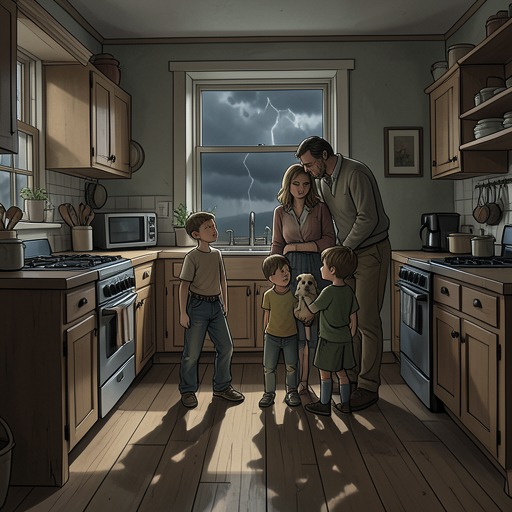
Eventually, the news reaches the wrong people, and someone makes a call from a scrambler phone. On the last day of April, Shop agents return to the Manders farm, approaching through the dawn fields in flame-resistant suits with a National Guard unit behind them. The Guard does not know why it has been sent to the peaceful town of Hastings Glen, New York. At the farm, the agents find Irv and Norma in the kitchen and a note from Charlie saying she thinks she knows what to do. She has eluded the Shop again, but she is now alone.
The ending exposes the limits of the policy. The Shop can coordinate an account that makes its name nearly vanish from national coverage, monitor the press, pressure witnesses, and deploy agents with military support. Yet its efforts leave a trail of people, records, rumors, and unresolved knowledge. The gap between the polished public story and the renewed pursuit of Charlie is central to the policy’s significance: institutional secrecy is shown as an active exercise of power, but also as a precarious one, repeatedly threatened by those who have seen what the official account excludes.