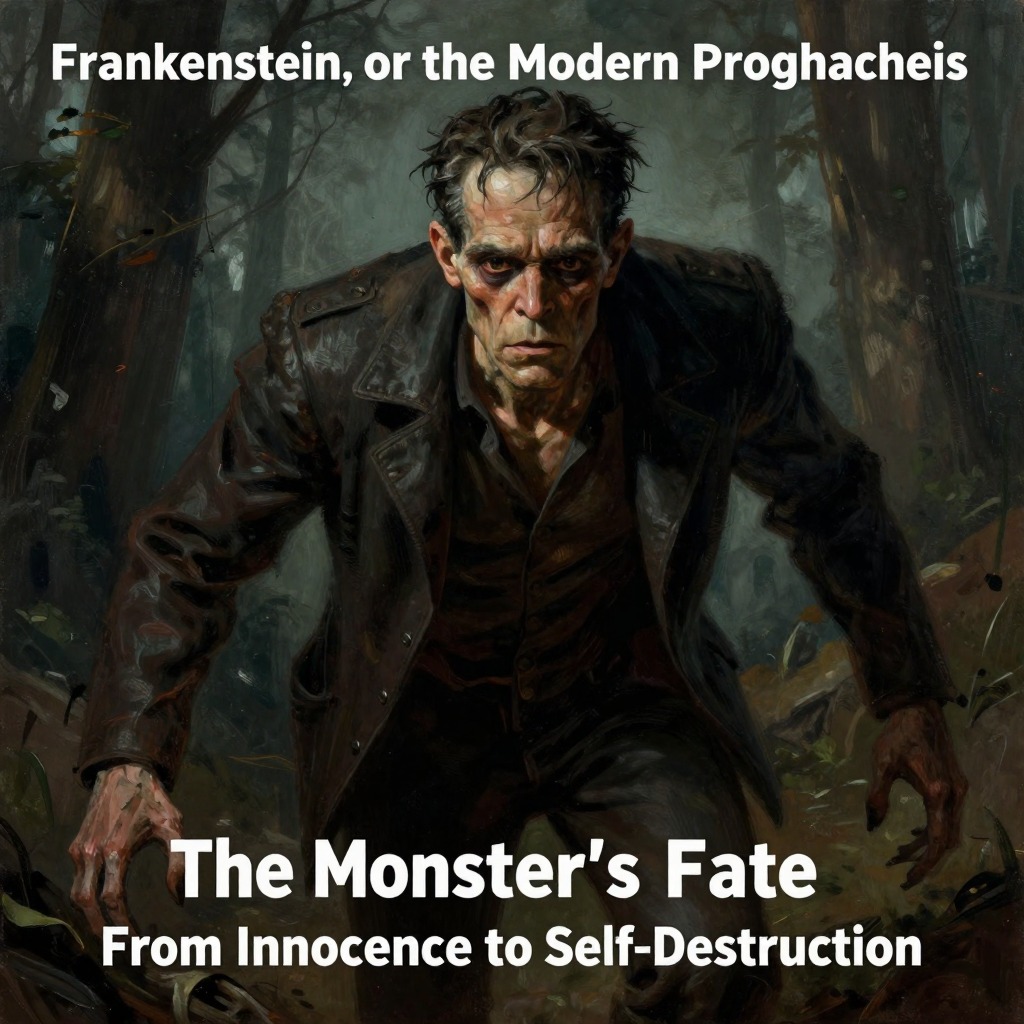
The Creature's Self-Imposed Death
The Creature's Self-Imposed Death is the culminating act of the monster in Mary Shelley's Frankenstein, a self-willed destruction that he announces to Robert Walton after Victor Frankenstein's death and then immediately executes by leaping onto an ice raft and disappearing into the darkness and distance. This final resolution transforms the creature from a figure of relentless vengeance into one of profound remorse and self-condemnation, closing the narrative with a promise of absolute annihilation rather than redemption.
Origin and Context of the Vow
The creature's decision to die is not a sudden impulse but the logical endpoint of a trajectory that began with his creation. From the moment Victor Frankenstein animated his "lifeless thing" on a dreary November night, the creature was marked by rejection and isolation. Victor's immediate horror and flight, his nervous fever, and his subsequent inability to endure the sight of his own handiwork set the pattern for every human encounter the creature would have. The creature himself later described his early state as one of confusion and pain, wandering helplessly, knowing and distinguishing nothing, and weeping in desolation. His first experiences of human cruelty—the shepherd who fled shrieking, the villagers who attacked him with stones—confirmed his outcast status. Even his most benevolent act, rescuing a young girl from a rapid stream, was rewarded with a gunshot wound that shattered his flesh and bone. These cumulative rejections, culminating in the De Laceys' flight after his attempt to befriend the blind old man, transformed his initial benevolence into a burning desire for revenge.
The Creature's Final Appearance and Declaration
After Victor Frankenstein's death aboard Walton's ship, the creature enters the cabin where the body lies and delivers a long, anguished soliloquy that constitutes his final self-judgment. He acknowledges that with Victor's death his "crimes are consummated" and the "miserable series of my being is wound to its close." He describes himself as having been "fashioned to be susceptible of love and sympathy," but when wrenched by misery to vice and hatred, he endured a torture beyond imagination. He admits that after the murder of Elizabeth Lavenza he "had cast off all feeling, subdued all anguish, to riot in the excess of my despair," and that evil thenceforth became his good. Yet now, standing over the corpse of his creator, he expresses a horror of himself that exceeds any hatred Walton could feel: "I look on the hands which executed the deed; I think on the heart in which the imagination of it was conceived and long for the moment when these hands will meet my eyes, when that imagination will haunt my thoughts no more." He declares that his work is nearly complete and that neither Walton's nor any other man's death is needed; only his own.
The Method and Meaning of the Self-Imposed Death
The creature specifies the exact manner of his suicide: he will quit the vessel on the ice raft that brought him thither, seek the most northern extremity of the globe, collect a funeral pile, and consume his miserable frame to ashes. This method is carefully chosen to prevent any "curious and unhallowed wretch" from using his remains to create another being like himself. The immolation is thus both a personal act of atonement and a precautionary measure against the repetition of his own tragedy. He describes the act with a "sad and solemn enthusiasm," declaring that he will "ascend my funeral pile triumphantly and exult in the agony of the torturing flames." The light of that conflagration will fade away, his ashes will be swept into the sea by the winds, and his spirit will sleep in peace—or if it thinks, it will not think thus. This vision of self-annihilation is presented not as despair but as the only consolation left to him, a final assertion of control over a life that was never his to choose.
Thematic Significance and Narrative Closure
The creature's self-imposed death serves as the moral and emotional resolution of the novel's central conflict. Throughout the story, Victor Frankenstein had pursued the creature with a single-minded vow of revenge, swearing by the sacred earth and the spirits of the dead to destroy the being he had created. Yet in the end, it is the creature who completes the cycle of destruction by choosing his own extinction. His final words to Walton—"Fear not that I shall be the instrument of future mischief. My work is nearly complete"—echo Victor's own dying advice to avoid ambition, but they also carry a weight of genuine remorse that Victor never achieved. The creature acknowledges that he has "murdered the lovely and the helpless" and "strangled the innocent as they slept," and he accepts full responsibility for his actions. His suicide is not an escape from punishment but the final punishment itself, a self-inflicted death that he embraces as the only fitting end to a life of misery and crime. By leaping from the cabin window onto the ice raft and being "soon borne away by the waves and lost in darkness and distance," the creature vanishes from the narrative, leaving behind only the memory of his tragic transformation from a benevolent being into a malignant devil—and the haunting question of whether his creator's failure to love him was the original sin that made that transformation inevitable.