The monster's wedding-night threat
The monster's wedding-night threat is the most consequential verbal declaration in Frankenstein, a single sentence that transforms the creature's demand for a female companion into a direct, personal vendetta against his creator. Uttered in the heat of rage after Victor tears apart the half-finished female creature, the words "I will be with you on your wedding-night" become a death sentence that Victor initially misinterprets as aimed at himself, only to realize too late that the monster intended to destroy Elizabeth, the person Victor loved most. This threat crystallizes the creature's shift from pleading for sympathy to embracing revenge as his sole purpose, and it drives the final, catastrophic acts of the novel.
The Context of the Threat
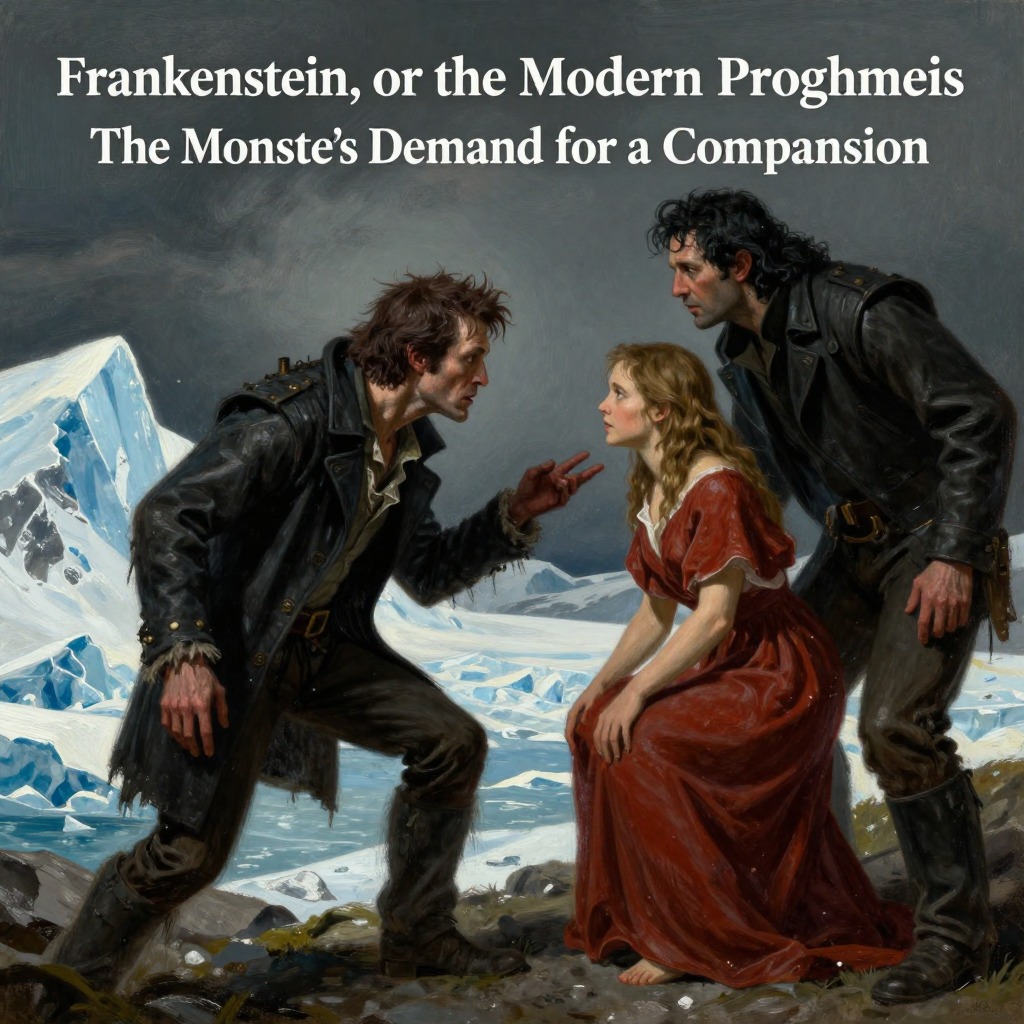
The threat emerges from a confrontation that is itself the climax of a long chain of broken promises and escalating violence. Victor Frankenstein, having reluctantly agreed to create a female companion for the monster, works in a solitary hut on the Orkney Islands, consumed by revulsion. As he sits in his laboratory one evening, a train of reflection leads him to consider the potential consequences of his work: the female might prove more malignant than her mate, the pair might hate each other, or they might produce a "race of devils" that would threaten all humanity (E00665-E00667). Overcome by these fears, Victor tears the unfinished female creature to pieces. The monster, who has been watching through the window, witnesses the destruction of his only hope for companionship and, with a "howl of devilish despair and revenge," withdraws . He then confronts Victor directly, and when Victor refuses to create another being, the monster delivers his threat: "I will be with you on your wedding-night" .
Victor's Misinterpretation and Its Consequences
Victor immediately assumes the threat is directed at himself. He starts forward, exclaiming, "Villain! Before you sign my death-warrant, be sure that you are yourself safe" , and attempts to seize the monster, who eludes him and escapes across the water. In the hours that follow, Victor's thoughts are consumed by the prospect of his own death. He reflects that "in that hour I should die and at once satisfy and extinguish his malice" , and he resolves not to fall without a struggle. Yet even as he contemplates his own fate, his mind turns to Elizabeth: "when I thought of my beloved Elizabeth, of her tears and endless sorrow, when she should find her lover so barbarously snatched from her, tears, the first I had shed for many months, streamed from my eyes" (E00682-E00683). This misinterpretation—that the monster intends to kill Victor on his wedding night—persists throughout the subsequent journey to Geneva, the marriage itself, and the journey to Evian. Victor arms himself with pistols and a dagger, believing he is preparing for a direct confrontation with the creature . He never considers that the monster's vengeance might be more subtle and more devastating: the murder of Elizabeth, not Victor.
The Fulfillment of the Threat
The wedding-night threat is fulfilled with horrifying precision. After the ceremony, Victor and Elizabeth travel to Evian, where they spend their first night as husband and wife. Victor, still expecting an attack on himself, urges Elizabeth to retire while he searches the inn for the monster. He hears a "shrill and dreadful scream" from her room and rushes in to find her "lifeless and inanimate, thrown across the bed, her head hanging down and her pale and distorted features half covered by her hair" (E00796-E00797). The murderous mark of the fiend's grasp is on her neck. Looking up, Victor sees the monster at the window, grinning and pointing at the corpse before leaping into the lake . The threat is thus fulfilled not as a direct attack on Victor, but as the destruction of everything he loves, a pattern the monster had already established with William, Justine, and Clerval.
Thematic Significance
The wedding-night threat is the narrative hinge on which the novel's final tragedy turns. It demonstrates the monster's psychological sophistication: he understands that killing Elizabeth will cause Victor far greater suffering than killing Victor himself. The threat also reveals the creature's transformation from a being who sought sympathy and companionship into one who finds his only satisfaction in causing despair. Victor's failure to interpret the threat correctly is a final, fatal error in a series of misjudgments that began with the creation itself. The words "I will be with you on your wedding-night" echo through the remainder of the novel, a reminder of the inescapable consequences of Victor's ambition and his refusal to take responsibility for the being he brought into the world.