Victor's Pursuit of the Monster
Victor Frankenstein's pursuit of the monster is the final, consuming action of his life, a desperate and obsessive chase that transforms him from a guilt-ridden creator into a relentless avenger and ultimately leads to his own death aboard Robert Walton's ship. After the murder of his wife Elizabeth on their wedding night and the subsequent death of his father Alphonse, Victor is left utterly desolate. His initial grief and madness give way to a single, all-consuming purpose: to hunt down and destroy the being he brought to life. This pursuit becomes the sole reason for his continued existence, a pilgrimage of vengeance that carries him across continents and into the frozen wastes of the Arctic, where his story intersects with that of the explorer Robert Walton.
Origins and Oath of Vengeance
The pursuit begins in the cemetery where William, Elizabeth, and Alphonse Frankenstein are buried. Victor, kneeling on the grass and kissing the earth, swears a solemn oath "by the sacred earth on which I kneel, by the shades that wander near me, by the deep and eternal grief that I feel" to pursue the daemon "until he or I shall perish in mortal conflict." His vow is answered by a loud, fiendish laugh from the monster, who whispers, "I am satisfied, miserable wretch! You have determined to live, and I am satisfied." This exchange seals their mutual destiny: Victor is now bound to a life of pursuit, and the monster is assured that his creator will not die of despair before their final confrontation. Victor's first resolution is to quit Geneva forever, a country that has become hateful to him in his adversity. He provides himself with money and a few jewels that had belonged to his mother and departs, beginning wanderings that are to cease only with his life.
The Chase Across Continents
Victor's pursuit is a grueling, multi-continental ordeal. He follows the monster through the wilds of Tartary and Russia, often guided by the terrified reports of peasants who have glimpsed the horrid apparition. At times, the monster himself, fearing that Victor might lose all trace of him and despair, leaves marks to guide his pursuer. Victor sees the print of the monster's huge step on the white plain and finds inscriptions on tree bark or cut in stone, such as "My reign is not yet over" and "Follow me; I seek the everlasting ices of the north." The monster even leaves a dead hare for Victor to eat, a taunting gesture of sustenance. Victor endures cold, want, and fatigue, often subsisting on wild animals and gaining the friendship of villagers by distributing money or sharing the food he has killed. He is sustained by the hope of night, for in sleep he dreams of his friends, his wife, and his beloved country, seeing the benevolent countenance of his father, hearing the silver tones of Elizabeth's voice, and beholding Clerval enjoying health and youth. These dreams provide the only respite from his hateful existence, and he clings to them as a source of strength to fulfill his pilgrimage.
The Arctic Pursuit and the Final Confrontation
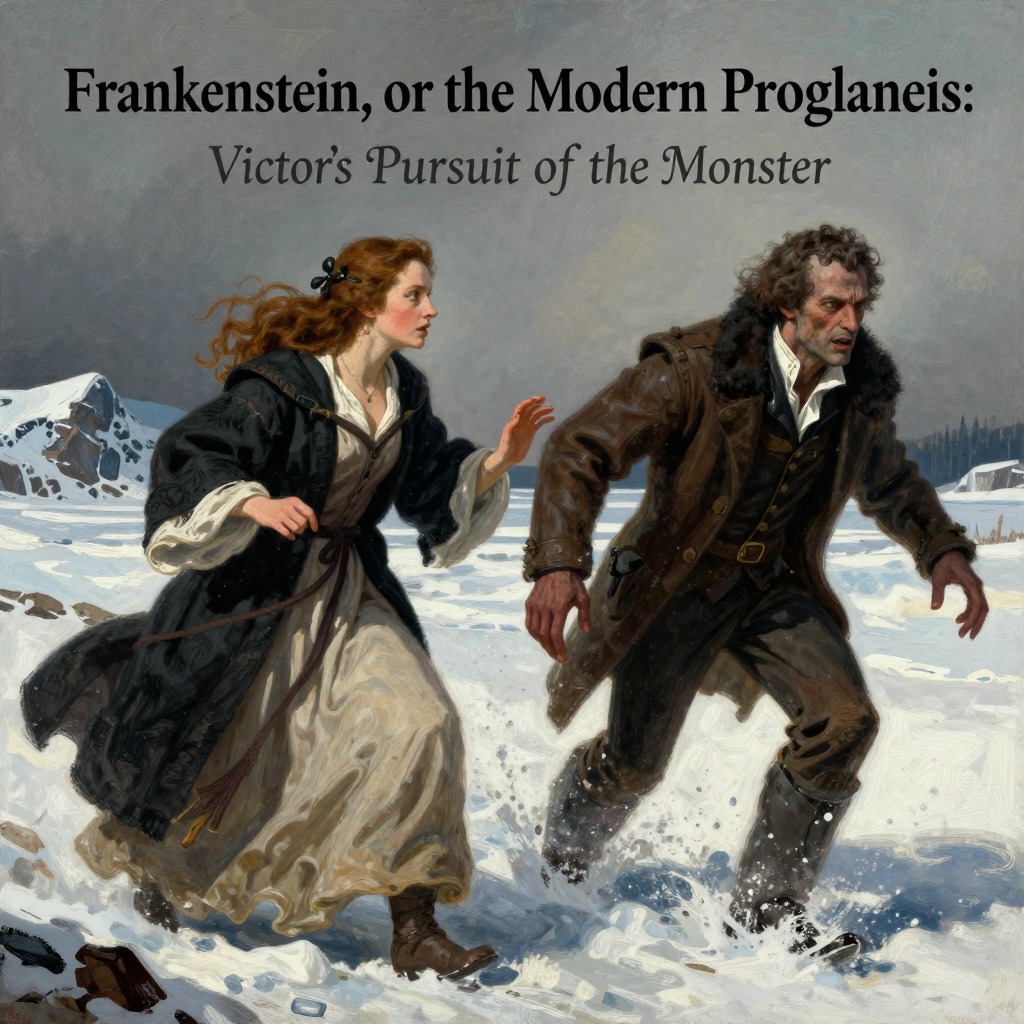
The chase culminates in the Arctic. Victor procures a sledge and dogs, traversing the snows with inconceivable speed. He gains on the monster, and when he first sees the ocean, the monster is only one day's journey in advance. Victor arrives at a wretched hamlet on the seashore, where the inhabitants tell him that a gigantic monster, armed with a gun and many pistols, had arrived the night before, stolen their winter food, harnessed a drove of trained dogs to a sledge, and pursued his journey across the sea in a direction that led to no land. Victor suffers a temporary access of despair, but his rage and vengeance return like a mighty tide. He exchanges his land-sledge for one fashioned for the frozen ocean, purchases a plentiful stock of provisions, and departs from land. For what he guesses to be three weeks, he endures immense misery, with mountains of ice barring his passage and the thunder of the ground sea threatening his destruction. Finally, he catches sight of a dark speck on the dusky plain and distinguishes a sledge and the distorted proportions of a well-known form. He utters a wild cry of ecstasy and continues his route, gaining on the monster until he is no more than a mile distant. But a ground sea splits the ice, creating a tumultuous sea between him and his enemy. Victor is left drifting on a scattered piece of ice, his dogs dying, and he himself about to sink under the accumulation of distress when he sees Walton's vessel and is rescued.
The End of the Pursuit and Victor's Death
Victor's pursuit does not end with his rescue. He tells Walton his story, hoping to induce him to grant a boat with which he could continue the chase, but Walton's ship is heading north, and Victor's vigour is exhausted. On his deathbed, Victor's burning hatred and ardent desire for revenge subside into a more reasoned conviction. He tells Walton that he feels justified in desiring the death of his adversary, but he cannot ask Walton to renounce his country and friends to fulfill the task. He leaves the decision to Walton's own judgment. Victor's final words are a warning: "Seek happiness in tranquillity and avoid ambition, even if it be only the apparently innocent one of distinguishing yourself in science and discoveries." He dies peacefully, a gentle smile passing away from his lips. The monster, who has been watching from the cabin, appears over the coffin, lamenting his creator's death and declaring that his own crimes are now consummated. He vows to die, to ascend his funeral pile triumphantly, and to be swept away by the winds. He springs from the cabin window onto an ice raft and is borne away by the waves, lost in darkness and distance. Victor's pursuit, which began as a vow of vengeance, ends not with the destruction of the monster but with the death of the pursuer and the monster's own self-imposed exile into oblivion.
Narrative Role and Thematic Significance
Victor's pursuit of the monster is the structural and thematic climax of the novel, transforming the narrative from a Gothic horror story into a tragic epic of revenge. It is a journey that mirrors the monster's own earlier wanderings, creating a parallel between creator and creature as both become isolated, desperate, and consumed by a single purpose. The pursuit literalizes the inescapable bond between Victor and his creation; they are bound together in a mutual dance of destruction, each unable to find peace without the other's annihilation. Thematically, the pursuit underscores the novel's central warnings about the dangers of unchecked ambition and the consequences of abandoning one's responsibilities. Victor's obsessive chase, which leads him to sacrifice his health, his sanity, and ultimately his life, is the final, devastating proof of the monster's claim: "I am malicious because I am miserable." Victor, in his relentless pursuit, becomes as monstrous as the being he hunts, his humanity eroded by the very vengeance he seeks. The pursuit thus serves as a powerful cautionary tale about the destructive nature of revenge and the impossibility of escaping the consequences of one's own actions.