Walton's ambition
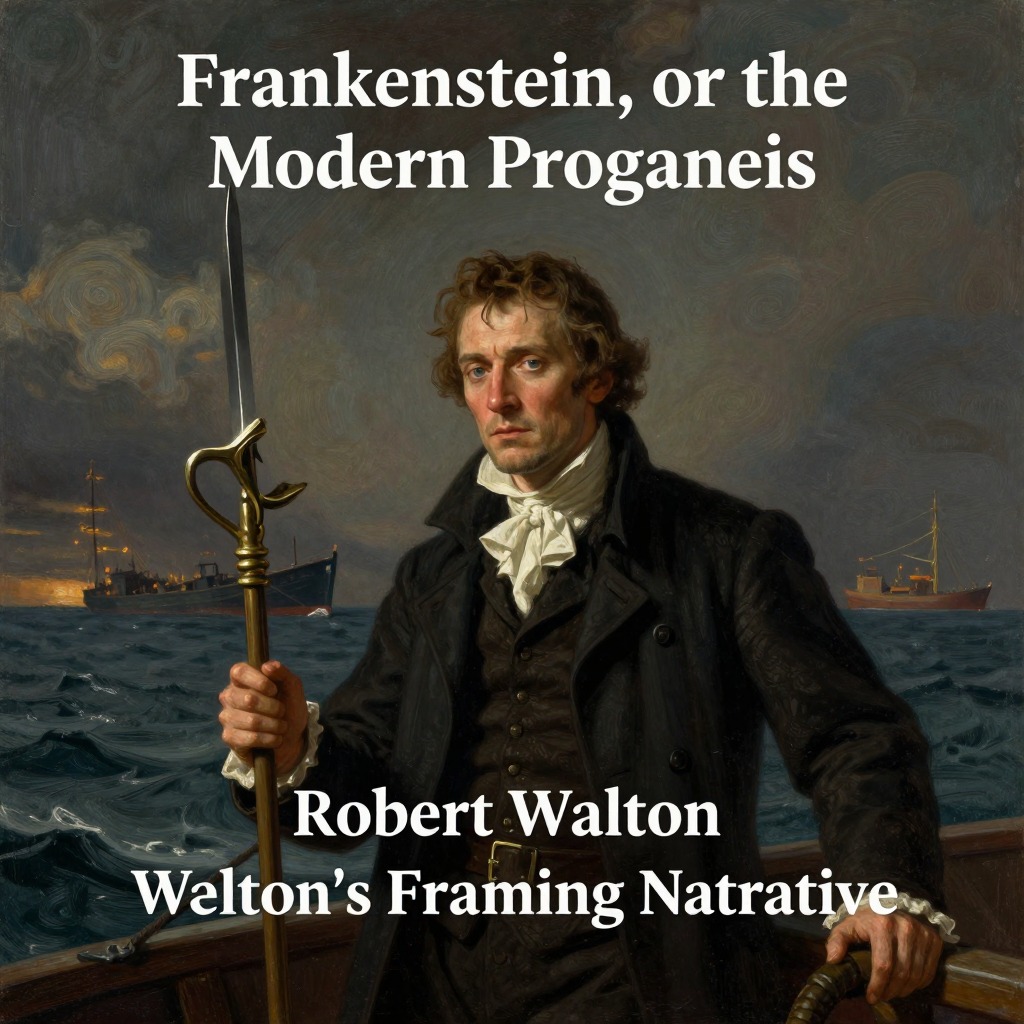
Walton's ambition is the engine of the novel's frame narrative, a consuming desire for glory and discovery that propels him into the Arctic's perilous ice. From his first letter, he frames his expedition as a heroic quest, one that will confer "inestimable benefit" on all mankind by discovering a northern passage or the secret of the magnet. He writes to his sister Margaret Saville that he would "sacrifice my fortune, my existence, my every hope" to further his enterprise, revealing a willingness to risk everything for a place in history. This ambition is not merely practical; it is intertwined with a "love for the marvellous," a belief in the wondrous that hurries him "out of the common pathways of men." He explicitly compares himself to the "Ancient Mariner," acknowledging the romantic danger of his undertaking while asserting he will "kill no albatross." His ambition is thus a blend of Enlightenment rationalism—seeking practical knowledge—and a Romantic yearning for the sublime and the unknown.
Origins and Early Development
Walton's ambition was forged in childhood. Denied a seafaring life by his father's dying injunction, he found solace in his Uncle Thomas' library, devouring accounts of voyages. This early passion was briefly displaced by poetry, and for a year he lived "in a paradise of my own creation," imagining himself a poet on par with Homer and Shakespeare. His failure in this pursuit, however, redirected his energies back to the sea. Inheriting a fortune from his cousin, he dedicated himself to his present undertaking, spending six years preparing his body and mind. He endured the hardships of whaling expeditions, studied mathematics and medicine, and twice served as an under-mate on a Greenland whaler, earning the offer of a second-in-command position. This preparation was a deliberate forging of himself into an instrument capable of achieving his great purpose.
The Need for a Sympathetic Friend
Despite his resolve, Walton's ambition is shadowed by a profound loneliness. He bitterly laments the absence of a friend who could share his enthusiasm and sustain him in dejection. He desires a man "gentle yet courageous, possessed of a cultivated as well as of a capacious mind," whose tastes are like his own. This lack, he feels, is a "most severe evil," and he confesses to Margaret that he is "self-educated" and his magnificent daydreams lack "KEEPING." His encounter with Victor Frankenstein, a man of similar ambition but tragic experience, seems to answer this need. Walton immediately begins to love him "as a brother," seeing in him the friend he has always sought. This relationship becomes the crucible in which Walton's ambition is tested.
Confrontation with the Consequences of Ambition
Victor Frankenstein's narrative serves as a direct warning to Walton. Victor explicitly states that he once sought knowledge and wisdom as Walton does, and he ardently hopes that the gratification of Walton's wishes "may not be a serpent to sting you, as mine has been." Walton listens to Victor's tale of creation, destruction, and remorse, and he is deeply affected. Yet, when his own crew, trapped in the ice and fearing for their lives, demands that he turn south, Walton hesitates. He is torn between his own desire for glory and his responsibility to his men. Victor, roused from his sickbed, delivers a passionate speech urging the sailors to be "men, or be more than men," and to continue the voyage. Walton, however, ultimately yields to the crew's demands, choosing the safety of his men over the fulfillment of his ambition.
The Final Reckoning and Legacy
Walton's decision to return south marks the defeat of his ambition. He writes to Margaret that his hopes are "blasted by cowardice and indecision" and that he returns "ignorant and disappointed." He has lost his friend Victor, who dies after imparting his final warning: "Seek happiness in tranquillity and avoid ambition, even if it be only the apparently innocent one of distinguishing yourself in science and discoveries." Walton's ambition, unlike Victor's, does not lead to the creation of a monster, but it does lead him to the brink of destruction and to the heart of a tragedy. He is left to record Victor's story, a tale that becomes a testament to the dangers of the very ambition that drove him north. His final act is not one of discovery but of bearing witness, and his letters become the vessel through which the cautionary tale of Frankenstein is delivered to the world.