A person who had a twin and has now lost them
HamnetA person who had a twin and has now lost them is the unnamed condition Judith tries to articulate after the death of her twin brother, Hamnet. Her question turns private bereavement into a problem of language: she knows the words for a spouse who survives a husband and a child whose parents have died, but cannot find an equivalent for what has happened to her. The exchange does not establish that no such word exists; it shows that neither Judith nor Agnes can offer one in that moment. Its force lies in the difference between the loss itself, which has already reshaped the family, and the language available to recognize it.
The Question of a Name
Judith asks Agnes what a person is called when they once had a twin and no longer do. She approaches the question by analogy, setting it beside two established terms: a woman whose husband dies becomes a widow, and a child whose parents die becomes an orphan. Each term makes a changed family position legible. Judith is asking whether language offers a comparable name for the surviving member of a pair of twins.
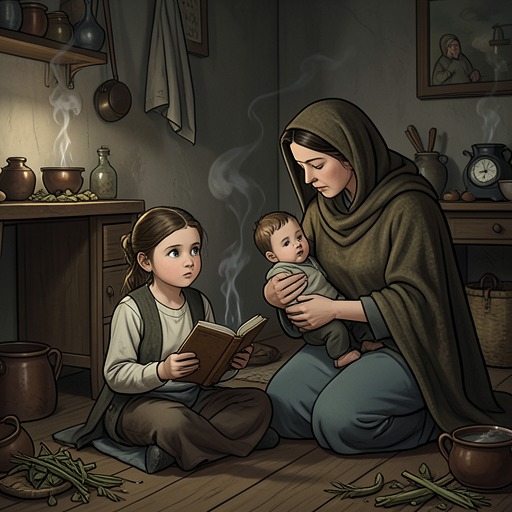
The circumstances make the question more than a search for vocabulary. Agnes is dipping a double wick into hot tallow when Judith speaks. She stops, but does not turn around. The small interruption registers the weight of the question without resolving it. Agnes says she does not know. Judith watches liquid run from the ends of the wicks into a bowl, then suggests that perhaps no word exists. Agnes agrees, again without supplying a name. The scene gives the absence a precise shape: a question, a pause, an admission of uncertainty, and a possibility neither can disprove.
The expression therefore describes a condition rather than supplying a settled title for it. Judith’s words identify what has happened to her, but the conversation does not transform them into a conventional label. That distinction matters: her loss is unmistakable, while its place in ordinary categories of bereavement remains uncertain. The exchange leaves the difficulty open instead of pretending that naming can make the loss manageable.
A Twin Bond Made Visible by Loss
The question follows Hamnet’s death, but the bond it reveals had already been expressed through the twins’ closeness. Their separation is not simply one child missing from the household. Judith has lost the person who shared her twin identity, a relation for which the analogies of widowhood and orphanhood do not quite account. The inability to name her changed position marks the particularity of that relation, rather than diminishing it.
Other moments in the aftermath show how the loss keeps returning without becoming intelligible. Agnes’s thoughts repeatedly contract around the fact that Hamnet has died, then expand into questions about how the family will live, how Judith will bear it, and what Agnes should have done. Her habitual mental roll call of the children continues to reach for Hamnet as though he might still be at school, playing, or by the river. The question of where he is persists even after she knows he is dead. Judith’s later question about what to call a surviving twin gives a different form to the same rupture: one is an involuntary search for the absent child; the other asks what the survivor has become.
The family’s experience of the funeral sharpens that change. Agnes leaves the cemetery with two children after entering with three, and cannot bring herself to cross the gate away from Hamnet. At its post she imagines that she could contain the broken family if her daughters stood on one side and her son on the other. The image is not a literal solution to grief; it makes visible the impossible wish to keep the living and the dead within one arrangement. Judith’s search for a name belongs to this altered family landscape, where the bond remains important but its other member is gone.
Objects, Memory, and the Unfinished Work of Mourning
The wordless question occurs amid the family’s material practices of remembering. Agnes keeps a lock of Hamnet’s hair in a small clay pot above the hearth. Judith has made a silk bag for it and, when she thinks no one is watching, brings a chair to the mantel and takes the pot down. The hair is the same color as Agnes’s and slips through her fingers like water. This keepsake gives physical presence to what cannot be restored, while the private act of handling it shows that remembrance continues beyond the public rituals of burial.
Hamnet’s pebbles furnish another small record of the child who is gone. He kept a collection in four jars on a desk and liked to take the stones out and sort them in different ways. Agnes looks into the jars and sees that his last arrangement was by color rather than size. The detail preserves an ordinary habit without claiming to explain grief. It also places the absent child inside the household’s remaining objects: his things are still there, arranged by a mind that is no longer available to rearrange them.
The exchange about a name happens while Agnes is making candles, and nearby traces of Hamnet’s life remain part of the home. These details set the language problem within continuing domestic time. The family still handles objects, makes things, and encounters reminders; none of those actions produces a term for Judith’s condition or closes the gap left by Hamnet.
Shared Grief, Differing Responses
Agnes and Judith meet the loss from different positions. Agnes’s grief turns toward the questions of a mother: how the family can continue, how Judith will cope, and why she did not recognize that Hamnet was the child in danger. Her distress also appears in the days after the death, when she touches Hamnet’s still fingers and hair and cannot respond to the preparations for washing and shrouding him. The repeated recognition that he has died does not immediately become comprehension.
Judith’s question, by contrast, asks what the death means for the surviving twin. Its structure is careful and relational: first the wife and the orphan, then the child who has lost the person who shared twinship. Agnes’s brief uncertainty does not take the question away from Judith or settle its meaning for her. The exchange allows the daughter’s grief to appear in her own terms, even when those terms cannot culminate in a name.
Later, when Agnes fears that her husband’s return may bring a confession that he has given his heart to another woman, he asks how much she thinks about him. Agnes initially misunderstands whom he means; she then recognizes that he is asking about Hamnet and sees his bowed head and grief. The moment confirms that Hamnet’s absence belongs to both parents, though their grief is expressed differently. It also returns the family to the unresolved fact at the center of Judith’s question: the dead child remains present in thought, but presence in memory cannot supply the missing twin or an adequate word for the survivor.
Significance
The expression’s significance lies in the gap it holds open between a recognizable loss and a readily available name. Judith can identify the structure of her bereavement by comparing it with widowhood and orphanhood, yet those comparisons do not fully describe losing a twin. The conversation neither invents a term nor declares that language can never provide one. Instead, it records the moment when a child asks for recognition and her mother can only acknowledge uncertainty.
That uncertainty resonates with the novel’s repeated movement between remembering Hamnet and confronting his absence. Agnes’s thoughts keep searching for him; the hair and pebbles preserve traces of his ordinary life; Judith asks what to call herself now. Together, these details distinguish mourning from a single act of farewell. The bond survives as memory and as a changed family relation, but its altered form is not neatly captured by the familiar words Judith knows. The unanswered question is therefore not an ornamental reflection: it makes the surviving twin’s loss visible precisely by showing where the conversation runs out of names.