Exchange places
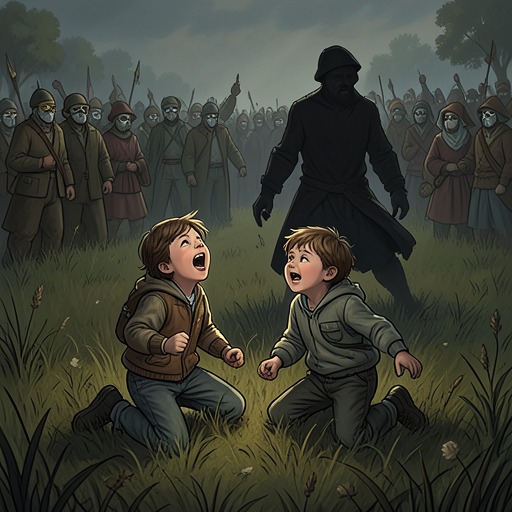
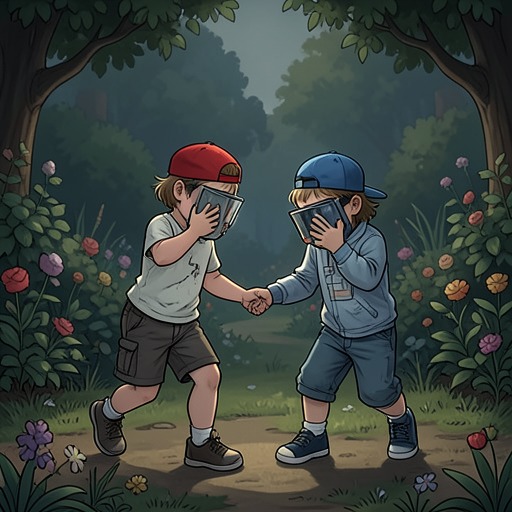
HamnetExchange places is a recurring pattern of substitution in Agnes’s story: first, a twin’s body is mistaken for the other’s; later, William Shakespeare imaginatively takes Hamnet’s place in death and gives his son a return onstage as Hamlet. The motif moves from a mother’s tactile recognition of which child is ill to her understanding of how grief has been transformed into drama.
The twins’ bodies and Agnes’s recognition
At night, Agnes touches the children to determine which one has ink on her. Her fingers find Judith’s long braid looped around Hamnet’s neck, Hamnet’s wrists emerging from Judith’s apron, and the crescent-shaped scar left by a sickle when he was little. The shorter-haired child’s hair is dark with Judith’s fever sweat, while Judith sleeps with the ease of the healthy. Their positions and clothing make them appear exchanged, but touch supplies the details that undo the confusion.
Agnes pulls back the sheet and compares their bodies on the mattress: the sick child’s feet extend farther down, and the ill twin is the taller one. The discovery reverses her understanding of the scene. It is Hamnet, not Judith, who is sick. Here, exchange is a frightening resemblance between the twins, resolved through the intimate evidence of a braid, wrists, a scar, and height.
The stage’s living and dead doubles
At the performance, Agnes sees the young Hamlet react to the ghost with a force that recalls Hamnet. The actor tilts his head and brings his knuckles to his mouth when he hears something he does not immediately understand. Agnes wonders how a young performer who never knew Hamnet could resemble him so closely. As she moves through the crowd toward the actors, she recognizes the work behind the likeness: William Shakespeare has taught the boy how to speak and move, rehearsed him, and shaped his gestures. She imagines the painstaking instructions that could have produced the familiar walk and turn of the head.
The stage gathers the substitutions into one figure. Hamlet is a living young man, while the ghost who speaks to him bears William Shakespeare’s hands, beard, and voice. The ghost tells of a death by poison that floods the body like mercury. For Agnes, the young actor’s resemblance to Hamnet and the ghost’s resemblance to her husband make the scene more than a likeness: the living son and dead father occupy the same theatrical moment.
A father takes the son’s place
Agnes understands the play as an exchange of deaths. In her reading, William Shakespeare has taken Hamnet’s death and made it his own, placing himself in death’s grasp and bringing his son back in his place. The father’s suffering onstage enacts what Agnes understands as a parent’s wish: to suffer instead of the child and offer himself in exchange for the child’s life. The play cannot reverse Hamnet’s actual death, but it gives the loss a dramatic form in which father and son can meet as ghost and living actor.
Agnes plans to tell her husband what she has understood after the performance. The imagined conversation is deferred until the play ends, the actors bow, and the stage is stripped of its battlements, graveyard, and castle. William Shakespeare then finds her in the crowd, still wearing the powder of performance, and takes her hand. The exchange thus ends not with Hamnet restored to life outside the theatre, but with Agnes recognizing the act of imaginative return and meeting her husband after the stage has emptied.