Where is Hamnet
HamnetWhere is Hamnet? is the recurring question through which the novel gives form to Agnes’s struggle to comprehend her son’s death. It begins in the habits of ordinary motherhood, when she mentally locates each child, and returns as a search that cannot be satisfied: Hamnet is physically present as a dead child, yet absent from the living patterns of attention that keep drawing Agnes toward him. The question eventually belongs, in different forms, to Judith and William Shakespeare too, marking grief as a bond that persists without yielding an answer.
A Habit of Attention
Agnes’s question grows out of a familiar practice. Like other mothers, she repeatedly directs her thoughts toward her children, wondering where they are and how they are. By the fire, she mentally checks their locations: Judith is upstairs, Susanna next door. The check for Hamnet follows as naturally as the others. Her mind casts toward him again and again, as if fishing, expecting a response because the habit has always found one.
After his death, that habit continues to ask about ordinary possibilities. Hamnet might be at school, playing, or by the river. The places belong to the living routine of a child, and their repeated appearance shows why the question cannot simply stop when the facts change. Agnes’s mind keeps reaching for a son who should be somewhere in the familiar world; it has not learned how to replace that expectation with the knowledge that he is gone.
The question therefore carries two incompatible kinds of knowledge. Agnes knows that Hamnet has died, but the words of death remain difficult to grasp. Her thoughts swell around the practical and emotional consequences—how the family will live, what she will tell people, how Judith will bear it, and whether she could have saved him—then contract to the bare fact of his death. Even that fact does not settle the search. She tries to direct herself to the body: Hamnet is cold and lifeless on the board in front of her. The question nonetheless returns, showing the distance between seeing death and absorbing its permanence.
The Search After Death
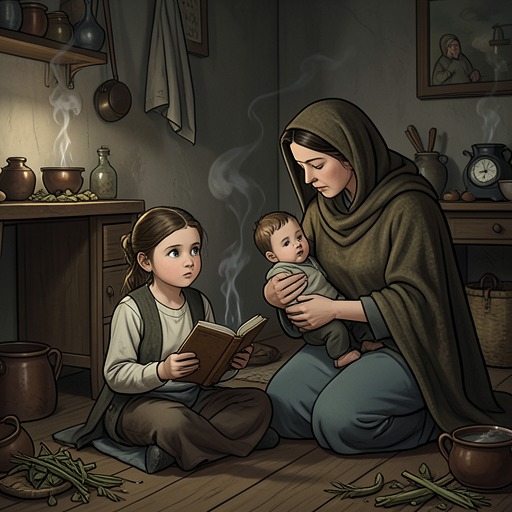
Agnes’s search does not end with the immediate crisis. Night after night, for weeks and months, she waits for Hamnet. She keeps a blanket around her shoulders and a lit lantern beside her, sitting where his bed used to be. She also sits in his father’s chair, in the precise place where Hamnet died. The room and its rearranged spaces become sites of vigil: the lost child is sought through the house that still holds the coordinates of his life and death.
The search extends outside. In the frosted yard, beneath the plum tree stripped of leaves, Agnes calls for Hamnet and asks whether he is there. The setting changes from bedroom to open air, but the result does not. There is no sign of him and no response. Repetition makes the question less a request for information than an expression of refusal to let the bond lapse into silence; each night renews the possibility she hopes to test, and each night ends without confirmation.
That failure is especially acute because Agnes is portrayed as unusually receptive to what other people cannot perceive. She can hear the dead, the unsaid, and the unknown; by touching someone, she can sense illness moving through the veins, and she reads eyes and hearts as others read a book. Yet this sensitivity cannot locate her own son’s spirit. She listens closely and tries to distinguish his presence from the wishes and discontent of other, noisier beings, but hears nothing. The question exposes the limit of her gift at the point where she most needs it: intimate knowledge of the living does not grant access to the dead.
Different Ways of Hearing Him
Judith’s experience offers a contrast to Agnes’s fruitless vigil. Judith finds Hamnet in ordinary sounds and movements: a broom brushing the floor, a bird settling on a wall, a pony’s moving mane, hail tapping at the window, wind reaching down the chimney, and the woven willow of her shelter making its small sounds. These are not answers to Agnes’s call, nor does Judith announce them as proof. She keeps the experience to herself, closes her eyes, and privately permits herself to feel that she sees and hears him. The question that leaves Agnes with silence opens, for Judith, a quiet and inward way of maintaining connection.
The contrast does not resolve the uncertainty around Hamnet’s presence. Agnes waits for a response she cannot hear; Judith recognizes him through impressions she does not share aloud. Their different experiences preserve the same absence rather than explaining it away. The question remains unanswered in public speech, while the private forms of attention around it differ from one person to another.
The Question Across Distance
William Shakespeare’s grief gives the question another setting. In London, while performing before an audience, he searches the crowd each night for the particular face of a boy with a slightly crooked smile and a perpetually astonished expression. His companions do not know that he is looking. He proceeds carefully through the faces because he cannot accept that Hamnet might have disappeared entirely; he believes he need only find him somewhere among them. The same impulse that makes Agnes ask after her son turns William’s public work into a private search.
Distance also shapes what William can bear. His work in London moves quickly from writing to rehearsal and performance, and months can pass before he realizes how long he has been away. He fears losing his place if he steps out of that routine. More privately, the depth of Agnes’s grief seems to him like a dangerous current: he believes that coming close enough to be swept into it might sink him, and that he could pull the others down with him. In the city, he nearly persuades himself that returning would reveal the family unchanged, with three children asleep in their beds. The imagined scene contradicts what he knows: there are only two children now.
Across these scenes, the question is not simply a request to name a location. It measures the persistence of familial attention against the irreversible fact of death. Agnes searches the rooms, the yard, and the reaches of her own extraordinary perception; Judith finds reminders in the world around her; William looks through the audience from far away. Their searches are distinct, but each is organized around the same absent child. The question keeps Hamnet within the family’s field of thought even where no answer can return him to it.