Remember me
HamnetRemember me names the final words the ghost speaks to Agnes from the stage. The line gathers the scene’s central doubleness: Hamlet appears both as a living young man and as a dead father, while the ghost bears William Shakespeare’s hands, beard, and voice. When the ghost fixes his gaze on Agnes and speaks, the play’s appeal to memory becomes an intimate address from husband to wife, and from the stage toward the audience.
The Line in the Performance
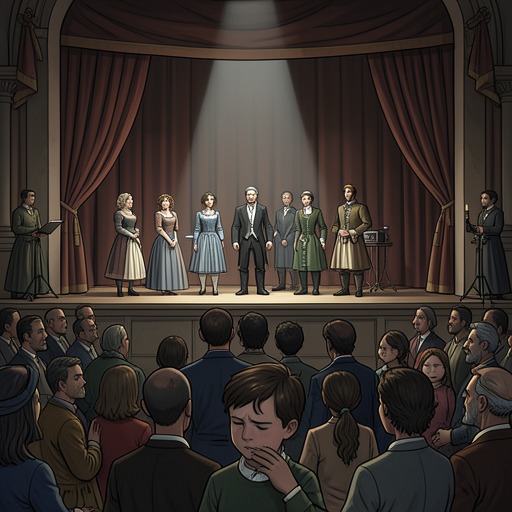
Agnes is standing in the front row, both hands braced on the edge of the stage. Close enough to reach, Hamlet appears to her as the person he would have been had he lived; beside him is the ghost, whose features and voice recall William Shakespeare. The line comes at the ghost’s exit: he turns his head toward Agnes, looks straight at her, and holds her gaze as he speaks his final words. Its placement makes the address more than a general command to remember the dead. Within the scene, it is directed to one particular witness.
Agnes’s Recognition
The line follows Agnes’s recognition of what William Shakespeare has done in writing the play. She understands him to have exchanged places with Hamnet: taking his son’s death upon himself in the drama and bringing the child back to life in the only form available to him. The ghost’s voice makes that substitution perceptible in the theatre, where the living actor gives speech and presence to the dead father while Hamlet stands before Agnes as the living son she lost. Remember me thus gathers the grief that has shaped the play into a single appeal, spoken by a figure who is at once theatrical and personal.
The Boundary Between Stage and Life
Agnes reaches her arm and hand toward the air between the three figures, as if she might touch them or cross the boundary separating audience from actors, life from theatre. The gesture answers the ghost’s direct look physically: memory is not only something Agnes understands but something she reaches toward. The line marks a threshold the scene cannot literally erase, even as performance gives the dead a voice and a place before her.
Agnes intends to tell William Shakespeare what she has understood after the performance. First, the dead return to the line of actors at the edge of the stage; William Shakespeare and the child hold hands and bow repeatedly beneath the audience’s ovation. When the stage has emptied of its battlements, graveyard, and castle, William Shakespeare finds Agnes in the crowd, takes her hand, and draws her close. The remembered appeal therefore continues beyond the spoken line: the performance ends, but its recognition becomes something Agnes plans to share with her husband.