Cheat death
HamnetCheat death describes Hamnet’s attempt to save Judith by making death mistake one twin for the other. A familiar game of exchanging clothes and identities becomes, in the sickroom, a deliberate offer of substitution: Hamnet takes Judith’s place and gives her his life as he understands it. The expression gathers the twins’ likeness, their closeness, and the story’s refusal to let love make death reversible.
The childhood trick behind the expression
The plan comes from a practice Judith and Hamnet have used since childhood: changing places and clothes so that other people mistake one twin for the other. They have the same face, and people tell them so every day. A mantle or hat, a doublet, a lowered gaze, and a concealed smile are enough to sustain the deception for a moment. Their mother Agnes can mistake Judith for Hamnet and send her to fetch firewood; their father William Shakespeare can see a child in a doublet and ask for a Latin verb, only to discover that the supposed son is Judith while Hamnet has been hiding nearby.
The trick is more than a resemblance in appearance. It depends on the twins knowing each other’s gestures and on their family being accustomed to reading clothing and position as signs of identity. In ordinary life, the confusion is playful and temporary: the hidden twin eventually appears, and the people fooled by the exchange discover who is who. In the sickroom, Hamnet takes that small, repeatable deception and tests it against a force that cannot be corrected by revealing the truth.
Hamnet’s attempted exchange
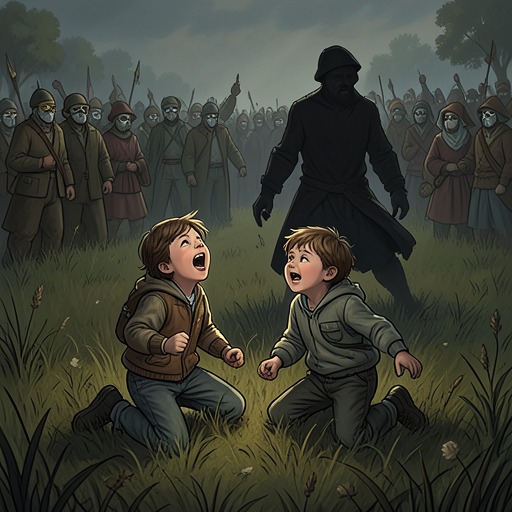
As Judith lies dangerously ill, Hamnet senses death waiting in the room, near the door. He imagines it approaching to take his sister, beyond his power to stop. The idea that follows is an extension of the twins’ old game: perhaps death, too, can be fooled if they change places one last time. He looks toward the darkness beside the door and tries to create a moment in which death will not see clearly.
Hamnet acts physically, not just in thought. He slides one arm beneath Judith’s shoulders and the other beneath her hips, shifts her toward the hearth, and settles into the space she has left. He smooths his hair to either side of his face and draws the sheet over them both, tucking it beneath their chins. The gestures reproduce the conditions of their childhood impersonations, but their purpose has changed completely. This time the exchange is not meant to fool a parent for an instant; Hamnet hopes it will make death take him instead of Judith.
Judith understands what her brother is doing. She tries to sit up and tells him no, but she is too weak to rise from the bed. Hamnet holds the sheet over them, breathes into her ear, and imagines giving her his strength, health, and everything that is his. His offer is an act of tenderness, but also an assertion: since only one of them can live, he chooses that it should be Judith. The childhood deception has become a willing surrender of his own place in the world.
The limits of substitution
The scene makes the exchange emotionally legible without making it a literal bargain with death. Hamnet believes that likeness might confuse death and that his choice can determine what happens. The scene’s power lies in the gap between that conviction and the helplessness surrounding it: Judith cannot get up, Hamnet can only hold the sheet and breathe beside her, and the death he senses is not an ordinary observer whom the twins can trick by changing clothes. Their closeness gives him a way to imagine action where he has almost none.
The attempted substitution also makes the twins’ shared identity painful. Their resemblance, previously a source of amusement and a means of moving between roles, now becomes the basis for a sacrifice. Hamnet does not simply want Judith to survive; he wants her to keep living with what he understands as his own life. His decision reveals both the force of their bond and its limit: the twins can exchange places in the family’s sight, but they cannot make their two lives interchangeable in fact.
The aftermath: care, burial, and irreversible loss
The later scenes of Hamnet’s death and burial give the attempted exchange its tragic measure. After he dies, Agnes is confronted with a body altered by illness: the skin has yellowed, the bones stand out, and fever has hollowed his cheeks. She remembers closing his eyelids with her own hands and placing two pennies on them to hold them shut. The once-familiar face and the body that held his speech and sight remain present, but no trick of clothing or resemblance can restore the child they contained.
The household must prepare him for burial under the town’s rule that plague victims be buried quickly, on the day they die. Women bring warm water, cloths, a white sheet, needles, and strong thread; they have already burned the bedding, aired and cleaned the room, and moved Judith upstairs while she recovers. Agnes washes Hamnet herself, recognizing particular marks on his body: a scar from a fall at Hewlands, a knot left by a dog bite, a writing callus, and the dimples of a childhood rash. She folds dried rue, comfrey, chamomile, lavender, thyme, and rosemary into the shroud, omitting plants whose smell Hamnet disliked or that had failed to help him. Then she sews from the feet upward, making the sheet into the covering for his journey beyond the living.
At the burial, William Shakespeare carries Hamnet’s body through Henley Street, first alone and then with Edmond. Agnes follows with Susanna and Judith; Judith, still weak, is carried by Bartholomew. Near the grave by the river, Agnes struggles to leave the churchyard, feeling that she entered with three children and must depart with two. These acts of washing, wrapping, carrying, and burial cannot enact Hamnet’s hoped-for exchange. They mark instead the separation that his childhood trick could only momentarily disguise. Cheat death therefore names both the tenderness of his attempt and the story’s stark distinction between exchanging identities and escaping loss.