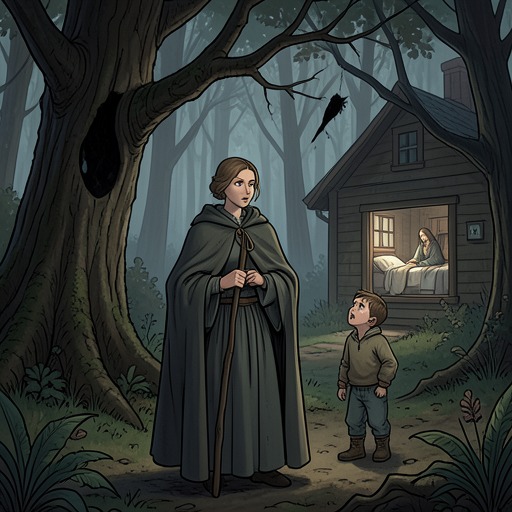
En la linde de un bosque, una niña.
HamnetThe expression En la linde de un bosque, una niña. is a deliberately simple opening formula whose force lies in what it promises rather than what it explains. Repeated as the first image of a tale, it places a girl at the boundary between home and forest, inviting an audience to imagine what will happen next. The line also introduces a household and a family history shaped by the nearby woods, where inherited stories blur the distinction between ordinary life and the uncanny.
An Opening Passed Among Neighbors
The phrase belongs to a story people tell one another in the region. They bring it up while sitting by the fire at night, kneading bread, or carding wool for spinning. These are ordinary shared tasks, and the tale has practical as well as imaginative uses: it shortens the night, settles a restless child, and distracts others from their worries. Its repeated telling makes the girl’s presence at the forest’s edge familiar before the story supplies any explanation of who she is.
The opening’s compactness is part of its design. It offers only a place and a figure, withholding names, motives, and events. That absence encourages listeners to complete the scene for themselves: they may picture the girl moving among the trees or standing beside the forest’s green wall. The narrator’s promise is not a particular outcome but the arrival of a story. Those within earshot turn toward it and listen more closely, already imagining what may follow.
The Forest as a Threshold
The woods surrounding the opening are not a neutral backdrop. Dense with brambles and interlaced ivy, their trees stand so close together that, in places, people say light never reaches the ground. The paths loop back on themselves and draw travelers away from their intended routes. Untraceable breezes, music, whispers, and a voice calling someone by name make the forest seem capable of leading people astray. The girl’s position at its edge therefore places her beside a space that unsettles familiar ideas of direction, safety, and belonging.
The community’s warnings reinforce that boundary. Children near the forest are taught from infancy never to enter it alone, and maidens are advised to keep away from whatever may lurk among its leaves. People who must cross the woods stop to pray at an altar or cross, hoping to be protected from the forest’s inhabitants and spirits. Others leave offerings: strips of clothing, beer, bread, pieces of bark, or strings of bright beads. The cross itself is said to have been swallowed by ivy. These contrasting acts of prayer and appeasement show how thoroughly the forest has entered local life, shaping both its cautions and its customs.
The Girl and Her Household
The tale places the girl in a house at the forest’s edge with her little brother. From the back windows they can see the trees; on windy days the treetops move, and in winter their bare, twisted branches seem to raise their fists toward the sky. The siblings have known the forest’s power and its call for as long as they can remember. In this way, the opening’s boundary is part of their daily surroundings, not merely a distant danger described by other people.
The phrase’s singular focus on the girl also gathers the story around her, even though the brother is present from the beginning. The contrast does not erase him: the household is introduced as a pair of children living beside the woods. But the opening selects the girl as the figure through whom the listeners first approach that place. The result is a small narrative imbalance that generates curiosity without yet explaining what distinguishes her.
The Mother’s Uncertain Origin
The neighbors’ account reaches backward from the girl to her mother. The oldest people in the area believe that the mother came out of the forest, though nobody knows where she was from. They speculate that she may have been one of the forest’s humanlike inhabitants, separated from her own kind, or that she may have been something else. The tale preserves these possibilities without resolving them.
In its more particular version, the mother appears one day as she parts the brambles and emerges from the green, shadowed world. A farmer happens to be nearby, watching his sheep, and cannot stop looking at her. He removes leaves from her hair and snails from her skirts, brushes twigs and moss from her sleeves, and cleans mud from her feet. He takes her home, feeds and clothes her, marries her, and, not long afterward, the girl is born. The sequence supplies the household’s origin while keeping the mother’s earlier life obscure: the farmer can bring her into his home, but the story cannot establish where she came from or what she was before she appeared at the forest’s edge.
The expression thus works on two linked levels. It is the opening cue of a tale shared in everyday settings, and it names the boundary around which the family’s inherited mystery gathers. The girl begins in a place where the woods can call, misdirect, or take in those who enter; her mother’s reported emergence makes that same boundary a possible passage into domestic life. The story offers no final explanation of the forest or the mother’s nature. Instead, the repeated opening keeps the question alive by returning the listener to its spare, suggestive image: a girl, a forest’s edge, and the promise of something more.