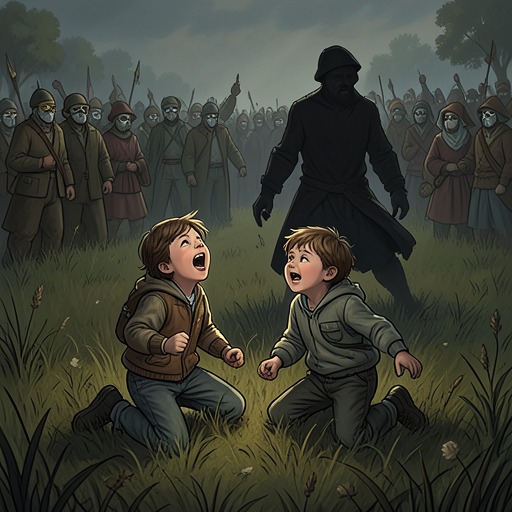
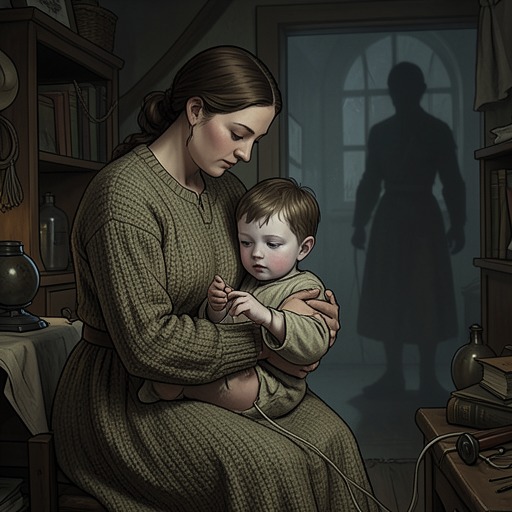
Agnes Discovers Hamnet Is Ill
HamnetAgnes Discovers Hamnet Is Ill is the turning point at which a mother’s fear for Judith becomes the recognition that Hamnet is in grave danger. In candlelight, the twins’ closeness first makes them look like two versions of the same child; then the traces on their bodies expose the reversal. Judith is recovering, but Hamnet has the fever. The discovery shatters Agnes’s confidence in what she has been watching and leads into the death she cannot prevent.
The mistaken bedside vigil
Agnes approaches the bed believing Judith is the child whose life is ebbing away. Her experience caring for the sick tells her that the girl may not last, while the part of her that has raised and cherished Judith refuses the possibility. She bends to touch the child’s forehead and take her pulse, carrying a candle into the dim room. At first, she sees what seems to be Judith lying there with hands joined. Then she realizes that one hand is holding another: a second body is curled beside the girl.
Hamnet has come down during the night and climbed into the bed beside his twin. He is asleep, peaceful, and holding Judith’s hand. The sight seems at once ordinary in its tenderness and uncanny in its doubleness: Agnes sees her sick daughter with her brother’s arm around her, an arm that seems both Hamnet’s and not his. The twins’ familiar likeness briefly obscures the crucial fact that one is dangerously ill and the other is sleeping beside her.
The clues that reverse the scene
Agnes begins to touch the children, trying to establish what her eyes have failed to tell her. Hamnet has good color and lies close to the fire; Judith is on the other side of the bed. But the evidence resists that first impression. Judith’s long braid is wound around Hamnet’s neck. His wrists protrude from Judith’s apron, and the sick child’s shorter hair is dark with sweat. The healthy child is the one sleeping peacefully.
Agnes draws back the sheet. The sick child’s feet extend farther down the mattress: the fever belongs to the taller twin. The realization is direct and unmistakable. It is Hamnet, not Judith, who is ill. As his eyes open and meet his mother’s, he addresses her; the brief exchange makes the child she has been searching for in the bed unmistakably present before her. Recognition arrives through touch and comparison as much as sight: braid, wrists, apron, scar, hair, and the lengths of their bodies undo the misleading first image.
Judith’s recovery and the failed remedies
The reversal becomes still more painful when Judith is seen sitting upright in a chair. She is pale, thin, and weak, but her eyes are bright; she is awake, opens her mouth for broth, and looks steadily at Agnes. The daughter Agnes had feared losing has been returned to her, while Hamnet, trembling and sick, is now the child she must hold. Relief and dread occupy the same moment. Agnes embraces her son and understands that Judith’s survival seems to have come at his expense.
Agnes has given Hamnet a purgative and rosemary-and-mint jelly, as she gave Judith other remedies. She has placed a hole-pierced stone beneath his pillow and, at Mary’s help, tied a toad to his abdomen with fine cloth. None of these measures brings him back from the illness. Her attention had been fixed on protecting Judith; now she feels that this concentration has made her blind to the danger beside her. The story’s reversal is not a consequence of a deliberate choice by Agnes, but of the mistaken certainty that the child most visibly feared for was the one at risk.
From recognition to mourning
After Hamnet dies, the household’s response is shaped by both grief and the demands of plague burial. Richard and Edmond, his uncles, have helped carry the child, but they leave the room soon afterward, each giving a reason to go. The women remain: they burn the bedding, air and clean the room, move the still-weak Judith upstairs, and set out warm water, cloths, a white sheet, thread, and needles. The Stratford plague-burial ordinance requires those who die of plague to be buried the same day, so there is little time to defer preparing the body.
Agnes’s attention fixes on the face she has known: she closes Hamnet’s eyelids with her own fingers and remembers how difficult it was to touch them. She holds his hand and hair, the parts that still feel familiar, while the fever’s damage and the changes after death make the body harder to recognize. When she finally washes him, she traces the particular marks of his life: the scar on his arm from a fall at Hewlands, the knot left by a dog bite, the writer’s callus on his right ring finger, and the small hollows on his stomach from a childhood rash. These intimate details make the act of washing both care for the dead and a record of the living child he had been.
Mary helps Agnes unfold the white shroud, whose scent of juniper, cedar, and soap meets the darkened room. Agnes chooses rue, comfrey, chamomile, lavender, thyme, and rosemary to place with him, leaving out plants whose smell he disliked or whose prickly leaves might scratch his skin. She threads a thick needle and sews from the feet upward. The work gives her hands a task even as it makes the burial real: the shroud is both a final covering and the preparation of Hamnet’s body for the journey beyond the household.
Burial and the cost of recognition
Hamnet’s father carries his body to burial, wrapped in the white shroud with flowers and sprigs around him. Agnes follows with Susanna and Judith; Bartholomew carries Judith, who hides her face against his neck and weeps. The family and others from the household and community accompany the procession through Henley Street. At the crossroads, Edmond joins his brother and helps carry the board, taking the weight at Hamnet’s feet.
At the grave, Agnes cannot bear to watch her husband lower their son into the earth. She loses the moment of Hamnet’s disappearance beneath the clay, and only afterward confronts the fact that she entered the churchyard with three children and must leave with two. The discovery in the sickroom had corrected her mistaken fear, but it could not save the child whose illness she had finally recognized. Its consequence is therefore not resolution but a more terrible knowledge: Judith has recovered, Hamnet is dead, and the mother who had been watching for one child’s departure must leave the other behind.