Hamnet’s Death
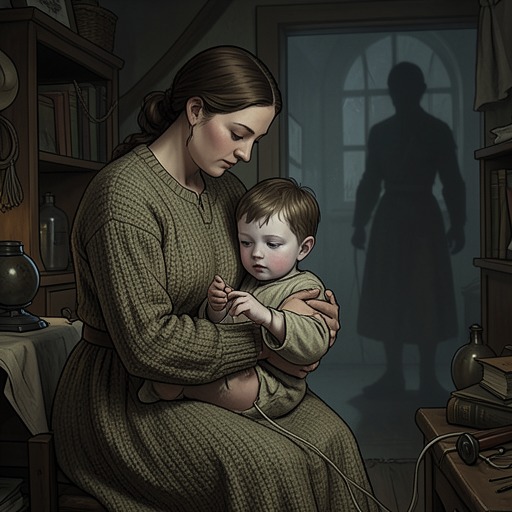
HamnetHamnet’s Death is the decisive rupture in the family’s life: the healthy, vigorous twin whom Agnes had not believed to be in danger succumbs to the plague at home, while she tries to keep him alive with the care and remedies she knows. His final hours bring the family’s efforts to a halt; the washing, shrouding, and hurried burial that follow turn private loss into an ordeal shared by those around him, but do not make his absence comprehensible to Agnes.
The Misjudged Danger
The crisis begins with Agnes beside Judith, sitting on the floor by her pallet with a cloth in her hand. She has stayed there all night, neither eating nor sleeping nor resting. Mary can persuade her only to drink a little. Under Mary’s watch, Agnes wets the cloth in a basin and wipes Judith’s forehead, arms, and throat, murmuring softly to her. Judith’s fever has not broken, and a taut, swollen pustule on her neck makes her condition appear perilous. Mary fears that Judith may die within days, perhaps even that night.
That vigil helps explain the terrible reversal when Hamnet becomes the child Agnes must try to save. She realizes that her attention has been fixed on protecting Judith, while Hamnet was the one destined to die. The remedies in Agnes’s garden and stores of powders, potions, leaves, and liquids have not brought him back from the illness. Her confidence in what she has cultivated gives way to anger and helplessness: she wants to tear up the plants, unable to accept that years of tending them cannot answer this calamity.
Hamnet’s Final Hours
Agnes holds Hamnet by the shoulders and chest as his body twists and convulses. The illness seems to her an enemy too powerful to loosen its grip. She keeps wiping his forehead and limbs with a damp cloth, puts bags of salt in the bed, and lays valerian and swan feathers on his chest for comfort. His fever continues to rise; the pustules swell and tighten, and one hand turns a bruised grey-blue. Agnes would give her blood and organs if doing so could ease his suffering, but her care cannot reverse the disease.
The scene moves between the room and Hamnet’s altered consciousness. His mother and sisters, his aunt, and his grandmother first remain near enough for him to hear and feel them. Then they recede, and he finds himself alone in a silent landscape of falling snow. The whiteness covers paths, rocks, and branches; its cold and quiet seem comforting. He longs to lie down and rest, though something tells him not to yield. In the room, Agnes tries to hold a poultice against the swellings at his neck and armpits, but his shaking prevents it from staying in place. She calls his name repeatedly.
The others experience his dying differently, but none can stop it. Eliza carries Judith away from the bed as Judith makes a hoarse, wheezing sound and kicks at her aunt. Susanna sees her mother continue with ointments and bandages and cannot bear to watch. Judith protests that she needs to be beside her brother. Mary kneels at the foot of the bed and grips Hamnet by an ankle; Susanna presses her forehead to the wall and covers her ears. Then Hamnet stops trembling. The room falls silent, and he lies motionless, his gaze fixed upward. In the snowy landscape, he lowers himself onto the ground and closes his eyes after telling himself he will rest only for a moment. At home, in his mother’s arms and beside the fire in the room where he learned to crawl, eat, walk, and speak, he takes his last breath. Silence and stillness follow.
Preparing and Carrying the Body
The women prepare the room and Hamnet for burial. They burn the bedding and straw, air and clean the room, and move Judith upstairs because she is still weak, though recovering. They bring warm water, cloths, a white sheet, strong thread, and sharp needles. The town’s rule requires plague victims to be buried on the day they die, so there is no time to postpone the preparation. Agnes does not respond when the women offer to help. She remains seated, touching Hamnet’s inert, curled fingers with one hand and his hair with the other.
Agnes has closed his eyes herself and placed two pennies over them to keep the lids shut. As his body changes, she clings to the features and textures she recognizes: his hair, his hand, and the old marks on his skin. She washes him, tracing the scar on his arm from a fall at Hewlands and the raised mark left by a dog bite; Mary changes the water while Agnes washes and dries his feet. When Mary unfolds the white sheet, its breadth confronts Agnes like an empty expanse. She brings it to her face; its smells of juniper, cedar, and soap, and its soft touch offer a moment of tenderness amid the work.
Agnes chooses herbs to tuck beside him in the shroud: rue, comfrey, chamomile, lavender, thyme, and rosemary. She rejects plants associated with failed remedies or with discomfort for Hamnet, including valerian and the sharp leaves of milk thistle. She threads thick yarn and begins sewing at his feet, concentrating on the cloth as she closes it around his body. The work takes the form of a final act of care, even as the shroud prepares him to leave the household.
Hamnet’s father carries the body to burial, laid on a board and wrapped in the white shroud with flowers and sprigs around him. Agnes follows, holding Susanna’s hand and Judith’s; Bartholomew carries Judith, who hides her face against his neck and weeps. The family and neighbors join the procession along Henley Street. Edmond eventually comes alongside his brother, and the two carry the board together, one at the head and one at the feet.
Burial, Separation, and Aftermath
Agnes imagines that Hamnet would have chosen a burial place near the river, since he loved water. She cannot look as his father lowers him into the ground. The moment of burial passes outside her grasp: she turns her attention to Judith, and when she looks again Hamnet is gone from sight, covered by the riverbank’s dark earth. Leaving the churchyard is harder for her than entering it. She feels pulled back by the dead and cannot reconcile the fact that she entered with three children and must leave with two. At the gate, she grips a wooden post with both hands, unable to make herself cross away from her son.
The family’s grief takes different forms. Susanna becomes stern and furrowed; Judith weeps continuously and silently. Agnes feels that Hamnet had been the pin holding them together, and that without him they may fall apart. In the first two nights after the burial, Hamnet’s father paces below while Agnes hears his footsteps from the room above. The house is otherwise quiet. Later, when he asks Agnes how much she thinks about Hamnet, the question meets her expectation of explanations about his absence from the family, but reveals that his grief, too, is directed toward their dead son.
The death’s force lies not only in the sudden loss of a child but in the distance between practical acts and emotional acceptance. The town’s deadline dictates the burial; the family washes, wraps, and carries Hamnet because the body must be prepared, while Agnes’s attention remains caught on the living son she cannot save and the grave she cannot leave. The repeated silence after his last breath, the empty white sheet, and her hands fixed to the churchyard gate mark the limit of what ritual can accomplish: it can order the treatment of the dead, but it cannot make separation feel complete.