Judith Contracts the Plague and Hamnet Tries to Take Her Place in Death
HamnetJudith Contracts the Plague and Hamnet Tries to Take Her Place in Death is a crisis of illness and attempted substitution: as Judith lies gravely sick, Hamnet offers to die in her place. The scene turns the twins’ familiar game of exchanging clothes and identities into a desperate effort to outwit death. Judith survives, but Hamnet later dies, making his gesture both an expression of their bond and a painful image of the loss that the family cannot escape.
The Vigil and the Threat to Judith
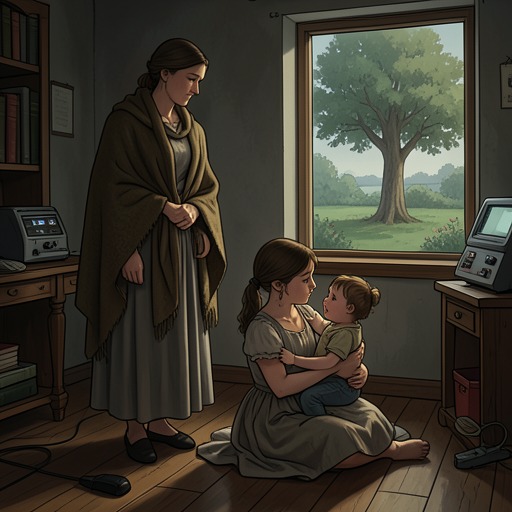
Agnes keeps watch beside Judith through the night, seated on the floor by the pallet with a cloth in her hand. She does not rise, eat, sleep, or rest. Mary manages to get her to drink a little. In the heat of the fire, Agnes’s cheeks redden; loose strands of hair cling damply to her neck. Under Mary’s watchful gaze, she wets the cloth in a basin and wipes Judith’s forehead, arms, and throat, murmuring softly to her daughter.
The care is intimate, but it cannot make the danger less plain. Judith’s fever has not broken, and the swelling on her neck is stretched so taut that it might burst. Mary believes the child may die within hours or days. Her certainty is shaped by experience: three of her daughters have died, two of them as newborns, and she recognizes in Agnes the same helpless wish to hold a child to life. The scene sets the present vigil against that history of loss. To Mary, a child’s ordinary signs of life—breathing, drinking, moving, speaking, playing—are never guarantees of safety.
The household’s helplessness gives the vigil its pressure. Agnes can clean and soothe Judith, but there is nothing else to be done for her. When Hamnet wakes, his parents’ bed is empty, his sisters’ pallet holds only one body, and he remembers that Judith is ill. His return to awareness is disorienting: his mouth is dry, his heart feels heavy, and his head hurts so badly that he struggles to think or control his movements.
The Twins Together
Hamnet is eleven, yet illness draws him toward his mother with the urgency of a much younger child. He crawls from bed and makes his way downstairs as the pale light of morning enters the house. The steps seem to rock beneath him, and he has to turn toward the wall because everything else appears to move. In the room below, Eliza is asleep at the table; the candles have burned out, the fire has fallen to ash, and Agnes has slumped asleep beside Judith’s pallet with the cloth still in her hand.
Judith looks directly at him. Hamnet tries to speak to her, but his dry mouth and irritated throat make it difficult. He crawls through the straw and takes her hand. Her face shows how ill she is: hollow cheeks, cracked lips without color, and red, shining swellings on her neck. Her eyes roll back before she opens them again and struggles to look at him. She manages a faint smile, presses his fingers, and tells him not to cry.
For Hamnet, their closeness is not merely affection. He understands Judith as the other side of himself, a twin who fits him like one half of a whole. The thought of surviving her feels like being left wounded and incomplete. As he holds her hand, tears appear on her cheeks; he knows they have fallen from his own eyes, though the twins’ shared identity makes them seem almost hers as well. Judith tries to reassure him that nothing bad will happen to him. He refuses the comfort: he intends to go with her.
Judith answers that he must stay because he is needed. Hamnet perceives death as waiting in the room, and he cannot accept that it will take her while leaving him behind. His response is not a plan to seek a remedy but a transformation of the twins’ childhood game into a last attempt at protection.
The Attempt to Exchange Places
Hamnet remembers how he and Judith have fooled other people by changing clothes. Their faces are so alike that a parent can mistake one for the other: a mantle or hat, a different place at the table, a concealed smile, and the trick can hold until the real child appears. They have used their resemblance to confuse their family. Now Hamnet wonders whether they can confuse death in the same way.
He shifts Judith gently toward the hearth, moving her by the shoulders and hips, then lies in the place she has left. He smooths his hair to either side of his face and pulls the sheet over them both, tucking it beneath their chins. To him, their likeness makes the deception plausible: perhaps death will take him instead. The familiar exchange has changed in scale and meaning. What once produced a joke becomes an effort to make the twins’ shared identity into a shield.
Judith understands what he is doing and tries to sit up, but she is too weak. Hamnet holds the sheet fast. He breathes toward her ear as if he could give her his strength, health, and everything he has. His offer is absolute: if only one of them can live, he wants it to be her. The attempted exchange is therefore an act of love as well as a child’s desperate logic. Hamnet believes that because they can exchange places in life, they may be able to do so with death; the scene lets that hope take bodily form without suggesting that it can change the course of illness.
Survival, Loss, and Aftermath
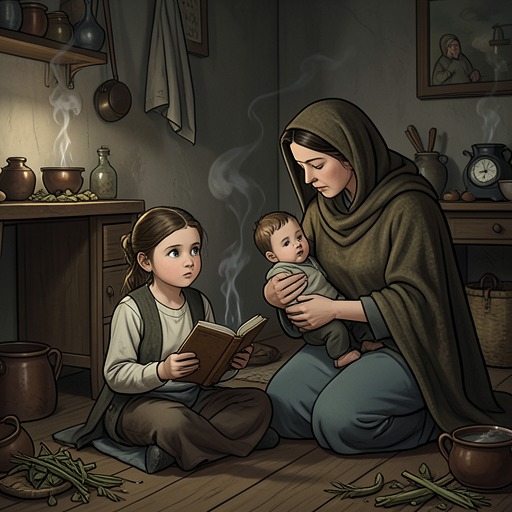
Judith survives the immediate crisis, but her later life remains marked by fragile health. As a young child she suffers convulsions, fevers, chest congestion, and difficulty breathing; illnesses that are mild for her siblings can become severe for her. Agnes delays the family’s intended move to London while she waits for Judith to improve, setting new hopes against new seasons. When Judith is two, Agnes spends nights tending her breathing, placing warm bowls containing pine and clove near the bed curtains. The move never becomes possible because Judith would not survive the journey or life in the city.
Hamnet’s substitution does not prevent the family’s later bereavement. After his death, the women prepare his body while Judith, herself still weak but improving, is kept upstairs. The town’s requirement that plague dead be buried the same day presses urgency onto the task. Agnes eventually washes Hamnet, lays herbs beside him in the white sheet, and sews it into a shroud. His father carries the body to burial. Agnes leaves the churchyard with two children where she had entered with three, unable to reconcile the living family with the child left in the ground.
The later events do not make Hamnet’s gesture a literal exchange of fates; they sharpen its tragic contrast. Judith lives, though precariously, and Hamnet dies. The attempt remains significant because it reveals how completely the twins experience themselves as bound together: Hamnet cannot imagine a life in which he survives her, and he gives his own life to her in thought before death takes him. Their childhood impersonations return in the crisis not as a playful trick but as the form his love can take when he has no power over illness.