Rowan’s Death and the Newborn’s Death
HamnetRowan’s death and the newborn’s death form a defining childhood trauma for Agnes: mother and baby are lost together, while the surviving children are left in a household where grief is followed by enforced silence. The event returns years later through Agnes’s memory, linking a private family death to her distrust of the explanations adults give her about death, faith, and what may be spoken aloud.
Death after the third birth
After two earlier births, Rowan becomes pregnant for a third time. This pregnancy ends in catastrophe: she gives birth to a third child and never rises from her bed again. The newborn is also dead. The women who come to wash and dress Rowan place the small wrapped body in her arms, making the two losses present together in the room.
The villagers’ grief is uneasy and self-directed. They do not weep because they had loved Rowan: she had come out of the forest, married one of their own, and kept apart from their attempts at friendship. Instead, her death makes them confront their own mortality. As they wash and comb her, clean beneath her nails, and dress her in a white shirt, their care for the dead is also a recognition of their shared vulnerability.
The children and the widow
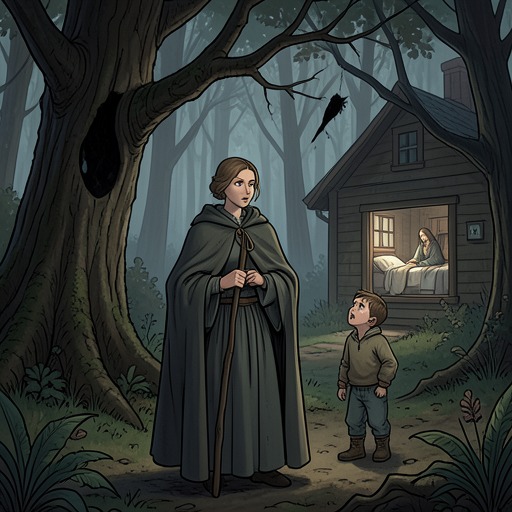
Rowan’s young daughter watches the preparations in silence, fixed on her mother’s body. She does not cry or make a sound. A younger brother cries in her lap, and she refuses to let the well-meaning women take him from her; when they approach, she spits and scratches like a cat. The women find it difficult both to help her and to feel compassion for her resistance.
The only person the girl allows near is the old widow who had been Rowan’s friend. The widow sits beside the children with a bowl of food and waits. From time to time, the girl permits her to feed the little boy a spoonful of porridge. The small permission marks the limit of what the bereaved child can accept: she will not surrender her brother, but she can allow one trusted person to care for him.
Agnes’s memory and the denied priest
Agnes remembers nearly everything about the woman who took her into the forest, but not where that other mother went or why she left. Later, the sight and smell of her father cutting a lamb behind the pigsty abruptly return her to the bloody bed and the dead Rowan. In the memory, Rowan’s body is waxen, cold, and silent, with the dead newborn held in her arms. The scene is not a vague impression: Agnes recalls a narrow box, a priest summoned secretly at night, and smoke rising from a bowl as he prayed over the dead.
The memory carries a prohibition. Her father had told Agnes never to reveal that the priest came or spoke those words over Rowan and the baby. When the lamb’s blood brings the scene back, Agnes tells him that she remembers; he denies that the priest ever came, or touched her forehead. His denial leaves Agnes uncertain whom he means by her mother when he warns her not to let her mother hear: Joan, the woman in the household, or Rowan, who is dead.
Aftermath and significance
The contradiction breaks open Agnes’s sense of a stable world. She is certain of the cross at the priest’s neck, the smoke above the bodies, and the repeated invocation of Rowan’s name, yet the adult beside her insists that these things never happened. She runs from her father and the slaughtered lamb into the forest, where she shouts her accusation to the trees and rejects the idea of an afterlife. The remembered death thus becomes the source of a lasting conflict between what Agnes has witnessed and what authority demands she deny.
Agnes tells the widow, who warns her never to tell anyone else, lest seven evils of seven kinds be drawn upon her. The warning extends the silence surrounding Rowan’s death: first imposed by Agnes’s father, it is reinforced by fear of what speaking might bring. In the novel, the event is therefore both a family bereavement and the origin of a private knowledge Agnes must carry alone. Its return through the slaughtered lamb shows how the past persists not as an orderly account but as a vivid, involuntary encounter with the dead.