Judith Falls Ill as Hamnet Rushes to Find Help
HamnetJudith Falls Ill as Hamnet Rushes to Find Help is the crisis in which an ordinary day of play becomes an urgent search for medical care, and Hamnet’s devotion to his twin is tested by the limits of his age and the absence of the adults he expects to protect her. As Judith’s symptoms worsen, he tries to reach a physician and then returns to find her alone. The episode establishes the bodily signs of the illness, but also the twins’ closeness and the terrible gap between Hamnet’s confidence that his mother can cure anything and what he actually encounters.
The Sudden Change from Play
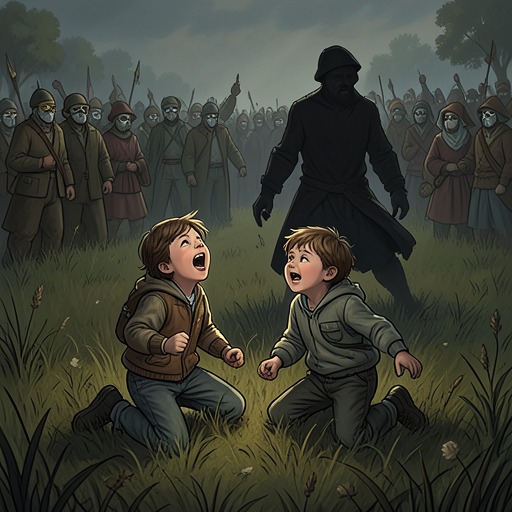
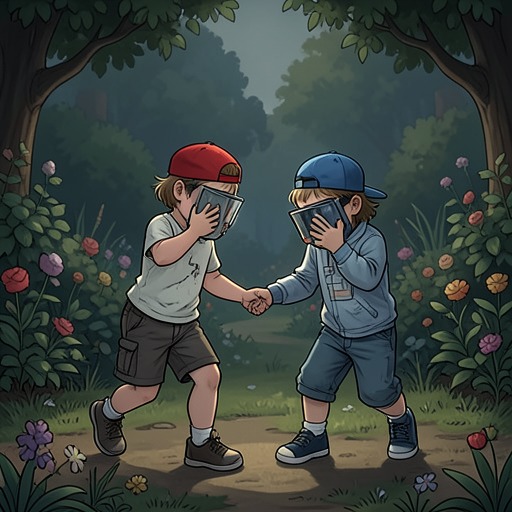
Hamnet and Judith have been playing with kittens that have escaped an early death. Their familiar mischief is close at hand: on an ordinary day, Hamnet might persuade Judith to climb onto the kitchen roof and reach for the ripe plums hanging over the neighboring wall. He knows she dislikes doing anything forbidden, but usually manages to win her over. This time the play stops when Judith says her head hurts and her throat burns. She feels cold, then hot, and goes home to lie down. The contrast between the children’s usual freedom together and Judith’s retreat into bed marks the first turn in the emergency.
Hamnet knows he must find someone who can help. Yet his attention can slip away from the immediate world: in the forbidden glove workshop, he becomes absorbed by the hanging skins, touching the soft kid leather and noticing the tools on the wall. He even puts a misplaced, narrow glove form back on its hook. This brief diversion does not make his concern for Judith less real; it shows how difficult it is for him to hold his purpose steady amid unfamiliar sights. He has entered the workshop to seek assistance, but its objects momentarily draw him out of the urgent task.
When he returns to Judith, she is lying dressed on the bed, with her shoes turned upside down on the floor. He touches her hand and asks whether she feels better. Their hands have the same nails and knuckles, though his are larger and dirtier. Judith’s fingers are hot and slippery; when she moves, she tangles them with his. Beneath the skin, Hamnet sees two swellings, one at the base of her throat and another where her shoulder meets her neck. Their pale, oval shape reminds him of quail eggs. The observation gives his fear a concrete object: this is no longer only a headache or a feverish complaint, but a visible change in Judith’s body.
Hamnet’s Search for a Physician
Hamnet runs through the town to the physician’s house, asking a woman on the way where the doctor lives. The route carries him past a patient horse between the shafts of a cart, men gathered at the town hall with serious faces, a woman urging a child to hurry, a man striking a donkey, and a dog that barks as Hamnet rushes by. These ordinary street encounters continue around him while his attention is fixed on getting help for his sister.
At the physician’s door, Hamnet studies the woman who answers and remembers Judith’s fingers. He knocks harder when she scolds him for making a disturbance and tries to send him away. He apologizes and pleads for the doctor, explaining that his sister is ill and asking whether the physician can come to the house at once. The woman looks at his face with concern, but tells him the doctor is out visiting a patient. The answer does not resolve the emergency; it leaves Hamnet to carry his alarm back home without medical help in hand.
Asked whether Judith has a fever or pustules, Hamnet does not understand the word at first. He can describe what he has seen: lumps beneath the skin, at the neck and under the arms. The exchange makes the limits of his knowledge plain. He can report the signs accurately, but cannot name the illness or judge its course. The woman’s response is to push him away from the house. For Hamnet, the word she uses becomes frightening before it becomes medically intelligible; its sound seems to swell around the symptoms he has already witnessed.
The Adults He Expects Are Missing
On the way back, Hamnet seems to expect that Agnes will be at Judith’s bedside, giving her one of the remedies he believes can cure any illness. The expectation rests on what he has seen at home: people from Stratford, Warwickshire, and farther away come to Agnes for help; she listens to them, holds their hands, prepares plants, and sends them away with remedies. In Hamnet’s mind, her skill offers an answer to whatever has happened to Judith. He climbs the stairs exhausted, leaning on the handrail, certain that his mother will be there to restore his sister.
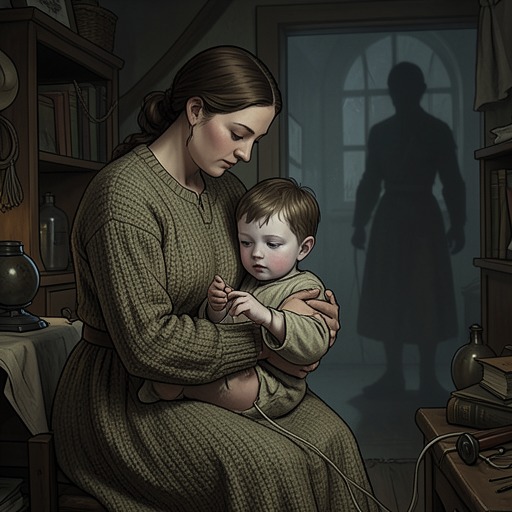
Instead, Judith is alone. During the short time Hamnet has been away, she has grown paler and weaker. The skin around her eyes is blue, her breathing is shallow and rapid, and her eyes move as if following something he cannot see. Hamnet sits on the edge of the bed, links his little finger with hers, and takes some comfort in hearing her labored breathing. The scene reverses his expectation: he has imagined returning to an adult who can take charge, but reaches a sick child with no one beside her.
Agnes, meanwhile, leaves the kitchen to search for the children. At the large house she sees John bent over his work in the glove workshop, calls up the stairs, and gets no answer. She goes out onto Henley Street, where the day’s heat is beginning to ease and people are returning home for supper. When she enters her house again, Hamnet stands motionless at the foot of the stairs, pale and gripping the handrail. He has a swelling and a cut on his forehead that were not there that morning. He cannot explain what has happened; he shakes his head and points upstairs. Agnes understands the gesture and takes the stairs two at a time.
From Judith’s Illness to the Family’s Loss
The crisis leads into the plague illness that kills Hamnet while Judith survives and begins to recover. After his death, the family faces the practical demands of mourning under Stratford’s order that plague victims be buried the same day. Women prepare the room, burn the bedding, air and clean the space, and bring warm water, cloth, a white sheet, thread, and needles. Judith is moved to an upstairs room because she remains weak, though she is improving. At first Agnes cannot respond to the women’s preparations; the need to begin the burial rites confronts a grief she cannot yet act upon.
Agnes eventually washes Hamnet herself, tracing the scars and marks that belong to his particular life: a scar from a fall at Hewlands, a bite mark from a dog, the callus made by holding a quill. She chooses herbs to place beside his body, excluding plants whose smell or sharp leaves would distress him, and sews the sheet into a shroud, beginning at his feet. The care she had imagined administering to Judith cannot save Hamnet; after his death, care takes the form of tending his body and preparing it for burial. His father carries him through Henley Street on a board, wrapped in the white shroud and surrounded by flowers and sprigs.
The twins’ unequal fate makes the earlier bedside scene more than the beginning of a medical emergency. Hamnet’s hand is joined with Judith’s as he tries to comfort her; later, Agnes enters the cemetery with three children and leaves with two. At the gate she cannot accept that she must leave Hamnet behind. The event’s urgency therefore acquires its full meaning in retrospect: Hamnet’s search is an effort to bring an adult to his sister, but it also begins the chain of absence, failed expectation, and loss that the family will have to live through.