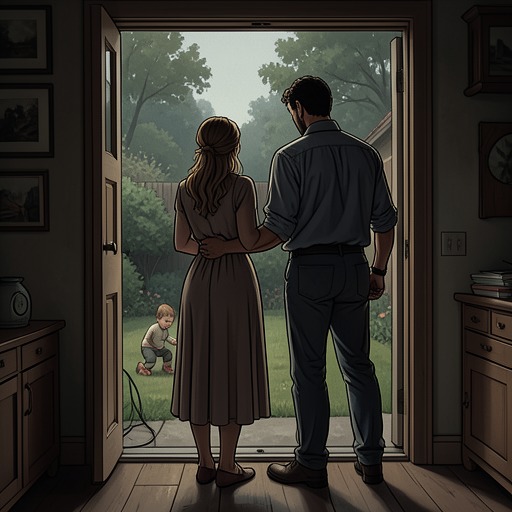
Agnes’s Pregnancy Is Discovered, and She Leaves Hewlands
HamnetAgnes’s Pregnancy Is Discovered, and She Leaves Hewlands marks the moment when a concealed pregnancy becomes a household crisis and Agnes’s life at Hewlands ends. Joan uncovers the pregnancy through the routines of domestic work, confronts Agnes with violence, and declares her expelled. Bartholomew challenges Joan’s authority over the house, but Agnes chooses to depart all the same, carrying a small bundle and her hooded kestrel.
The Clue in the Laundry
Joan’s discovery is delayed by the sheer demands of running the farm. Widowed for a year, she governs the house under the terms of her late husband’s will, while Bartholomew manages the fields and flocks. Joan oversees the kitchen, poultry yard, and orchard, tends pigs and cows, prepares food for the farmworkers and shepherd, and cares for the younger children. Baking, preserving fruit, brewing, mending, sweeping, and washing fill the intervals between those duties. In this crowded routine, it takes three months for her to realize that some of the menstrual cloths are missing from the laundry.
The washing offers Joan a regular pattern to compare against. Every fortnight, the women’s cycles produce alternating loads: one large pile from Joan and her daughters, followed by a smaller one containing Agnes’s cloths. Joan handles those cloths separately, lifting them with wooden tongs and covering them in salt. One morning in late October, she sees that the pile of dirty clothes is smaller than usual. The discrepancy has become visible not through confession or a message, but through the absence of something Joan expects to find among the household’s work.
At first Joan considers whether she has miscounted. Then she looks at the girls and wonders if she has been feeding them properly, before dismissing the suspicion that the youngest could be pregnant: she is still a child. Joan asks where Agnes is. Joanie looks alarmed and fixes her gaze on the muddy sheet underfoot; Caterina turns away, as if she understands what the question may mean. Her evasive answer does not establish the truth, but it deepens Joan’s suspicion. Joan follows the clue to the warm cowshed, where she finds Agnes milking a cow.
The Confrontation
Agnes has her head against the cow’s flank, and Joan hears the milk striking the pail. When Joan shouts, the cow shifts and Agnes turns with a wary expression, seemingly braced for what is coming. Joan pulls her from the milking stool and pushes her against the partition between the stalls. Only then does she notice that James is in the adjoining stall and appears to have been helping Agnes milk.
Joan searches beneath Agnes’s clothes while Agnes resists and tries to push her away. Her hand finds a warm, rounded swelling beneath the fabric: the physical confirmation Joan had been seeking. The discovery is intimate and coercive, made by force rather than disclosed by Agnes. Joan responds by insulting her. Agnes shoves Joan against the cow; as the animal moves uneasily at the interruption, Agnes breaks free and runs through the half-asleep sheep and out of the shed.
Joan catches her near the farm enclosure by grabbing a lock of her hair. She pulls Agnes down and holds her there, using the grip to make her listen. Joan demands to know who has put a child in Agnes’s womb. Her mind runs through the suitors who have sought Agnes since the news of her father’s dowry spread: a carter, a farmer from the other side of Shottery, and a blacksmith’s apprentice. Joan remembers that Agnes seemed to like none of them, but she has no answer to the question she is shouting. Agnes’s face is twisted with pain and anger, and tears gather as she tries to free herself.
Violence and the Claim to Kinship
The quarrel continues in the farmyard. Joan accuses Agnes of striking her, invoking the authority of a mother; Agnes answers that Joan is not her mother. Joan slaps her again, and Agnes returns the blow. The exchange makes their conflict over kinship explicit: Joan claims the standing of a parent, while Agnes rejects that claim at the moment Joan is asserting control over her body and future.
Bartholomew restrains Joan from behind and holds her hands still. Thomas steps between the two women with his crook raised, while the other children stare beside the henhouse. Caterina holds the crying Joanie, and Margaret lifts the youngest child into her arms as he hides his face against her neck. The surrounding family is not a silent audience: the children’s shock, their attempts to protect one another, and Bartholomew’s intervention turn Joan and Agnes’s struggle into a crisis for everyone in the yard.
Joan breaks away from Bartholomew and goes into the house. She gathers Agnes’s possessions—a couple of shirts, a spare shawl, an apron, a wooden comb, a hole-pierced stone, and a belt—and throws the bundle at her feet. Joan declares that Agnes is expelled from the house forever. Bartholomew answers that the house belongs to him, inherited from his father, and that Agnes may remain. Joan’s authority as the widow who governs the household is checked by the terms of inheritance: she may live there and manage the home, but the farm is Bartholomew’s.
Departure from Hewlands
Bartholomew’s refusal does not settle the matter. Joan appeals to their father’s memory and asks what he would have wanted, but Bartholomew maintains that Agnes can stay. Agnes places a hand on her brother’s sleeve, and the two look at one another in silence. Bartholomew spits on the ground, puts his hand on her shoulder, and nods. Agnes gives him a crooked smile, her split lip still bleeding, wipes her face with her sleeve, and unties and reties the bundle twice. The gestures make their agreement visible without resolving the dispute between Joan and Agnes.
Bartholomew tells his sister that he will take care of it and touches her hand. Agnes says she is not worried. She crosses the yard without much hesitation and enters the Despensa de las manzanas. A moment later she emerges with the kestrel on her gloved hand. The bird is hooded, its wings folded, but its head moves in every direction, registering the changed circumstances around it. Agnes takes up her bundle and leaves without saying goodbye. She walks around the house and disappears from view.
Significance of the Rupture
The departure is not simply the outcome Joan intends. Joan declares Agnes banished, but Bartholomew’s inheritance gives him the power to countermand her, and he explicitly offers Agnes a place in the house. Agnes leaves after that offer, making her departure a choice within a conflict rather than a straightforward eviction. The distinction matters: Joan can expose the pregnancy and attempt to dictate Agnes’s future, but she cannot make Bartholomew enforce her decision.
The scene also turns on the difference between what the household can observe and what Agnes will reveal. Missing cloths, the evasive reactions in the laundry, and the swelling Joan feels establish the pregnancy; Joan’s shouted demand for the father receives no answer in this episode. The unanswered question preserves the identity of the man as unknown here, even as the consequences become immediate. Agnes leaves the farm with her belongings and kestrel, while the family remains behind with the rupture she has neither explained nor repaired.