Hamnet’s Funeral and Burial
HamnetHamnet’s funeral and burial transform a death the family can barely comprehend into a public, hurried passage from home to grave. The plague ordinance requires burial on the day of death, but its timetable cannot make grief orderly: Agnes washes and shrouds Hamnet herself, William Shakespeare carries his son through Henley Street, and Agnes has to be pulled away from the cemetery gate by her family. The ritual moves the dead child into the earth while exposing how fiercely his mother resists the separation it demands.
The death enters the household
The burial follows the sudden illness and death of Hamnet, the healthy, robust child Agnes had not understood to be in danger. Her thoughts swing between practical fears about how the family will go on and the stark fact that he has died; again and again, her mind searches for him among the ordinary places of childhood, as if he might still be at school, playing, or by the river. The familiar question of where Hamnet is becomes impossible to answer in the terms that once organized family life.
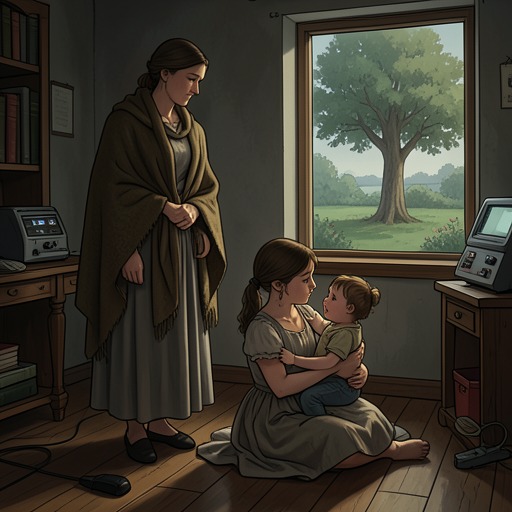
Before the burial, Agnes has spent the night beside Judith, who remains feverish and dangerously ill. Mary watches as Agnes wipes Judith’s forehead, arms, and throat with a wet cloth and murmurs to her. That vigil gives the bereavement an immediate, living counterpart: Judith, Hamnet’s twin, is still weak but improving, while Agnes’s attention is divided between the child she may lose and the child already gone.
The women prepare the room and the surviving twin for what must happen next. They burn the blankets, mattress, straw, and sheets, air and clean the room, and move Judith upstairs. They set out warm water and cloths, a white sheet, strong thread, and sharp needles. The town’s rule requires those who die of plague to be buried that same day, so the women explain that Hamnet must be washed and wrapped without delay. Agnes does not answer them. She sits with one hand on his curled, inert fingers and the other on his hair, unable at first to turn toward the work waiting beside her.
Agnes prepares Hamnet
Agnes’s grief is sharpened by the bodily difference between the son she remembers and the changed body before her. She closes his eyes herself, using her own trembling fingers, and the family must place two pennies over them to hold the lids shut. His skin has yellowed, his bones protrude, and the fever has emptied his cheeks. Against these signs of death, Agnes holds to the details her hands still recognize: his hair, and the fingers she keeps clasped in hers.
When she begins to wash him, the task becomes a form of attention to the individual life contained in the body. She passes her fingers over the scar on his arm from a fall at Hewlands, the puckered place left by a dog’s bite at a harvest feast, the writing callus on his right ring finger, and the marks of a childhood rash. She washes his legs and feet, changes the water with Mary’s help, and washes and dries his feet again. The repeated motions do not undo the loss; they let Agnes tend to Hamnet through the last familiar particulars of his body.
The white sheet, unfolded by Mary, opens before Agnes as a great blank expanse. She lifts it to her face; it smells of juniper, cedar, and soap. With Mary helping to raise Hamnet’s legs and torso, Agnes passes the sheet beneath him. She places dried rue, comfrey, chamomile, lavender, thyme, and rosemary in its folds, close against his body. She rejects plants associated with failed remedies or with smells Hamnet disliked, and avoids the sharp leaves of milk thistle because they might scratch his skin. Then she threads thick yarn and begins sewing at his feet. The work is exact and practical, but its image is also one of passage: she stitches a shroud around her son as if preparing a vessel for a journey beyond the living world.
The family procession
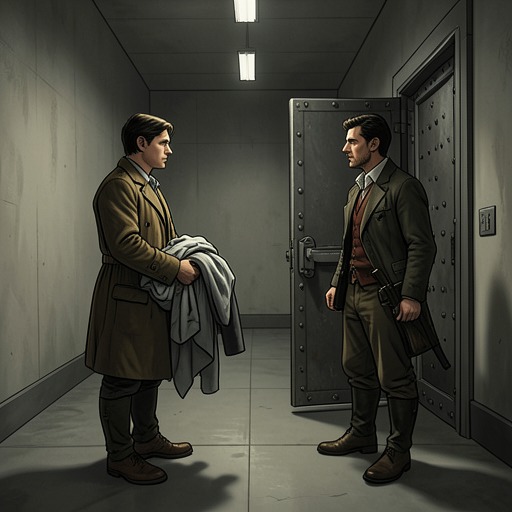
William Shakespeare returns in the rain, soaked through, pale, and looking as though he has not slept. He sees Judith standing beside the candle and smiles at the sight of her alive; then he touches Hamnet’s cold cheek and the wound in his eyebrow, unable to accept what he sees. The family surrounds him. The father who has been away is now present at the decisive act of carrying his son to burial.
William lifts the board bearing Hamnet’s shrouded body and carries it out, with flowers and sprigs laid around the child. Agnes follows with Susanna and Judith; Bartholomew carries Judith, who hides her face in her uncle’s neck and wets his shirt with tears. Mary and John, Eliza and her brothers, Joan, Agnes’s brothers, and the baker and his wife join the procession. At the crossroads, Edmond comes alongside William, and the two brothers carry the board together, William at the head and Edmond at the feet.
The procession passes through Henley Street without assistance from the surrounding crowd. Neighbours and passers-by put down their tools, bundles, and baskets and clear a path. They remove their hats, make the sign of the cross, pray, offer consolation, and in some cases weep. Their attention also turns to William’s standing in London: people whisper about the successful glove-maker’s son in embroidered sleeves and polished boots, and wonder at the money he earns in a playhouse. The public recognition of his success runs alongside the sight of his dead child and the grief of the family. Agnes cannot take comfort from the crowd’s prayers or sympathy; she resents the way people close ranks again behind the mourners, as though the passage through the street had left no mark.
The grave and its aftermath
At the cemetery, the grave appears to Agnes as a deep, dark split in the earth. Beyond it, the river bends and runs onward. She thinks Hamnet would have chosen that ground near the water, which he loved, and is struck by the final contradiction: the child who was drawn to rivers and wells will lie enclosed in the earth. William lowers the body. Agnes cannot bear to watch the burial and loses sight of the moment Hamnet disappears beneath the soil.
Leaving the cemetery proves harder than entering it. Agnes experiences the graves and the spirits she imagines there as hands tugging at her skirts and asking her not to leave. She has come in with three children and must leave with two, but the arithmetic offers no emotional way to release the one who remains behind. At the gate, she grips a wooden post with both hands. William takes her arm, and the face beside her seems at once unfamiliar and marked by Hamnet’s features. Agnes feels herself emptied and unable to cross out of the cemetery; it takes the combined strength of William, Bartholomew, Susanna, and Judith to pull her away.
The loss continues inside the household after the burial. Agnes hears William pacing downstairs through the first night and the second, with no other sound in the house. Later, still fearing that his absence has taken him from her in another way, she expects an explanation about their marriage; instead, William asks how much she thinks about Hamnet. The question reveals that the dead child occupies the space between them, though they approach that grief differently. The funeral has carried Hamnet out of the house and into the grave, but it has not given the living a common route through mourning.