Agnes Gives Birth to Susanna in the Forest
HamnetAgnes Gives Birth to Susanna in the Forest is the birth scene in which Agnes leaves the household expecting her to deliver and bears her daughter alone in a woodland hollow. In spring 1583, she carries a basket past the sleeping husband who does not notice her absence, avoids the family farm, and reaches a place she once shared with Bartholomew as a refuge from childhood duties. There, amid severe labor, she gives birth, tends the newborn with the few things she has brought, and confirms that both mother and child have survived. The scene makes the forest at once a chosen shelter, a remembered refuge, and the setting for a perilous passage into motherhood.
Departure and Deliberate Secrecy
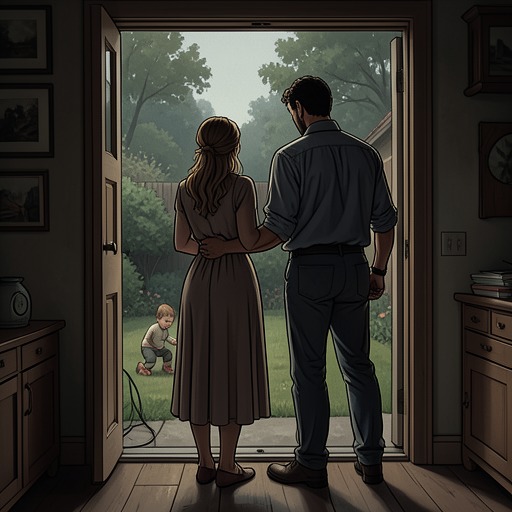
A spring morning finds Agnes leaving the narrow house in Henley Street where she and her husband live as newlyweds. She sets a basket on her shoulder and heads northwest. Above her, her husband turns in bed, sleeping deeply; the empty, cooling side of the bed does not wake him. His unawareness contrasts with the purposefulness of her departure: this is not a brief errand, but a journey she has arranged without telling the household where she is going.
At Rother Market, Agnes pauses to speak with the baker’s wife. They talk about the threatened rain, the heat of the bakery ovens, and how low Agnes feels the child sitting in her body. The woman tries to give her a bun; when Agnes refuses, she insists and puts it into the basket. Inside, she glimpses clean, carefully folded cloths, scissors, and a lidded jar, but makes no comment. These supplies show that Agnes is prepared for the birth, while her silence keeps the purpose of the journey concealed.
Agnes continues along the riverside with the basket tiring her arm. It is mid-May, and she notices valerian, campion, wild rose, sorrel, ramsons, and lilies growing beside the path. Ordinarily she would stop to gather tender stems and flowers; this time she does not. Her attention to familiar plants remains, but the labor and the urgency of her destination prevent her from following the foraging impulse that would usually draw her from the road.
The Forest as Chosen Refuge
Agnes circles Hewlands rather than taking a route that might bring her face to face with Joan, Bartholomew, or her other siblings. She fears that, if they saw her, they would raise the alarm, summon someone, and compel her to return to the farm—the very place she is determined not to enter for the birth. The route is therefore a practical act of concealment. Yet it is not an escape from all attachment: she sees her brother Thomas walking from the house to the cattle yard, hears Bartholomew’s sharp whistle for the dogs, and recognizes the thatched roof, pigsty, and back of the apple storehouse. The familiar sight makes her smile even as she continues away.
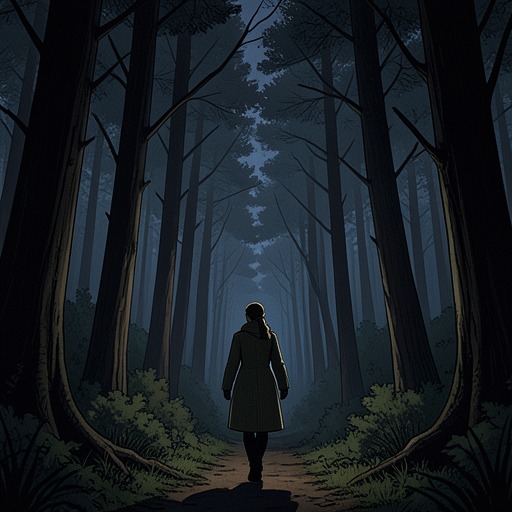
About a kilometer into the forest, Agnes’s pains have become too close together for her to recover properly between them. She stops beside a huge elm and braces a hand against its rough bark as the pain rises from her lower back and takes hold of her. When she can move again, she lifts the basket and presses on to the part of the forest she has chosen. She crosses the river, passes a grove of holly, and reaches a sunlit clearing where green grass and rounded fern fronds gather beneath the trees.
A great fir lies almost horizontally across the clearing, its roots exposed and its reddish trunk caught among the forked branches of smaller trees. Where it once stood is a dry, sheltered hollow large enough for several people. Agnes and Bartholomew used to hide there as children when Joan shouted at them or gave them too many tasks. They brought bread and cheese in a cloth bag and imagined living in the forest as elves, never having to return. The old hiding place now offers Agnes cover during labor: a childhood retreat becomes the place where she must face the physical danger of giving birth.
Labor and Birth
Agnes crouches on the dry ground beneath the uprooted tree, where the earth is covered with fir needles. As another contraction approaches, she turns and grips a root, breathing through the pain as she knows she must. Its growing force strips thought down to the wish for it to end. Agnes understands the pain as a demand to act: there will soon be no interval in which to rest or gather herself, and she must bring what is inside her out into the world.
She is not inexperienced with birth. She has watched women labor, remembers seeing and hearing her mother give birth, and has assisted Joan through all her deliveries. She has received her younger brothers and sisters into her hands and cleaned blood and birth fluid from their mouths and noses. She has also been called to help when animals were in difficulty: her father and Bartholomew relied on her to reach into the warm, slippery birth canal of a sow, cow, or sheep and draw out trapped legs, a muzzle, or folded ears. This knowledge gives her a conviction that she and her daughter will live, but it does not make the labor familiar or controllable.
The force of this birth overwhelms her usual confidence in her strong, capable body. She knows herself as someone able to milk a cow, work wet laundry, carry a child, a bucket, or an armful of firewood. This pain, however, will not yield to strength or deliberate effort. The scene places practical experience beside helplessness: Agnes knows what a birth requires and has helped others through it, but now her own body carries her into a trial she cannot master by will.
Across the clearing she sees the silvery trunk and delicate leaves of a rowan tree. Even in labor, she repeats its name to herself and recalls its red berries, its use for stomach and chest complaints, and the belief that planting its branches by a doorway keeps evil spirits away. The tree’s name also recalls her mother, whose name Agnes learned from the pastor because her father never spoke it. In a scene governed by bodily strain, this brief attention to the rowan connects the forest’s living forms to remembered family knowledge and to Agnes’s mother.
The child is alive. Agnes had feared that her premonitions might be answered by a stillborn baby, but the newborn turns her head, wrinkles her face, and cries with surprising force. At first the girl’s face is wet and grayish; Agnes turns her onto her side, as she used to do with lambs, and fluid drains from her mouth. Color then comes into the baby’s lips, cheeks, chin, eyes, and forehead. Her appearance becomes legible as human and familial: she has her father’s high forehead and lower lip, Agnes’s marked cheekbones and large eyes, and a swirl of hair at the crown.
Care and the Search at Home
Agnes takes the blanket and scissors from the basket, lays the baby on the cloth, and cuts the cord. Its unexpected thickness and strength make the act tangible: the cord is not a simple thread but a living, ridged connection that Agnes must sever. She then opens her shirt, brings the child to her breast, and watches her latch and suck. Her laughter comes with the recognition that feeding works, that the newborn knows what to do even when Agnes doubts her own skill. The immediate signs of life—crying, color, nursing—answer the fear that has shadowed the labor.
Meanwhile, Agnes’s absence turns into a household alarm. Eliza is crying, Mary goes up and down the stairs calling for Agnes, and John moves between his workshop and the commotion, alternately objecting that the noise makes work impossible and demanding to know where she is. Mary says she had prepared the birthing room and everything Agnes needed there. The prepared room sharpens the contrast between the household’s expectation of where the birth should happen and Agnes’s deliberate choice of the forest.
Ned, the apprentice, is sent to Hewlands, but nobody knows where Bartholomew is, having left early that morning. Joan, the sisters, neighbors, and men go out looking for a woman near childbirth carrying a basket. The baker’s wife is the only one who can report seeing Agnes, and says she went toward Shottery; distressed, she regrets having let her continue when she suspected something was wrong. Gilbert and Richard are sent to ask people in the streets whether they have seen her. Agnes’s husband goes to look for Bartholomew. The search establishes the consequences of her secret departure, but the birth scene leaves her and Susanna in the forest while those at home are still trying to find them.