Hamnet Dies of His Illness
HamnetHamnet’s death is the irreversible turn from desperate care to mourning in the family’s life. As his illness defeats every remedy Agnes can offer, the scene moves between her efforts to hold him in the living world and his vision of a quiet, snow-covered place where he longs to rest. He dies in his mother’s arms, at home, while those closest to him keep vigil; the plague ordinance then presses the family toward burial before Agnes is ready to let him go.
The illness and the vigil
Agnes understands, with growing horror, that the illness has become more powerful than anything she can do. She holds Hamnet’s shoulders and chest as his body convulses, and recognizes that she can stay beside him and make him as comfortable as possible but cannot master the disease. It seems to have reached the house from a distant place of decay and confinement, spreading through people, animals, and insects. The language makes the illness an antagonist in its own right: it has caught Hamnet in its tendrils and will not release him. Agnes continues tending him. She wipes his forehead, arms, and legs with a damp cloth, places bags of salt in the bed, and lays valerian and swan feathers on his chest. His fever keeps rising and the pustules grow swollen and taut. One hand has turned grey-blue along one side; she lifts it to her cheek, still prepared to try anything that might ease him. Her care remains physically intimate even as she recognizes its limits. The vigil draws the household into the same room, but not into a single response. Agnes repeatedly speaks Hamnet’s name while struggling to apply a poultice to the lumps on his neck and underarms; his trembling keeps the paste from staying in place. Eliza carries Judith away from the bed as the girl makes a harsh, hissing sound and kicks against her aunt. Susanna watches her mother apply ointments and bandages, angered and distressed by the helpless repetition. Judith, meanwhile, insists that she needs to be beside her brother. Mary kneels at the foot of the bed and holds him by an ankle; Susanna turns to the wall and covers her ears.
The snow vision and death
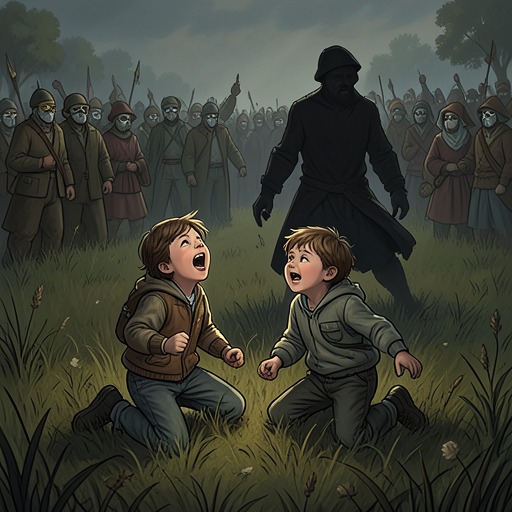
As Hamnet’s awareness recedes from the room, his family’s voices and touch fall away. He finds himself alone in a landscape of steady snowfall. Snow covers paths, rocks, and branches, turning the surroundings into whiteness, silence, and stillness. Its coolness and silver light comfort him. Tired and aching, he wants to lie down, though something within him warns him not to yield to that desire. That warning does not hold. Hamnet bends his knees and places his hands on the clean, crisp snow. It seems welcoming rather than too cold or hard. He lies down, presses his face to its soft surface, and closes his eyes, telling himself that he will rest only briefly before continuing. The scene gives his final surrender the shape of a desired rest, while the action in the room makes clear what that rest means. In the house, the convulsions stop and silence takes over. Eliza rocks Judith and murmurs a prayer; Susanna turns toward Hamnet and rests her wet cheek against the wall. Mary crosses herself and grips Agnes’s shoulder. Agnes bends to kiss her son’s forehead. In the room where he learned to crawl, eat, walk, and speak, Hamnet takes a breath and lets it go. He breathes for the last time in his mother’s arms; then there is only stillness.
From the bedside to the shroud
The women prepare for burial while Agnes remains fixed beside her dead son. The room is aired and cleaned, the bedding and straw are burned, and Judith is taken upstairs because she is still weak, though recovering. The women bring warm water and cloths, a white sheet, strong thread, and sharp needles. They explain that the town requires those who die of plague to be buried quickly, on the same day. Agnes does not answer or look toward the waiting basin and sheet; the practical necessity of the order cannot make her ready to begin. She attends to Hamnet’s body through touch. His changed face and fever-damaged skin no longer seem to her the same as the child she knew, but she can still recognize his hair and the fingers she holds. She remembers closing his eyes with her own trembling hands and placing a penny on each to keep the lids shut. Washing him brings his particular history back to the surface: the scar from a fall at Hewlands, the raised mark left by a dog bite at a harvest feast, the writing callus on his right ring finger, and the dimples on his stomach from an illness in childhood. The work is not anonymous preparation; each gesture meets the body of this child, known in its marks. Mary helps Agnes lift him so the sheet can be passed beneath him. When it opens, its broad white expanse fills the dark room. Agnes gathers rue, comfrey, chamomile, lavender, thyme, and rosemary and tucks the dried plants into the folds close to his body. She excludes plants whose scent he disliked or whose supposed help has failed him, including angelica and valerian; she also avoids milk thistle because its sharp leaves might scratch his skin. Then she threads a thick needle and begins sewing at his feet, making the shroud herself. The task is compared to a sailor sewing a sail for the vessel that will carry her son into the next world: a practical act shaped by the impossibility of keeping him.
Burial and its aftermath
Hamnet’s father touches his cold cheek and the wound in his eyebrow before carrying the body to burial. Wrapped in the white shroud and surrounded by flowers and sprigs, Hamnet is laid on a board that his father lifts into his arms. Agnes follows, holding Susanna’s and Judith’s hands; Judith is carried by Bartholomew. The family and others close to them make up the procession through Henley Street. At the crossroads, Edmond joins his brother and helps carry the board, taking the weight at the feet while Hamnet’s father bears it at the head. Agnes imagines that Hamnet would have chosen a place near the river, because he loved water. She had worried when he came too close to unsafe water and wells; now she has to imagine him enclosed in the earth beside the river. She cannot watch as his father lowers the body. Distracted by Judith’s tears and Susanna taking her hand, Agnes misses the moment when the shroud disappears into the dark, clay soil. The burial happens, but her attention cannot hold the instant of final separation. Leaving the churchyard proves harder than entering it. Agnes feels the dead tugging at her skirts and struggles to think of departing with two children after arriving with three. At the gate, her husband takes her arm. His face seems strange to her, aged and distorted by separation, grief, and tears; in it she can see something of their dead son’s features, but also the evidence of continuing life. Agnes, by contrast, feels emptied and unable to cross the gate or leave Hamnet behind. His death therefore does not conclude with burial: the ordinance can move the body into the ground, but it cannot make the mother’s departure from the child feel complete.