The Plague Reaches Stratford and Strikes Judith
HamnetThe Plague Reaches Stratford and Strikes Judith is the convergence of two narratives: Judith’s sudden illness in Warwickshire and the chain of accidents that carries plague across the Mediterranean and into her hands. A tiny flea, a ship’s cargo, and a box of millefiori beads connect distant places to the sewing room where Judith helps a seamstress unwrap her new materials. The event makes catastrophe feel at once global and intimate: the route is long, but its destination is a child opening a parcel.
The Outbreak at Home
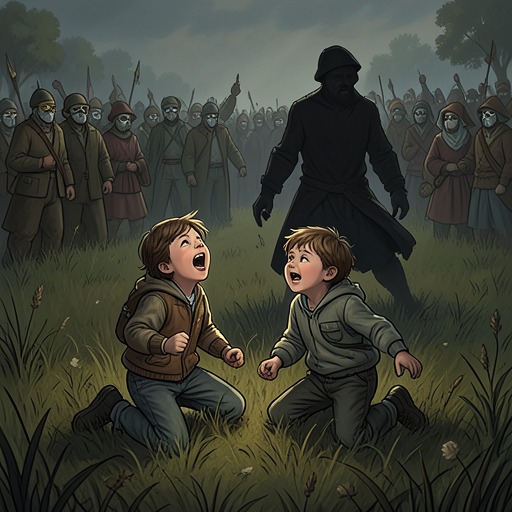
The local crisis is first seen through Hamnet, who answers three forceful knocks at the family’s door. A tall figure in a black cloak stands outside, his face hidden by a frightening mask with a long birdlike beak. Hamnet recoils and cries out, trying to shut the door, but the masked visitor pushes against it. His grandmother intervenes, apologizes to the doctor as if this were an ordinary call, and invites him in to see the patient. The doctor refuses to enter. Instead, he tells the household that they must remain inside and off the streets until the plague has passed.
Hamnet retreats to Agnes, who opens the shutter of the small window where she dispenses remedies. For the first time in years, he takes her hand; she squeezes it and reassures him that the apparition is only the doctor. The reassurance cannot dissolve his fear. He puts his other hand between her fingers as though her touch might keep him safe, and worries that the doctor’s notice of him will bring disaster. The scene makes the threat bodily before it becomes medical: the mask, the closed threshold, and Hamnet’s grip all give the epidemic a presence in the house.
The doctor offers a treatment for Judith that Agnes distrusts. He gives the grandmother a package and instructs her to bind it to the girl’s stomach in white cloth for three days; he begins to describe another remedy involving an onion. Agnes interrupts to ask what he has brought. Hamnet senses her composure in the face of a man he finds terrifying, and understands that the doctor resents her for cultivating herbs, gathering leaves and other ingredients, and treating people herself. In his view, the adult world is suddenly difficult to navigate: the visitor who claims medical authority also appears hostile to his mother’s work.
When the doctor recommends a dried toad for Judith, Agnes asks whether that is what the package contains and makes clear that she will not accept it. He insists that he knows more than she does and begins to explain that little can be done if Judith has contracted the plague. Agnes shuts the dispensing window before he can finish. Furious and distressed, she returns to Judith’s bedside and cools her daughter’s forehead with a damp cloth. The confrontation leaves the household with both a medical emergency and a divided source of authority: the doctor’s prescribed remedy is rejected, while Agnes continues her own care.
A Chain Across the Sea
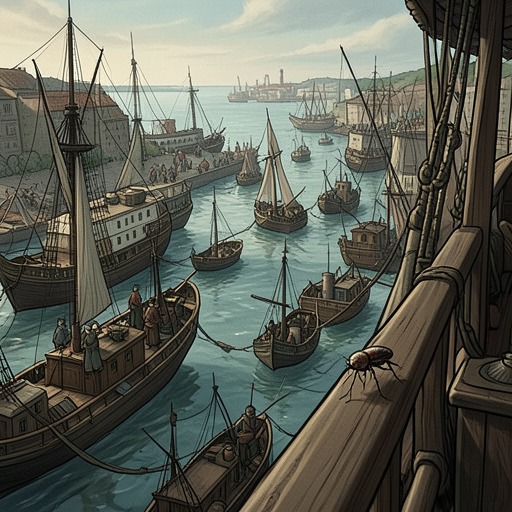
The narrative then traces the outbreak back through a chain of encounters set in motion months earlier. For plague to reach Warwickshire in the summer of 1596, it says, two people must experience separate events and later meet. One is a master glassmaker on Murano, in the Venetian principality; the other is a cabin boy aboard a merchant ship arriving from Alexandria. Their connection is not a planned exchange but a series of mishaps whose consequences travel farther than any participant can foresee.
In late 1595, the glassmaker is making millefiori beads, small glass pieces patterned in five or six colours. Distracted by a fight among the factory stokers, he slips and puts two fingers into the white-hot flame. The injury ends in the amputation of both fingers. While he recovers at home, another worker packs the beads. The master usually protects them with wood shavings and sand, but his companion instead uses rags from the factory floor. The change in packing material becomes one of the details that carries the story’s chain forward: the beads leave Murano wrapped in what was lying in the workshop, not in the usual protective materials.
Meanwhile, in Alexandria, the cabin boy is ordered ashore to find provisions for the ship’s hungry, exhausted crew. He has befriended a monkey, but the animal is dragged away from him. Unknown to the boy, three fleas have come loose from the monkey. One is crushed underfoot; another jumps from the boy to an innkeeper; the third lodges in the folds of the red handkerchief around his neck, a keepsake given to him by his beloved at home. Later, when the boy lifts his nearly white cat with its striped tail toward his neck, the flea jumps from the handkerchief into the cat’s thick white fur.
The cat sickens and dies in the lieutenant’s hammock. Other fleas remain where it had lain, and one that came from the monkey finds its way to the sleeping lieutenant and feeds. Three days after the ship has passed Damascus and is headed for Aleppo, the lieutenant is reported ill and confined below. The next day he is delirious, foaming at the mouth, and has a swelling on his neck. Several ship’s cats have also died. The captain orders the dead cats thrown overboard; the cabin boy watches them go, wiping his tears with the same red handkerchief that had carried one of the fleas.
The ship’s passage carries further losses. At Constantinople, all the cats are dead and rats have reached the provisions. Men succumb one after another to the same fever, which swells the neck and raises blisters that redden and sometimes blacken the skin. The captain makes an unplanned stop at Ragusa to recruit sailors. The new men are Polish-speaking and distrusted by the existing crew, though they are skilled at killing rats. The ship continues along its route as the number of sick and dead rises. By the time it reaches London, only five crewmen remain.
The Beads Reach Stratford
The glassmaker’s cargo survives the voyage amid a second, overlapping chain of animal movement. Cats sleep on the Murano bead boxes in the ship’s hold, while rats infest the vessel. As the cats die, their bodies remain among the crates, and flies move from dying rats to the cats and then across the boxes and the rags wrapped around hundreds of colourful beads. By then, the glassmaker himself has returned to Murano, where the factory has stopped because many workers have fallen ill with a mysterious, virulent fever. The infection’s progress is not confined to a single sickroom; it travels through animals, human bodies, shipboard spaces, and cargo.
After the ship reaches London, the cargo is gradually distributed. Most of the goods go to merchants and other buyers, but the smallest box of beads, still wrapped in the factory rags, spends almost a month on a warehouse shelf. It is then sent to a northern posting station and, after another week, handed to a courier riding to Warwickshire. During the two-day journey, the beads click together in the leather saddlebags. Fleas emerge from the rags, hungry after the time without a host, and jump among the horse, the rider, and people encountered on the road. By the time the courier arrives in Stratford, the fleas have laid eggs in the seams of his coat, the horse’s mane, the saddle stitching, the lace, and the cloth surrounding the beads.
The box reaches a seamstress on Ely Street, who needs Venetian beads for the bodice of a gown commissioned for a councillor’s wife. The order has travelled from Stratford to London and on to Venice; the customer has worried that the beads will not arrive in time. At last, the seamstress opens her shutter and receives the parcel. Judith, who helps her sort coloured threads and cut fabric, comes in just as the seamstress is about to unwrap it. The seamstress gives Judith the scissors and lets her cut away the dirty rags. Judith takes the box of millefiori with delight. The narrative places the child, the imported beads, and the contaminated wrapping together at the moment the long-distance chain reaches the household.
Quarantine and the Vigil
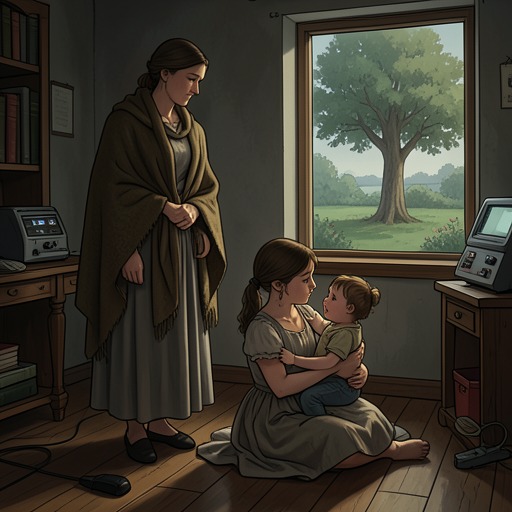
The outbreak’s consequences are registered in the change from a parcel opened with excitement to a child watched through the night. At Judith’s bedside, Agnes does not rise, eat, sleep, or rest. Mary manages to persuade her to drink a little. Agnes wets a cloth in a bowl and wipes Judith’s forehead, arms, and throat, murmuring to her as she works. The fever has not receded, and the swelling on Judith’s neck is so large and taut that Mary fears it may burst. She believes Judith may die that night or within the next few days.
Mary’s fear is shaped by earlier losses: three of her daughters have died, two of them newborns. She recognizes Agnes’s effort to hold Judith to life in the way the younger woman takes her daughter’s limp fingers. Mary knows the impulse to keep a child from being taken, having occupied the same place beside a sickbed herself. In her perspective, loss can arrive without warning, and a mother cannot take a child’s breathing, drinking, walking, or laughter for granted. Her experience turns Judith’s illness from a single family crisis into a recurrence of grief already present in the household.
The doctor’s order that the family stay inside gives the illness a civic consequence as well as a domestic one: the household is confined while Judith remains dangerously sick. The narrative’s scale keeps shifting between that closed room and the trade routes that made it vulnerable. A flea carried from a monkey, the death of shipboard cats, infected rats, contaminated rags, and Judith’s scissors all belong to the same causal movement, though none of the people handling these objects can see the whole chain. By ending at the bedside, the episode brings that immense route down to Agnes’s wet cloth and Judith’s unresponsive fingers. The plague’s arrival is not an abstract report of disease spreading through England; it is the moment a family must confront the possibility that Judith will not survive.