Hamnet Tries to Die in Judith’s Place
HamnetHamnet Tries to Die in Judith’s Place is the moment when a childhood game between twins becomes an act of attempted self-sacrifice. Faced with Judith’s apparent nearness to death, Hamnet tries to exchange places with her as literally as he once exchanged clothes: he lies in her bed, under her sheet, and wills Death to take him instead. The attempt cannot command what happens, but it reveals the depth of their bond and turns their familiar likeness into a desperate answer to loss.
Awakening to Judith’s Illness
Hamnet wakes from sleep covered by a sheet and finds the room strangely altered. His parents’ bed is empty; on the other sleeping place, where his sisters lie, there is only one body. He remembers that Judith is ill. The recognition arrives alongside a severe, bewildering pain in his head, a dry mouth, and a heaviness in his heart. The pain spreads through his muscles and senses, leaving him unable to think clearly. The scene establishes his own bodily vulnerability without making the cause or meaning of his symptoms certain: his attention is fixed on the sister who is already in danger.
He kneels and crawls through the straw to touch her. Judith’s face tells him that she is worse: her cheeks are hollow and pale, her lips cracked and bloodless, and the swellings at her neck red and shining. Her eyes have an unfamiliar silver light. She rolls them back, then opens them and turns them towards him with visible effort. Her slight attempt at a smile and the pressure of her fingers provide the fragile signs of recognition on which he depends. They interlace their hands, making touch, rather than clear speech, the first secure communication between them.
The Twin Bond and the Threat of Separation
Judith tells Hamnet not to cry and insists that nothing bad will happen to him. He answers that he is going with her: they will leave together. Her response is the opposite—he must stay because he is needed. The exchange makes their conflict plain. Hamnet experiences her survival and his own as inseparable; Judith, even in weakness, directs him back towards the living.
For him, the thought of losing her is not simply grief in anticipation. He feels that she is his other half, as if the two of them fit together like the halves of a walnut. Without her, he imagines himself left with an open wound where she has been separated from him. The narration enlarges this sense of shared identity through images of a heart deprived of lungs, a sky without its moon, and barley without rain. His tears fall on Judith’s face, where they seem as though they might belong to her as well. In the scene’s emotional logic, even the boundary between their feelings grows uncertain.
Death, meanwhile, becomes present in Hamnet’s perception as a watcher in the room, waiting in the shadows near the door. He imagines it approaching and taking Judith beyond his reach. Because he cannot bear that separation, he considers whether they should go together. The danger is not abstract to him: Judith’s wasting body, the pressure of her hand, and his own overpowering pain make the prospect immediate. His response is to search for an action that might preserve their union, even if it costs him his life.
Turning Their Game into a Sacrifice
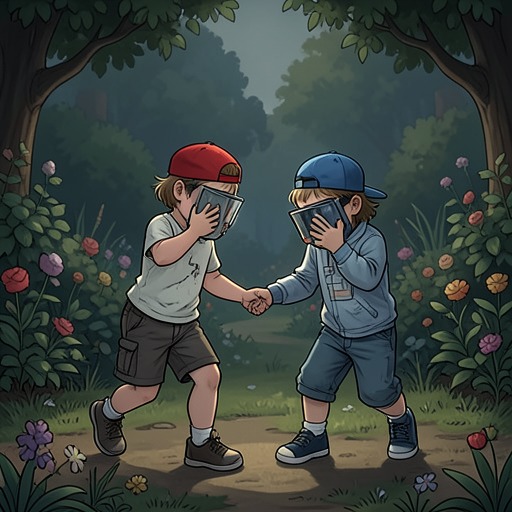
Hamnet’s plan comes from a trick the twins have practised since childhood. Their faces are so alike that they can mislead people by exchanging clothes and mannerisms. Hamnet can wear Judith’s shawl, sit with his head lowered, and be mistaken for her; Judith can put on his hat or jerkin and pass as her brother. Their parents have been fooled: their mother has mistaken Judith for Hamnet when asking for firewood, and their father has addressed Judith as though she were his son and asked her to conjugate a Latin verb. The game depends on shared appearance, concealment, and the instant in which an observer accepts one twin as the other.
Now Hamnet applies the same logic to Death. He looks towards the darkness beside the door and hopes that, if Death turns away even briefly, the twins can make their final exchange. He shifts Judith gently towards the chimney, then lies in the space she has occupied. He smooths his hair to the sides of his face, draws the sheet over them both, and tucks it beneath their chins. He believes that no one could tell them apart and that Death might carry him instead of her. The familiar manoeuvre has changed its stakes: the object is no longer to fool a parent for a moment, but to divert a fatal separation.
Judith understands at once. She tries to sit up and tells him no, but she is too weak to rise from the bed. Hamnet holds the sheet in place. He breathes towards her ear, imagining that he can breathe his strength, health, and whole life into her. He silently offers that life to her and insists within himself that, if only one of them can live, it must be Judith. His choice is deliberate: he wants her to remain, and he gives his attempted exchange the force of a decree, though he has no power to make it binding.
Consequences and Significance
The scene’s decisive reversal is that the twins’ resemblance, once a source of play, becomes the means by which Hamnet tries to substitute himself for Judith. Yet the scene does not present their exchange as a cure or as a successful bargain with death. Hamnet’s resolve can express love but cannot control the illness. Judith survives, while Hamnet later dies; the difference between the twins’ wished-for interchange and the outcome gives the episode its tragic weight.
The attempt also anticipates the family’s later confrontation with Hamnet’s death. At his burial, Judith is alive but still weak, and the household must reckon with the loss of one twin rather than the disappearance of both. The earlier offer therefore sharpens the meaning of that survival: Judith remains, but not because Hamnet’s proposed substitution has given him command over death. His wish instead stands as the most extreme expression of a bond that cannot prevent separation. The childhood trick works only on people who can be fooled; against death, likeness offers no guarantee, and love can make the sacrifice imaginable without making it effective.