Agnes Searches for Hamnet’s Ghost
HamnetAgnes Searches for Hamnet’s Ghost is an extended act of mourning in which a mother tries to locate the son she has lost, first through the body she must prepare for burial and then through the unseen presence she hopes to find. Agnes’s search draws its force from a reversal: the woman who can sense illness and hear what others cannot is unable to find Hamnet, while Judith discovers him in familiar sounds and movements. Grief leaves the family divided not only by death, but by different ways of perceiving what remains.
From the body to the search
Hamnet’s death first confronts Agnes as a physical fact that she cannot make intelligible. His body has been altered by illness: the marks and bruises have spread, his skin has turned yellow, and his bones show beneath it. Agnes recognizes his hair and fingers as the parts that still seem familiar. Even as she holds his hand and touches his hair, the rest of him appears to have become someone, or something, she cannot reconcile with the child she knew.
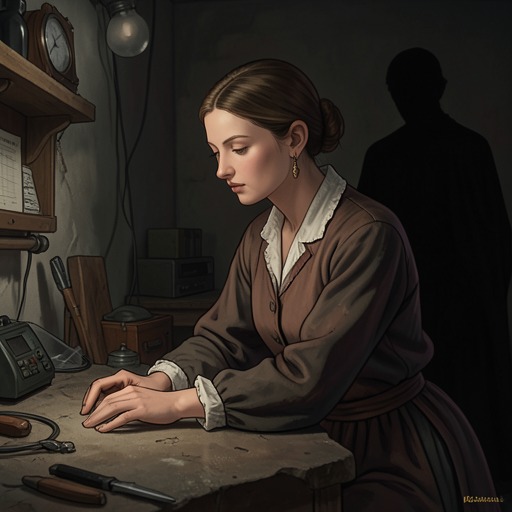
The women prepare the room and make practical arrangements around her. They have burned the bedding, aired and cleaned the room, moved Judith upstairs while she continues to recover, and laid out warm water, cloths, a white sheet, strong thread, and sharp needles. The town’s order requires plague victims to be buried on the day they die. Agnes initially does not respond to the women’s offers to help wash and shroud her son; the washbasins cool beside her, and the folded sheet remains at the door. The urgency of public regulation and the women’s patient readiness meet the private time of a mother who cannot yet begin.
When Agnes does begin, the work proceeds by touch and detail. She washes Hamnet’s body, encountering the scar from a fall at Hewlands, the mark of a dog bite, the writer’s callus on his right ring finger, and the dimples left by a childhood rash. Mary changes the water; Agnes washes and dries his feet again. The white sheet opens before her like an immense flower, and she brings it to her face, taking in its smell of juniper, cedar, and soap before Mary helps position it beneath him. Agnes threads thick yarn and starts sewing at his feet. The shroud becomes, in her perception, a sail being stitched for a vessel that will carry her son into another world: an image of care that makes the separation tangible without making it acceptable.
Burial and the resistance to leaving
The burial gathers the family around Hamnet’s body, but it does not resolve Agnes’s attachment to him. His father carries him through Henley Street, first alone and then with Edmond, who takes the foot of the board. Agnes follows with Susanna and Judith; Bartholomew carries Judith, who hides her face against his neck and wets his shirt with tears. Mary, John, Eliza, Joan, Agnes’s brothers, and the baker and his wife follow the procession. Hamnet is carried in the white shroud Agnes has sewn, with flowers and sprigs around him.
At the grave, Agnes imagines that Hamnet would have chosen a place near the river because he loved water. The thought makes the burial both particular and unbearable: the boy she once worried about near wells, drains, and dirty pools will now lie near the river, sealed in the earth. She cannot watch his father lower him. In the confusion of the moment she misses the instant when the shroud and Hamnet disappear into the dark, clay-rich ground, and understands that she will never see him again.
Leaving the cemetery is harder for Agnes than entering it. She imagines the dead reaching for her skirts and hands, begging her not to leave them behind; she must gather her skirt’s hem and hide her hands. The arithmetic of the loss is as stark as the grave: she entered with three children and leaves with two. At the gate, her husband takes her arm. His tear-bright, flushed face seems strange and aged to her, and she sees in it Hamnet’s cheekbones and forehead without being able to recognize the rest. Agnes feels insubstantial, as if she might break apart, and cannot bring herself to cross the gate and leave her son there.
A search that perception cannot complete
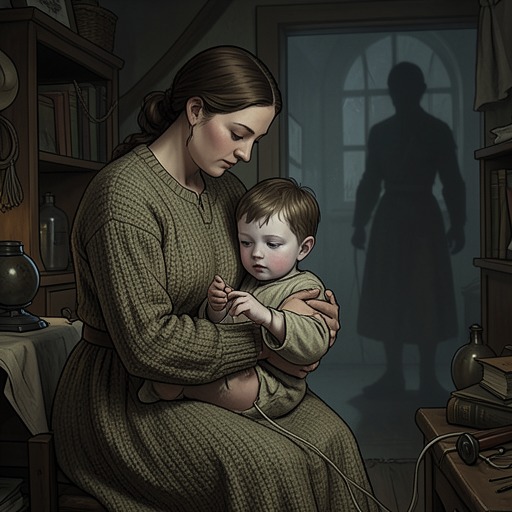
Agnes’s search continues long after the burial. Night after night, for weeks and months, she stays awake under a blanket with a lit lamp, waiting where Hamnet’s bed used to be. She sits in her father’s chair, in the exact place where Hamnet died. She also goes into the frost-covered yard and stands at the leafless plum tree, calling aloud to ask whether he is there. The repeated visits make the search a practice rather than a single desperate attempt: Agnes returns to the places where his life and death have left their strongest mark, listening for an answer that does not come.
That silence wounds her in a distinctive way because it contradicts the powers on which her sense of herself has depended. Agnes can hear the dead, the unspoken, and the unknown. By touching a person, she can perceive illness moving through the veins and sense the dark pressure of a tumour in a lung or liver; she reads people’s eyes and hearts as others read a book. Yet these abilities do not let her locate her own son. She listens through the wishes and discontent of other, noisier presences, but cannot hear the one voice she most wants. Her exceptional perception offers no privileged passage through this loss.
Judith’s different way of finding him
Judith experiences Hamnet’s continued presence differently. She hears him in the scrape of a broom against the floor and sees him in the slanting flight of a bird settling on a wall. She finds him in the movement of a pony’s mane, hail drumming on a window, wind reaching down the chimney, and the rustle of the willow withies forming the roof of her shelter. These are ordinary sounds and motions, not a dramatic apparition; their familiarity is what allows them to carry Hamnet for Judith.
Judith tells no one. She keeps the perception to herself, closes her eyes, and privately acknowledges that she sees and hears him while wondering where he is. The contrast with Agnes does not mean that Judith’s experience answers the mother’s search. Agnes calls directly and waits in named places; Judith recognizes her twin through passing details but does not disclose what she finds. Their different forms of attention preserve the bond in different ways, while leaving Agnes alone with the silence she cannot overcome.
The later night and the unanswered presence
The search reaches into a later night when Agnes wakes after midnight to quick, light footsteps whose cheerful rhythm she recognizes. A sensation of feet approaching the window gives her a clear impression that someone is outside. She is already in the street, a shawl around her shoulders, standing alone and waiting. She speaks aloud, turns her head from side to side, and asks who is there. The scene gives her waiting a new immediacy: rather than remaining beside the former bed or the plum tree, she steps out to meet the presence she believes may be approaching.
At the same moment, her husband sits beneath the same sky in a small boat moving against the current around a bend in the river. He senses the tide changing, the water seeming uncertain and pulled in opposing directions. The parallel places the separated parents beneath one sky, each caught in a different current of grief; it does not establish that Agnes has found Hamnet. Her call remains unanswered in the evidence of the scene. The search’s ending is therefore not reunion but continued exposure to possibility: Agnes is willing to wait, listen, and answer, even when her most trusted gift has failed to bring her son within reach.