Hamnet’s Father Leaves Stratford After His Death
HamnetHamnet’s Father Leaves Stratford After His Death marks the family’s first separation after Hamnet’s burial. William Shakespeare returns to London, citing his responsibilities to Shakespeare’s theatre company, while Agnes remains in Stratford with Judith and Susanna. Their argument makes the departure more than a practical journey: for Agnes, it is a painful declaration that the life William pursues elsewhere can draw him away even when their child has just died.
Background and Immediate Aftermath
Two days after the burial, William goes out to speak with a man who rents fields from him and to remind him of an outstanding debt. Outside, the streets are full of children: walking together, calling to one another, held by their parents, laughing, crying, sleeping on a shoulder, or having their cloaks fastened. The sight becomes unbearable to William. The children’s exposed fragility—skin, skulls, ribs, large clear eyes—turns ordinary family care into a source of alarm. His distress gives the departure its setting: the world around him continues its everyday life, but he can no longer encounter its children without seeing how vulnerable they are.
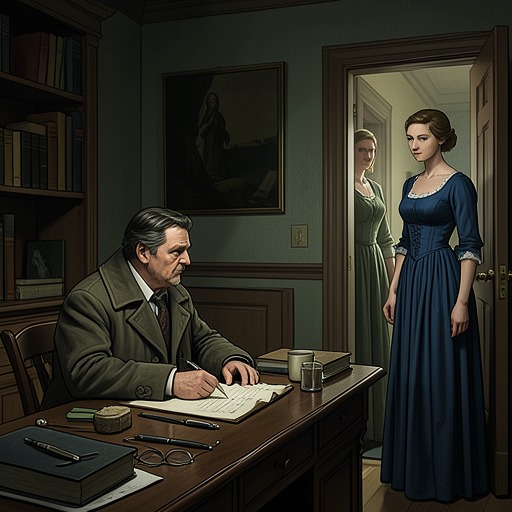
William tells Agnes that he cannot leave the company alone for long. The return to London and the coming season require preparation, he says, and rival companies would welcome the failure of his own. He insists that the work cannot be entrusted to someone else. Agnes listens while feeding the pigs, tipping the contents of a bucket into their trough. The physical task continues while his account passes over her; she is so absorbed in what he is saying that his remark about sending word startles her. When she realizes he means to go to London, she initially treats the prospect as absurd and tells him he cannot leave.
The Argument at the Pigsty
Agnes’s resistance is grounded in the death William’s professional timetable seems to disregard. He insists that the world has not stopped and that his company is waiting; she answers by naming Hamnet’s death. Speaking the name makes William lower his head and look at his boots. Agnes understands the situation in stark domestic terms: their child is dead, and the body is still newly buried. She expects the family to remain together behind closed doors, with William, Agnes, Judith, and Susanna united in the house. To her, his departure at this moment is incompatible with their shared loss.
The packed travel bag beside William’s boots makes the conflict tangible. Agnes points to it without speaking; he stumbles through an explanation of a group of merchants leaving for London that day and an extra horse available for the journey. He recalls that Agnes dislikes his travelling alone, presenting the arrangement as a sensible opportunity. Yet the details do not lessen the shock: he is ready to leave now, not at some indefinite later date. When he takes the pig-feed bucket from Agnes and holds both her hands, he shifts from explaining the journey to asserting that many people in London depend on him and that he cannot abandon them.
Agnes hears the imbalance in that claim. She asks whether he can leave them, and when he speaks again of his company, season, and preparations, she rejects those as the real explanation. Her anger sharpens into an accusation about the inward place she believes he inhabits: a whole country and landscape in his mind, once glimpsed by her, now more real to him than any other place. In her account, that inner destination has caught him like a fish on a hook, beyond the reach even of his son’s death. William restrains her wrists until he has lifted the bag onto his shoulder; the marks left on her skin give the disagreement a physical consequence as well as an emotional one.
Departure and Separation
Agnes asks whether he will leave without saying goodbye to the woman who bore his children, cared for Hamnet until his last breath, and prepared him for burial. William cannot offer the farewell she seeks. Instead, he tells her to care for the girls, promises to send word when he arrives, and says that he hopes to see them again before Christmas. His attention to the children acknowledges his family even as his words confirm that he is going away. The promise of a message and a possible return offers a future point of contact, but not the immediate presence Agnes wants.
The couple embrace. Agnes holds him tightly, as she had on the night she remembers, while the travel bag remains at their feet. For a moment, bodily closeness stands where words have failed: William seems about to speak, but Agnes does not need an explanation. The embrace does not reverse the decision. She recognizes that the son is gone, her husband is leaving, and she is the one who remains; time moves only forward. She then breaks away and tells him to go if he must, asking him to return when he can.
Consequences and Significance
After William leaves, Agnes discovers the duration and variety of grief through the days and nights that follow. She cries in sudden tears, deep sobs, and a quiet, seemingly endless flow; she treats the irritated skin around her eyes with eyebright and chamomile tincture. She comforts Judith and Susanna with assurances of heaven and reunion after death, although she does not believe what she tells them. Their need for consolation persists alongside her own disbelief, making her responsible for sustaining the girls while she is herself bereaved.
The community’s response is practical as well as verbal. People arrive without warning, leave bread and cakes on the windowsill, offer a timely kindness after church, and show affection to Judith. Such gestures cannot undo either loss: Hamnet has died, and William has gone. The departure therefore establishes a new division within the family’s grief. Agnes remains with the girls and the daily work, including feeding the pigs; William returns to the demands of the company and London. The scene does not present his professional explanation as the whole truth. Through Agnes’s perception of the landscape in his mind, it sets the obligations he names against the private imaginative world she believes draws him away, leaving their separation unresolved even as she lets him go.