Agnes Washes Hamnet’s Body and Sews His Shroud Herself
HamnetAgnes Washes Hamnet’s Body and Sews His Shroud Herself is the sequence in which Agnes claims the preparation of her dead son as a task no one else may perform. With plague regulations requiring the dead to be buried quickly, she delays the women’s offer of help until night, then washes Hamnet, gathers small remnants of his life, and stitches the white cloth around him. The work is both intimate care and an ordeal: it gives Agnes something precise to do, but each touch confirms the difference between the living child she knows and the body she must prepare for burial.
The Refusal and the Delay
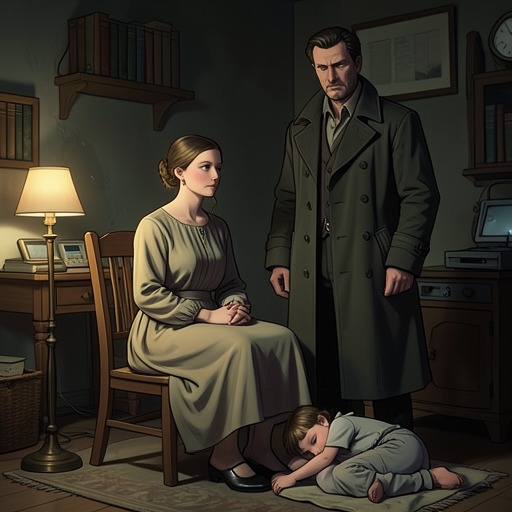
The household has already taken precautions against the plague. The women have burned the bedding and straw, aired and cleaned the room, and moved Hamnet’s still-weak twin, Judith, upstairs. A basin of warm water, cloths, a white sheet, strong thread, and needles are ready. They tell Agnes gently that they can help wash and shroud him, while reminding her that the town requires plague victims to be buried on the day they die. She does not respond; the basins cool beside her, and the folded sheet remains untouched.
Bartholomew speaks quietly, suggesting that Hamnet’s father may not yet have received the news and would understand that the burial preparations cannot wait. Agnes answers that they will wait until the following day and asks Bartholomew to tell the authorities. She will shroud Hamnet herself, and no one else. Her decision makes room for one last private act, even as it presses against the urgency of the burial order. She waits until night, after the others have gone and nearly everyone is in bed.
The delay does not mean the practical demands have disappeared. The town’s decree still governs what must happen, and Hamnet’s body is changing as the day passes. Agnes knows the burial cannot be postponed indefinitely. Waiting instead creates a narrow interval in which she can choose how to approach the task, without an audience and without surrendering it to someone else.
Washing and Recognizing Hamnet
Agnes begins with water and a few drops of oil, which remain in golden circles on the surface rather than mixing. She wets a cloth and starts at Hamnet’s forehead. His hair had resisted her efforts to flatten it when he was alive; even now, it will not lie as she tries to wet it. She combs it with her fingers, finding fluff, a teasel, and a plum leaf caught in it. She sets these remnants aside in a small dish, then takes a knife she uses to prepare fruit and cuts a lock from the back of his head. The hair is sun-lightened at the ends and nearly brown at the roots. She places it beside the other things she has gathered.
The body before her is not unchanged. The illness has left Hamnet’s skin yellowed and his bones prominent; the bruises spread after death before ceasing to widen. His lips are dry and sealed, his cheeks hollow, and his eyelids have turned a delicate gray-violet. Agnes had closed his eyes herself, even though touching those familiar lids was almost impossibly difficult. The account dwells on the ordinary, terrible particulars of death: she had to find two pennies and place one on each eye to keep the lids shut. The task of washing cannot undo what has happened, and her attention to each part of him makes that limit palpable.
She washes his face, the closed eyes, cheeks, lips, and the cut in his eyebrow, then his ears and neck. She cuts away his shirt with the same knife. Mary arrives while Agnes is washing Hamnet’s bruised and swollen underarms; her face is wet and her eyes swollen. Agnes lets her stay. Mary had been present when Hamnet was born, and now she sits nearby as Agnes continues, wetting and wringing out the cloth in a repeated motion.
As Agnes washes his arm and hand, the body carries the history of his living days: the scar from a fall over a fence at Hewlands, the raised mark left by a dog bite at a harvest feast, and the callus on his right ring finger from holding a pen. The dimples on his stomach remain from a childhood rash. Agnes washes his legs, ankles, and feet; Mary changes the water, and Agnes dries the feet once more. The care is attentive to the body not as an abstraction but as Hamnet’s particular body, marked by accidents, habits, and childhood.
Herbs, Cloth, and Stitching
Mary helps lift Hamnet so the sheet can be placed beneath him. When the time comes to wrap him, Agnes cannot continue and Mary takes the cloth from her, tucking it over Hamnet’s legs and chest. Agnes then chooses dried plants to place inside the folds: rue, comfrey, chamomile, lavender, thyme, and rosemary. Her choices are specific. She leaves out wild pansies because Hamnet disliked their smell; she rejects angelica and valerian because they did not lower his fever or save him. Milk thistle is excluded because its sharp leaves might scratch his skin. The plants are tucked close to him, where, in the scene’s tender imagining, they can offer comfort.
Agnes threads thick cotton and begins at the feet, stitching the sheet into a shroud. The work is likened to a sailor sewing a sail for the vessel that will carry her son into the next world. The image joins the repetitive labor of her hands to the irreversibility of what lies ahead: the needle can secure the cloth, but it cannot preserve Hamnet’s life. As the stitches reach his shins, Agnes sees Judith at the foot of the stairs. At first the sight nearly makes her believe that Hamnet has returned; then she recognizes the living twin, shaken and trembling.
Mary urges Judith back to bed, but Agnes asks her to stay. Judith clings to her mother and speaks through tears about kittens, dizziness, changing places, and her belief that Hamnet’s death was her fault. Agnes tells her that it was not her fault: Hamnet developed a fever, and nothing they could do helped. She offers Judith the choice of seeing him. Judith approaches the uncovered face, first incredulous, then timid and compassionate, before grief overtakes her. The sight of her daughter grieving is the point at which Agnes can no longer contain her own tears. Her work on the shroud continues in the presence of the family’s shared loss, rather than in the solitude she had initially chosen.
Completion and the Approach of Burial
By the uncertain, milky light of dawn, Agnes finishes the final stitches and secures the shroud beneath Hamnet’s shoulder and at his knees. Mary empties the basins, wrings out the cloths, and sweeps fallen leaves and flowers from the floor. Judith rests her cheek against the fabric covering her brother’s shoulder; Susanna has come in from the next room and sits beside her with her head bowed. The body is clean, dressed in the white cloth, and ready for burial. The preparation is shared in its final hours, though Agnes has performed the washing and the sewing herself.
Completion does not make the burial imaginable to her. Agnes can picture carrying Hamnet toward the church on a board, with Bartholomew and perhaps Gilbert and John helping. She can picture the priest blessing the body. But she cannot picture the descent into the grave or accept the finality of leaving her son in the ground. At the cemetery, William Shakespeare carries Hamnet’s body, wrapped in the white shroud and surrounded by flowers and sprigs. Agnes walks behind with Susanna and Judith, and later struggles to leave the churchyard, feeling that she has entered with three children and is leaving with two. Her meticulous preparation has made Hamnet ready for burial; it has not made separation bearable.