Alexandria
HamnetAlexandria is the Mediterranean port where a cabin boy’s brief shore leave becomes a hinge in the spread of plague: sent ashore for food, he encounters a monkey and unknowingly carries its fleas onward. The scene connects the movement of ships and goods to Judith’s illness, setting a tragedy in motion far from the harbor.
Port and Maritime Traffic
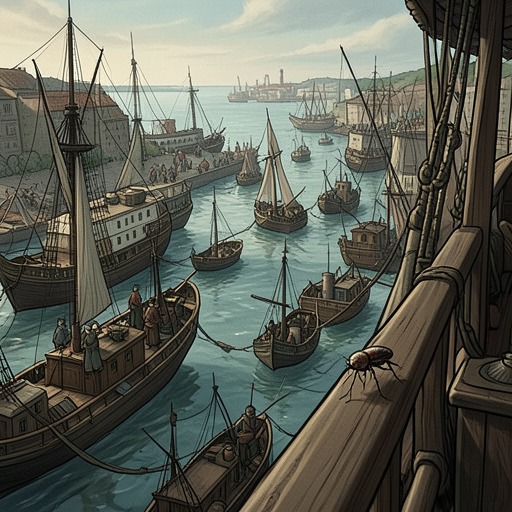
The cabin boy is ordered ashore in Alexandria to find provisions for shipmates who are hungry and exhausted after weeks at sea. He carries a bag given to him by the midshipman and walks awkwardly because the order has come with a hard kick to his backside. Around him, the crew unloads crates of Malay cloves and Indian indigo, preparing to take on sacks of coffee beans and bales of cloth. The port is presented through this exchange of cargo and labor, as a working stop on a long voyage rather than a still or isolated setting.
The Cabin Boy and the Monkey
After landing, the boy is struck by the firmness of the quay beneath his feet. He passes a stall selling spiced nuts and a woman with a snake coiled around her neck, then stops to watch a monkey on a gold chain. The animal wears a little red jacket and a matching hat. Its curved, soft back and oddly human, expressionless face hold his attention; its high, vibrating chatter reminds him of an instrument played by his uncle.
The encounter briefly draws the boy toward memories of home: his sister’s blessing in church after childbirth, his cousin’s wedding, and the safety of his family’s kitchen. He imagines the familiar language and music, in contrast to the shouting, kicks, and orders that define his life aboard ship. When the owner pulls the monkey away, the boy tries to hold on to it, touching its warm fur. The animal is dragged down onto the paving stones and away; the boy watches it go, distressed by the loss and wishing he could persuade its owner to give it to him.
Fleas and the Plague’s Passage
The boy does not know that the encounter leaves three fleas from the monkey on him. One reaches the ground and is crushed under his foot without his noticing. Another travels through his fair hair to the crown of his head, then jumps from his forehead to the innkeeper’s shoulder while the boy pays for a jug of local beer. The third remains hidden in a fold of the red handkerchief around his neck, a gift from his beloved at home.
The narration makes the consequence of the landing explicit: the cabin boy has to go ashore in Alexandria for Judith to contract plague and for tragedy to begin elsewhere. The flea’s journey is rendered through small, ordinary transfers—a touch, a leap, a concealed fold—rather than through any knowledge or intention on the boy’s part. Alexandria thus becomes the point where the maritime movement of people and goods intersects with an unseen chain of infection, linking a harbor encounter to the threatened lives of Judith and Hamnet.