Henley Street House
HamnetHenley Street House is the setting where Hamnet’s death becomes an immediate, physical fact for his family, and where Judith later returns to seek the twin she has lost. The house’s narrow rooms preserve the story’s movement from care of the dead body to public burial, then to a private vigil in the room where Hamnet died. It is at once a family dwelling and a place marked by grief that cannot be left behind.
The death room and the body
The house’s most consequential space is the room where Hamnet dies in fever and convulsions. After his death, the child’s body is laid on a door removed from its hinges and set beside the fire between two barrels. The makeshift bier brings the house’s ordinary materials into the work of mourning: a door that once belonged to the building becomes the surface on which the family prepares to confront the dead child.
Hamnet’s body is carried carefully from the pallet where he died. His bare feet still bear the dirt of his recent life: dust from the street, earth from the garden, and mud from the riverbank where he had bathed with his friends less than a week earlier. He remains in his nightshirt, his head turned slightly toward his mother. His skin is already losing the appearance of life, becoming pale, parchment-like, rigid, and sunken. These details place the physical traces of childhood beside the bodily changes of death; the house holds both at once.
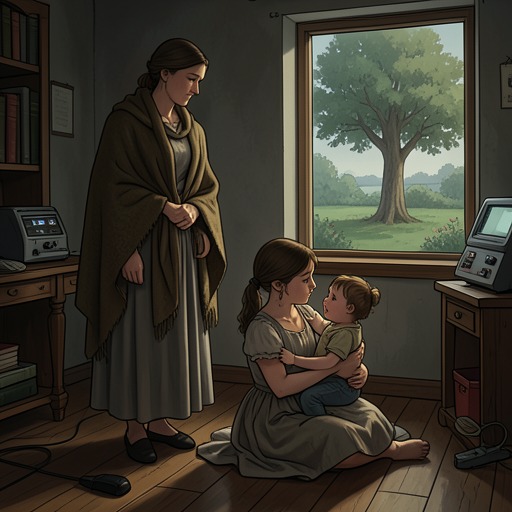
Agnes sits beside the body, bent forward and motionless, her loose hair falling to her shoulders. Her posture makes the room seem suspended around her: she appears scarcely to breathe, while the people elsewhere in the gathering murmur and look repeatedly toward the hearth. The stillness does not make the death less present. Instead, the house’s everyday furnishings and movements sharpen the contrast between communal activity and the mother’s vigil beside her child.
The family’s acts of mourning
Hamnet’s uncles, Richard and Edmond, remove the door and transfer the body with deliberate care, lifting him slowly and holding their breath as they move him. Their grief takes different forms. Edmond weeps; the tears blur his sight, but also relieve him from having to look directly at his brother’s still-faced child. He had known Hamnet throughout the boy’s short life and taught him small skills, from catching a wooden ball to making a whistle from a reed. Richard does not cry. His sorrow turns to anger at the task, at fate, and at the illness and death of a child; he directs that anger toward Edmond’s handling of the body, criticizing how much weight he bears and where he holds Hamnet’s legs. The room therefore registers not one uniform response to loss, but grief expressed as tears, practical care, and anger.
The mourning extends from the house into the streets when Hamnet is carried to burial. His father lifts the board and bears his son, wrapped in a white shroud with flowers and sprigs around him. Agnes follows, holding Susanna’s hand in one of hers and Judith’s in the other. Judith is carried by Bartholomew, hiding her face against her uncle’s neck and soaking his shirt with tears. The family and others follow behind. As the procession moves along Henley Street, neighbors and passersby make way, remove their hats, cross themselves, offer condolences, and pray. The house is thus not an isolated setting for private grief: the body’s departure draws the household’s loss into the shared public space of the town.
Judith’s return
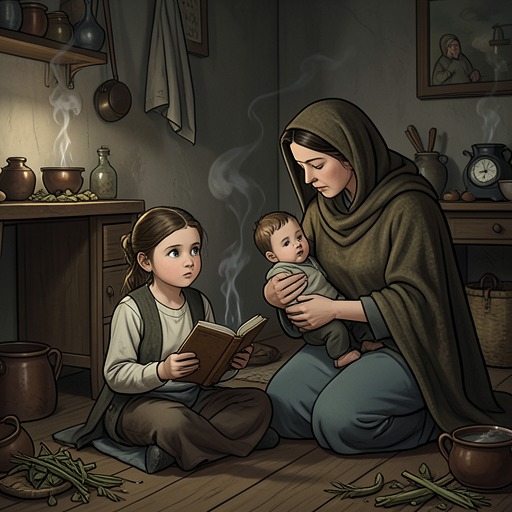
Later, Judith makes the house the center of a secret routine. She slips out every night and waits, without telling Susanna or Agnes. The midwife had told her alone that Hamnet appeared only at night, making the vigil a private bond between the surviving twin and the dead one. Some mornings Agnes watches Judith’s tired, shadowed face, and Judith wonders whether her mother knows, but she does not disclose what she is doing. Her secrecy preserves the hope of an encounter while protecting it from being questioned before it can happen.
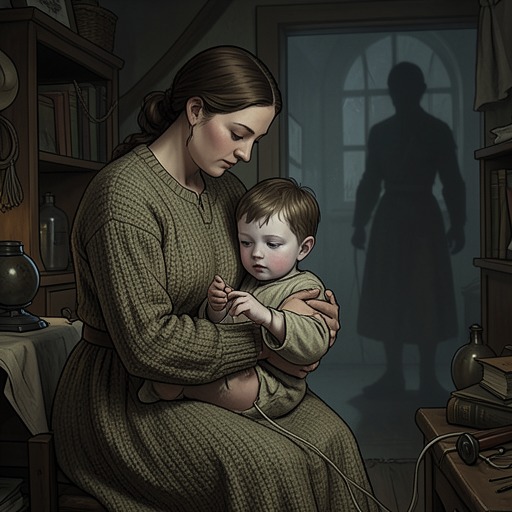
Judith returns specifically to the room where Hamnet died, the narrow house’s crowded space now filled with hatter’s heads: silent, faceless wooden forms all turned toward the door. She fixes her gaze on that doorway for a long time, waiting for Hamnet to appear. The objects do not answer her, but their repeated, watching faces give the room the quality of an audience gathered around an absence. The doorway becomes the point at which her hope is concentrated, even as nothing guarantees that anyone will come through it.
The vigil is shaped by the twins’ changed relation to time. Judith is growing older, nearly a woman, while Hamnet, if he could return, would remain a child. She cannot imagine how he would see her or whether he would recognize her passing in the street. In the house, then, the distance between the twins is not only the distance between the living and the dead: it is also the difference between a life that continues to change and one fixed at the age of death.
The house as a place of memory
Henley Street House links two distinct forms of mourning. At Hamnet’s death, the room contains his body and the family’s close, practical care; later, it contains Judith’s solitary expectation of his return. The door first serves as an improvised bier, then the room’s door becomes the object of her unwavering attention. That recurrence makes the house more than a backdrop: its ordinary thresholds and rooms carry the family’s movement between presence and absence.
The contrast between the procession and Judith’s night visits gives the location its particular force. Burial is witnessed by relatives, neighbors, and passersby, while the vigil is known only to Judith and perhaps suspected by Agnes. The house holds both the visible rituals of loss and a private, continuing attachment that has no public ceremony. For Judith, returning there is an attempt to preserve her bond with Hamnet; for the story, the room marks the limit of that attempt, holding the hope of recognition beside the knowledge that the surviving twin has grown beyond the child her brother will always remain.