Hewlands
HamnetHewlands is the farm, family home, and surrounding land at the centre of Agnes’s early life. It is at once a working estate of sheep, fields, and beehives; a place where her brother Bartholomew can exercise authority over family property; and a landscape Agnes knows through repeated acts of cultivation. Its fields bring her courtship into view of her stepmother Joan, while its woodland edge later offers Agnes a secluded place to give birth. The location’s importance lies in this double character: it sustains the family and its rules, but also gives Agnes room to work, choose, and seek shelter beyond the house.
Setting and cultivated land
Hewlands is described as a remote house surrounded by sheep, nearly two kilometres from the town. The Latin tutor travels there twice a week, following the river, to teach the younger boys of the household. The farm’s distance is practical as well as atmospheric: it makes the tutor’s visits a journey, and places Agnes’s life among fields and animals rather than within the town’s daily bustle.
Agnes has a plot at Hewlands that she leases to her brother. It runs from the house where she was born to the forest, joining domestic ground to uncultivated woodland. She tends bees in hives woven from hemp, and the bees’ continuous activity is set among rows of herbs, flowers, and plants, including climbing stems supported by stakes. Joan, Agnes’s stepmother, dismisses this carefully tended space as a witch’s garden. The label reveals the friction between Joan’s judgment and Agnes’s intimate knowledge of the plants she grows.
The garden is also a site of routine, practical labour. Nearly every week Agnes can be found pulling weeds, checking the hives, pruning stems, and quietly collecting particular flowers, leaves, pods, petals, and seeds in the leather pouch at her hip. Her knowledge is expressed through repeated attention to living things, and through the discretion with which she gathers what she needs. When her brother sends the pastor’s son to report that the bees have left their hive and clustered in the trees, the problem brings Agnes back into the working landscape she knows so well.
Household, property, and family authority
Hewlands is not only a landscape but a household governed through kinship and property. Bartholomew’s claim to its principal house rests on inheritance: their father left it to him. That ownership becomes consequential when Joan expels Agnes. Bartholomew intervenes, asserting his right to decide that his sister may stay. The confrontation makes the house a material source of protection: his authority over the property can counter Joan’s attempt to remove Agnes from it.
The farm’s sheep and fields also frame the negotiations that follow. Joan objects to Agnes marrying the Latin tutor, pointing to the debt owed by his family and insisting that Agnes should instead marry a prosperous farmer. She invokes Agnes’s dowry, left by her father, as part of the future she believes should be arranged for her. In Joan’s account, the tutor’s family liabilities make him an unsuitable match; in Agnes’s, that argument does not determine whom she wants to marry.
The dispute is staged in the open country among the sheep. From behind a wall, the children watch Bartholomew, Joan, and the tutor’s father talk at length. The gestures are more legible than the terms: Joan speaks heatedly and clutches her apron; Bartholomew looks toward the sheep and touches one’s back while making his case; the father pleads, counts on his fingers, and eventually smiles. Their exchange ends with handshakes between the father and Joan, then the father and Bartholomew. The children’s relief registers the immediate consequence, though the scene does not disclose every term of the agreement.
Courtship and the contested marriage
The fields at Hewlands bring Agnes’s relationship with the tutor into the sight of Joan. After a lesson, the pair walk together toward the far field as evening falls. They encounter Joan among the sheep, watching Bartholomew’s work—or making sure he knows he is being watched. Joan has already seen the couple approach hand in hand. Her response turns a private attachment into a family dispute in the very landscape where the household’s work is conducted.
Joan rejects the match not merely as a matter of preference but through the linked claims of age, family reputation, debt, and property. She reminds the tutor that his father’s dealings have brought dishonour and argues that his work teaching the younger boys could not repay what his family owes. She also says Agnes should marry a farmer with means. Agnes openly refuses that proposed future and declares her own wish to marry the tutor. Hewlands thus becomes the setting where different forms of authority meet: Joan’s power as stepmother, Bartholomew’s authority as property holder, and Agnes’s insistence on her own choice.
At the later wedding, Bartholomew’s protective role remains visible. He holds Agnes’s hand firmly and stops her when the groom approaches, then warns the tutor to take good care of her. The scene belongs to the marriage rather than to Hewlands itself, but it carries forward the family’s conflict and the brother’s insistence that Agnes be protected. The farm’s earlier negotiations have made that protection part of the story of how she reaches the marriage.
Woodland refuge and recurring garden
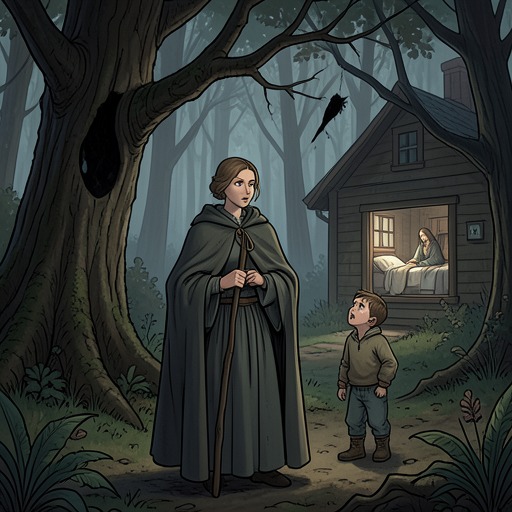
The woodland at the edge of Hewlands becomes a place of refuge when Agnes goes into labour. In mid-May she deliberately circles the farm’s enclosure to avoid Joan, Bartholomew, and the other family members, who might raise the alarm, summon help, or force her back into the house. She passes familiar features—the thatched roof, pigsty, and the back of the apple storehouse—before entering the forest about a kilometre from Hewlands. As her pains become closer together, she braces a hand against the rough bark of a large elm. The familiar farm marks the boundary she is trying not to cross back over; the forest gives her the privacy in which to face the birth.
Hewlands returns in Agnes’s dream after the death of her son. She sees its fields at night, newly turned into bare furrows, while her mother plants tiny white milk teeth in the earth. The familiar land is transformed into a dream image of loss and continuance: the soil receives what is precious, one small remnant after another. The dream does not make the grief less severe; it gives that grief a landscape already bound to Agnes’s family and childhood.
Later, at the house William Shakespeare buys for the family, Agnes establishes another garden. It is not Hewlands, but its planted rows, herbs, and beehives recall the practices she developed there. She sets out fruit trees, shrubs, medicinal plants, and seven hives; the former brewing room becomes a place where she dries and mixes plants, and people come to her for remedies. The contrast matters: at Hewlands her cultivated plot stretches from her birthplace toward the forest, while in the new house she shapes a garden within a walled domestic property. In both places, tending plants gives Agnes a domain defined by her own sustained work.