St Helen Parish, Bishopsgate
HamnetSt Helen Parish, Bishopsgate is the address Agnes and Bartholomew pursue on their journey to London to find William Shakespeare. The parish itself is not shown from within: it serves as a destination in an unfamiliar city, and the search for William’s lodging leads Agnes to a more intimate discovery in the sparse room where he lives and writes.
The Address in London
The address to St Helen Parish, Bishopsgate is written on a piece of paper carried by Agnes and Bartholomew. At Tyburn, Bartholomew dismounts to ask how to reach it; passers-by ignore him, while a barefoot young man laughs and slips into a doorway. The episode establishes the address as something they must negotiate through the city rather than approach by a clear or welcoming route.
By the time they believe they have reached the right neighborhood, Bartholomew asks a pie seller for directions to William’s lodging. She dismisses the question with a gesture and gives a sequence of vague turns: onward, then straight, then to one side just past the church. The directions do not identify a precise entrance to the parish or describe the church itself. Instead, St Helen Parish, Bishopsgate anchors a difficult search for a private address in its vicinity.
The Approach Through the City
The search follows a long, tiring approach to London. Agnes and Bartholomew travel by way of Oxford, crossing the Chiltern Hills in storm and hail; after a horse goes lame at Kidlington, Bartholomew changes it for a restless piebald mare. They spend the night in an Oxford inn, and on the third day Agnes first sees smoke over the city, then hears bells and sees the river winding through its crowded spread of houses.
Their route into the city passes Shepherd’s Bush, the gravel pits of Kensington, and the river at Maryburne. From Tyburn they ride toward Holborn through narrow, dark streets thick with shops, yards, taverns, and people. Sellers offer potatoes, pies, crab apples, and chestnuts; children push barrows, and old people sit among food for sale. Noise, refuse, and the smells of cabbage, burnt leather, bread dough, and filth overwhelm Agnes. These crowded streets make the search for a single lodging feel uncertain and expose the distance between the address on paper and the room she hopes to reach.
From Parish Search to Private Room
As they near the destination, Agnes’s resolve falters. She is exhausted, hungry, thirsty, and in pain, and now that she is close to seeing William she considers turning back to Stratford. She wonders how she can simply arrive at his door with her brother. Bartholomew, however, has already dismounted, tied his horse to a post, and gone to the entrance before she can stop him.
Agnes climbs the stairs and knocks at a paneled door, calling William’s name twice. No one answers. For a moment she fears what the room might disclose about his life in London, including traces of other women; then she turns back, opens the door, and enters. The scene moves from the public difficulty of locating St Helen Parish, Bishopsgate to the stillness of William’s lodging, without showing the parish church itself.
The Lodging and Its Revelation
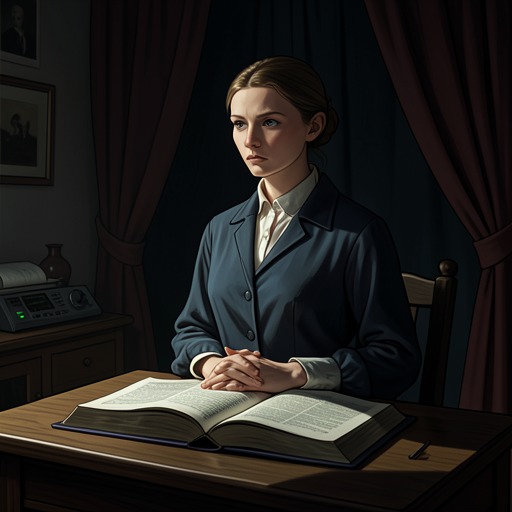
The room is low-ceilinged, with a ceiling that slopes at every corner. Its furnishings are spare: a low bed, a small rug, a cupboard, and a chest. Agnes recognizes William’s hat on the chest and his doublet on the bed. By the window stand a square table and a chair tucked beneath it; an open writing case holds a small case, an inkwell, and a knife. Beside them lie quills and three or four manuscripts in his handwriting, with one separate sheet of paper in front of the chair.
The room’s austerity surprises Agnes. It seems to her like a monk’s cell or a scholar’s study, and she senses that it is a private space where no one else has been admitted. That impression contrasts sharply with William’s large house and extensive land in Stratford. At the desk, she looks down at the single sheet: its opening salutation is followed by her name. The sought-for London address thus brings her not to a public encounter at the parish, but to the evidence of William’s solitary working life and a message directed to her.