Warwickshire
HamnetWarwickshire is the English county where the plague reaches the family’s world in the summer of 1596, turning a remote chain of accidents into a local catastrophe. Its narrative geography also joins household life, rural work, illness, and the family’s choice to build its future near Stratford rather than in London.
County and Rural Setting
The novel identifies Warwickshire as the place the plague reaches in England in the summer of 1596. The county is more than a point on the route of disease: the narrative’s associated scenes place the family within a rural world of houses, gardens, bees, and medicinal plants. The precise village or property is not specified in every scene, but the setting’s domestic scale is clear in the attention given to rooms, gardens, and the work of caring for a household.
One such scene follows Agnes among the beehives after her brother sends word that the bees have deserted a hive and gathered in the trees. She examines the remaining bees and the comb, then passes smoking rosemary over it. She wears no beekeeper’s veil and murmurs to the insects as they land on her clothing and face. The scene makes the rural setting a place of skilled, intimate attention to living things, while the agitated swarm hints at how readily a household’s ordinary order can be disturbed.
The Plague Reaches Warwickshire
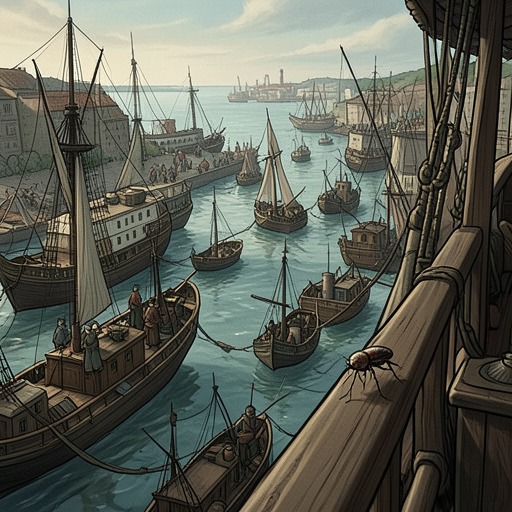
The account of the plague’s arrival makes the county the endpoint of a long chain of contingencies. For the disease to reach Warwickshire, two people must first experience separate events and later encounter one another: a glassmaker on Murano, in the Venetian principality, and a cabin boy aboard a merchant ship arriving from Alexandria on an unusually warm morning with an east wind.
Months before Judith falls ill, in late 1595, the glassmaker is distracted by a fight among the furnace workers. His hand slips, and two fingers touch the white-hot flame used to soften glass. The injury is severe enough that he does not initially understand what has happened; others rush to him, and the smell of burned flesh is followed by his cry of pain. By placing Warwickshire at the far end of this sequence, the narrative links a local epidemic to distant labor, travel, and chance without making the eventual illness seem less immediate to those who suffer it.
When Judith becomes sick, Agnes recognizes the signs in her daughter’s body. Judith’s pulse is erratic, and Agnes finds a swollen lump on her neck, about the size of a newly laid hen’s egg, followed by more swellings in her armpits. The feared symptoms, familiar enough to be recognized across town and countryside, are no longer an imagined danger: they are present on Judith’s skin. Warwickshire thus becomes the setting where the broad movement of infection is encountered as a mother examining her child.
Land and Household Life
The family’s connection to the region also takes material form in a decision about land. During the plague epidemic, when the playhouses close, the father visits his family. He has abandoned glove-selling and the promotion of his father’s goods, and now works only in the playhouses. Watching his wife carry their sick two-year-old through the kitchen, he sees the child’s silent tears and decides to spend the money he has saved not on a London house but on land outside Stratford, which he expects to provide a good income. The decision redirects the family’s future toward Warwickshire and away from a move the child’s fragile health could not withstand.
The household’s rural life is also expressed through its medicinal garden. After Hamnet’s death, Agnes stops tending the herbs: they dry out, and dust gathers on the jars. Susanna cleans the jars, takes down the useless dried plants, and burns them; she also makes a mixture of calendula petals, vinegar, and honey, stirring it each day. She directs Judith to water the medicinal plants behind the henhouse. In these precise domestic tasks, the garden remains part of the family’s life even as Agnes withdraws from the work that had once connected her to healing and to the people who sought her help.
Narrative Significance
Warwickshire holds together two scales of the story: the expansive geography of trade and contagion, and the close geography of family rooms, gardens, and bodies. The plague’s passage from distant ports and workshops ends in the recognition of Judith’s symptoms; the decision to buy land outside Stratford answers the practical limits imposed by her health. The county is therefore both a destination for forces beyond the family’s control and the place where the family makes its attempts to care, remain, and begin again.