Murano
HamnetMurano, an island in the principality of Venice, is the home of a master glassmaker whose millefiori beads enter a chain of events extending as far as Warwickshire. The island matters both as a place of skilled production and as the starting point for objects whose journey outlasts the maker’s injury and absence.
The Glassmaking Workshop
The glassmaker makes small beads in star or flower shapes, layering five or six colors in each piece. Their vivid red, yellow, blue, green, and purple surfaces give the work a precision and variety that contrasts with the dangerous heat required to produce them. The beads are not merely local wares: they are packed into boxes and sent into wider trade, carrying the mark of Murano beyond the island.
The Accident and Its Immediate Aftermath
Near the end of 1595, the glassmaker is distracted by a fight among the furnace workers. His hand slips, and two fingers touch the white-hot flame that had been heating a bubble of glass into a pliable mass. The pain is so overwhelming that he does not at first understand what has happened; he smells burned flesh, then cries out as those around him rush to help. Within hours, the injury ends in the amputation of both fingers.
The next day, while the glassmaker is at home bandaged and drowsy from poppy syrup, a fellow worker packs the beads. The master usually protects them with wood shavings and sand, but his colleague instead gathers rags from the workshop floor and wraps the beads in them. The small departure from the usual packing method gives the later shipment a material trace of the accident and of the glassmaker’s absence.
From Murano into the Plague’s Wider Geography
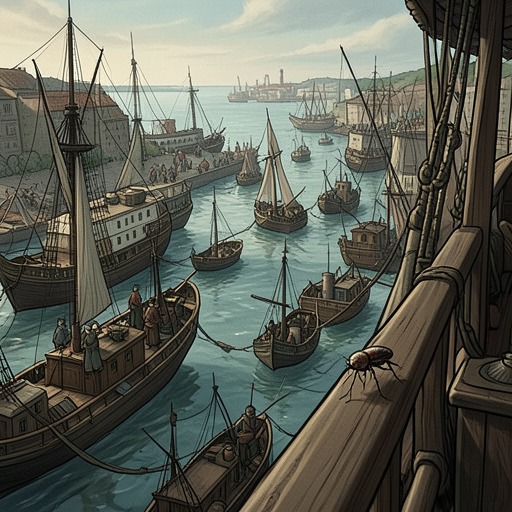
The glassmaker later appears at a dock, pushing a cart loaded with boxes toward the sailors. A boy notices that two fingers are missing and that the remaining hand looks strangely like liquid wax; when the cart begins to tip, he jumps forward to steady it. Neither the boy nor the glassmaker knows that a flea passes from the boy onto the glassmaker’s sleeve and then bites behind his left ear. The glassmaker is cold and focused on getting the boxes aboard and earning enough to return to Murano, where work awaits him.
The boxes’ journey continues after their departure from the island. They remain for almost a month on a warehouse shelf before being sent to different destinations. The smallest, still wrapped in the workshop rags, spends another week at a posting house at the northern end of London before a messenger carries it toward Warwickshire. On the two-day ride, the beads click together in the saddlebags; two are crushed, five are irreparably chipped, and the heavier ones gradually settle at the bottom. Murano thus remains present in the narrative not through the glassmaker’s return, but through fragile, altered objects moving outward into the same network of encounters and chance through which the plague reaches England.