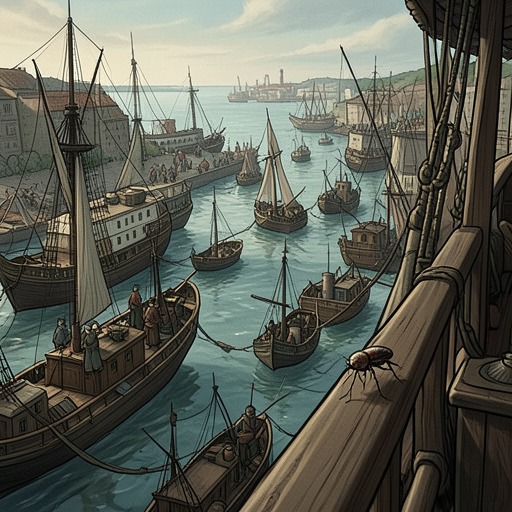
Naples
HamnetNaples appears as a maritime landmark in an account of sickness and death aboard a ship: as the vessel rounds Sicily, its second officer has fallen gravely ill, and he and two Polish men are buried at sea off the coast of Naples. The place marks the location of a collective loss, not an episode set in the city itself.
Coastal Setting
The passage places the ship near Naples after it rounds the tip of Sicily. Its wording locates the burial off the coast, so Naples functions as a point along the vessel’s route rather than as a visited port or a described urban setting.
Burial at Sea
By the time the ship reaches the coast, the second officer is suffering from what the text calls African fever. His fingers have turned purple and black; his body is so hot that sweat falls through the knots of his hammock to the floor. He is buried at sea alongside two Polish men. The brief account places Naples beside the stark practical fact of death during a voyage: the dead are committed to the water before the ship continues on.
Narrative Significance
The reference gives the deaths a precise maritime setting without pausing to describe Naples itself. In the broader passage, the ship carries cargo and traces the movement of illness through people and animals; against that circulation, the burial off Naples marks a point where the consequences become irreversible. The coast is present as a route marker, while the focus remains on the bodies lost at sea.