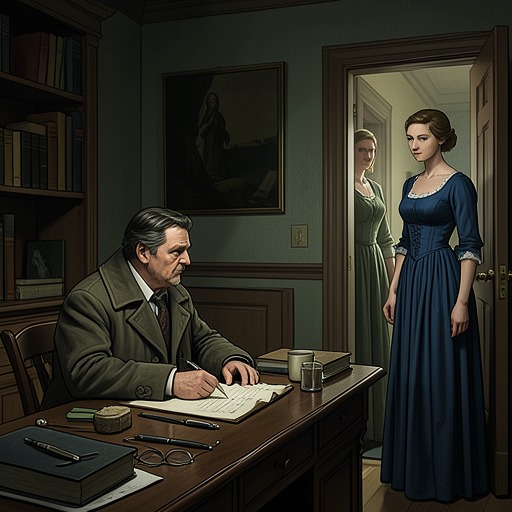
John Shakespeare
HamnetJohn Shakespeare is presented through brief but revealing family encounters: at home, his response to his son is physical and almost inarticulate; when Agnes announces that she will go to London alone, he openly urges caution. His presence is also tied to the workshop and the glove-making business that fills the household with its smells, customers, and talk of trade.
Family and Household Setting
John Shakespeare emerges from a home organized around work. The air is thick with the smell of leather, tanning, and singed hair; customers call at the window to buy and try on gloves, while conversation turns repeatedly to accounts, buttons, lace, merchants, tanners, farmers, silk, wool, and civic appointments. The business is not merely background: its demands make the house a place of continual interruption and commercial talk.
Encounter with His Son
John meets his son in the passage as he comes out of the workshop. The two stop and look at one another. John rubs his beard, swallows, and makes a sound that is neither a growl nor a cough; then he moves aside and goes back into the workshop. The scene gives no explanation for his hesitation. Its force lies in the contrast between the directness of the encounter and his retreat into work, leaving the meeting suspended in silence.
Response to Agnes’s Journey
When Agnes decides to travel to London without her daughters, friends, sisters, in-laws, or even Bartholomew, the household voices its fears. Mary warns that Agnes could be attacked or killed on the road, and Judith begins to cry; Susanna tries to comfort her but is also worried. John shakes his head and tells Agnes not to do anything foolish. Agnes remains composed at the table and says only that she will go. His warning belongs to a chorus of concern, but his direct opposition makes clear that he, too, sees the journey as dangerous; it does not change her decision.
Characterization
The two encounters show John chiefly through restraint and practical concern. In the passage, discomfort ends in withdrawal rather than explanation; in the family discussion, he speaks plainly, but his warning cannot overrule Agnes’s resolve. The workshop provides a recurring counterpoint to both moments: when intimacy or uncertainty presses in, the space of work remains close at hand.