Rowan
HamnetRowan is Agnes’s first mother: a woman said to have emerged from the forest, who raises Agnes and Bartholomew in close physical intimacy before dying in childbirth. Her life is seen through village stories and Agnes’s vivid, contested memories. The gap between the villagers’ account of her as an outsider and the child’s recollection of a warm, attentive mother makes Rowan both a person Agnes grieves and a presence others try to erase.
Identity and Origins
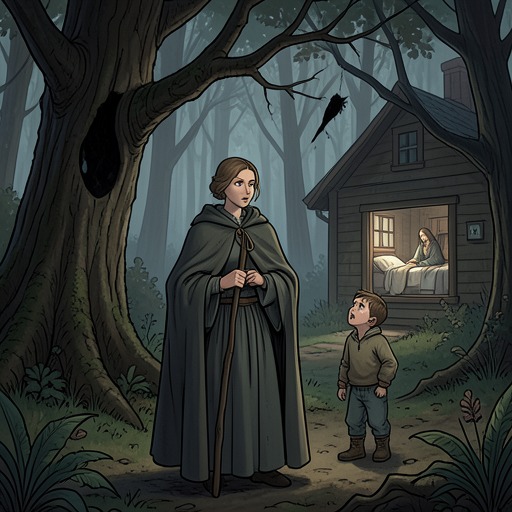
The oldest villagers cannot say where Rowan came from. In their account, she appeared one day parting the brambles and stepping out of the green, shadowed forest. A farmer happened to be watching his sheep nearby; once he saw her, he could not stop looking at her. He picked leaves from her hair, snails from her skirts, and twigs and moss from her sleeves, cleaned mud from her feet, and took her home. He fed and clothed her, married her, and soon they had a daughter, Agnes.
The tale leaves Rowan’s origins unresolved. Villagers speculate that she might have belonged to the forest and become separated from her own kind, or that she might have been something else. These are possibilities in local hearsay, not explanations confirmed by the narrative. Her arrival from the trees and her later, repeated returns to them preserve an ambiguity around her identity: she is a farmer’s wife and mother, yet remains associated with a world beyond ordinary domestic life.
Motherhood and Life at the Farm
The villagers describe Rowan as unlike any other mother they have known. She tied Agnes to her back and carried her everywhere, walking barefoot around the farm even in the coldest winter weather. She did not put the child in a cradle, even at night, but kept her close as animals keep their young. She would spend long hours in the forest with Agnes and return after dark, sometimes with unpeeled chestnuts in her apron. At home, the fire might be out and supper unprepared for her husband.
These absences and omissions draw the neighbours’ disapproval. They wonder how a husband can endure such treatment, then go to the farm to teach Rowan housekeeping, childcare, disease prevention, sewing, and the custom of covering her hair after marriage. Rowan listens with a distant smile, but the account gives no sign that she adopts the neighbours’ instructions. She is often seen with her hair loose, and she has made a small plot outside the farm for unusual plants: forest ferns, climbing herbs, pungent flowers, and low shrubs.
The one person she appears to speak with is an elderly widow at the far end of the village. Rowan visits the widow’s walled garden with Agnes on her back, barefoot and bareheaded as usual, and weeds there while the widow leans on her stick. The scene offers a quieter form of companionship than the neighbours’ lessons: Rowan works beside someone who seems to accept her presence without trying to correct it.
Rowan’s remembered care is expressed through touch and shared attention. Agnes recalls her mother’s warm, firm hand preventing a fall, and the shelter of her hair when Rowan carried her on her back through the woods. From there, the trees seemed lit with movement: Rowan pointed out a squirrel vanishing up a trunk and a kingfisher flashing over a stream. She climbed hazel branches and shook down nuts for the children. After Bartholomew was born, she carried him against her chest, where he and Agnes could look at and touch one another across her shoulders. She also cut green reeds, dried them, and made two identical dolls, which the children laid together in a box.
Death and Its Immediate Aftermath
Rowan gives birth to Bartholomew, a large, healthy boy, and returns to the forest with him on her back only a couple of days later, while Agnes walks unsteadily beside her. She becomes pregnant once more. After the third birth, she never rises from bed. The child is dead as well, and the women of the village wash and dress Rowan for the next world, putting a white shift on her and laying the small, wrapped body in her arms.
The women weep, but the account distinguishes their fear of their own deaths from affection for Rowan. They had resented her refusal of their friendship and instruction; they describe her as a woman from the forest, married to one of their own, bearing a tree’s name and having little to say to them. Her death makes mortality immediate even to those who had not welcomed her.
Agnes watches without speaking, her back against the wall and her eyes fixed on Rowan’s body. She does not cry or make a sound. Her living brother whimpers in her lap and wipes his eyes on her dress. When the women approach, Agnes spits and scratches like a cat and will not let them take him. Their difficulty in comforting her becomes part of Rowan’s aftermath: her daughter’s grief is fierce, mute, and protective, not easily accommodated by the people who have come to help.
Agnes’s Memory and Rowan’s Afterlife
As Agnes grows, she is told that she never had another mother and cannot remember one. She insists that she remembers everything, protesting with blows to the table and shouts. A widow who spins wool listens and quietly affirms Rowan’s goodness, describing her as exceptionally kind. Agnes’s memory is detailed but not complete: she can recall Rowan’s forest walks, the stone with a hole that Rowan filled with herbs, the reed dolls, and the plants in the garden, yet she cannot remember where Rowan went or why she left.
A later memory returns with particular force when Agnes sees her father kill a lamb. The blood recalls a red-soaked bed and the violent scene of Rowan’s death. Agnes remembers Rowan as cold and waxen in a narrow box, holding the dead newborn; she also remembers a priest summoned secretly at night. He carried a smoking bowl, prayed over Rowan and the child, and repeated Rowan’s name. Her father had told Agnes never to reveal that the priest came or spoke over them.
When Agnes tells her father what she remembers, he denies the visit and warns her not to speak of it, especially where Joan might hear. His denial leaves Agnes unsure whether he means her stepmother or her dead mother. She runs from him into the forest and cries out against the God of the orderly Sunday church, rejecting the idea that anything exists after death. The widow who hears Agnes’s account warns her never to tell anyone else, for fear that telling will bring seven kinds of misfortune.
Rowan therefore persists not through an acknowledged public history but through bodily memory, family silence, and fragments Agnes repeats. The contrast between the mother who carried her through the trees and the dead woman in the box gives Rowan’s absence a continuing force. The uncertainty over her origins remains, but Agnes’s recollections preserve the particular acts by which Rowan loved her: carrying, sheltering, pointing, gathering, and making.