Eliza
HamnetEliza is William Shakespeare’s sister and one of the household’s quiet interpreters: she can read when others around her cannot, listens for meaning in what is barely spoken, and turns that attentiveness into practical care. Her literacy begins as a private gift from her brother, but it becomes a way to preserve intimacy, recognize what people conceal, and carry urgent news across distance.
Identity and Family
Eliza belongs to a household marked by both affection and absence. Anne, her sister, has died, and the empty half of the bed Eliza once shared with her remains a measure of that loss. When Agnes unexpectedly arrives at the family home, Mary tells Eliza to share a bed with her until the wedding date is settled. Eliza notices the place beside the window where Anne used to sleep, and sees that Mary, too, looks toward that vacant half. She wants to ask whether her mother still waits to hear Anne’s steps, voice, or breathing at night; Eliza knows that she still does. Even after waking alone day after day, she continues to imagine that time might fold back and return her sister to the bed.
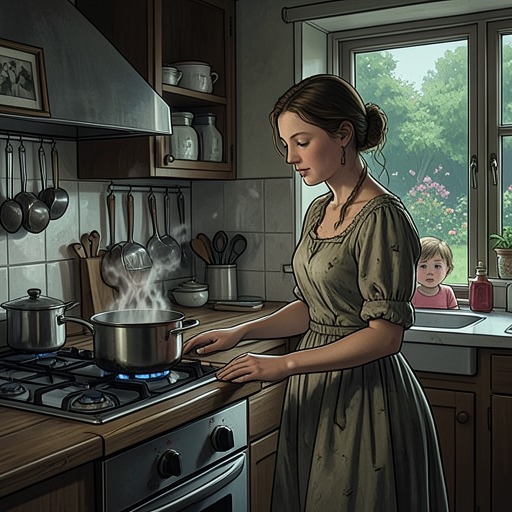
Eliza’s place in the family is also defined by her care for younger children. While making a wedding crown, she keeps Edmond beside her at the table and gives him leaves and daisy petals to handle. She does not treat his sounds as meaningless babble: she recognizes his rough attempts at words for leaf, Eliza, and soup. When he warns himself away from the fire, she understands what he means and answers him. His delight at being understood confirms the connection she has made by listening. In the same scene, Mary’s anger spills into the cooking, where roast, pastry, and sweets are all going wrong; Eliza stays with Edmond, away from the kitchen’s turmoil.
Literacy and Her Brother’s Confidence
Eliza’s reading is a secret she shares with very few people. Her brother taught her and Anne after returning from school, tracing letters in dust and showing them how to sound out a word by joining its parts. When she comes upon him in a warm, dusty space lit by two candles, he has fallen awkwardly and is holding his head. He would rather be left alone, but Eliza remains with him. She notices scraps of paper and can make out several words, evidence of writing he does not wish to discuss.
Their exchange shows both his evasion and her familiarity with it. He insists that he is doing nothing and then, when pressed, claims to recognize nothing. Eliza knows he is searching his knowledge of rhetoric for a way to answer without repeating his denial. She does not force him to confess, but raises the subject that has brought her upstairs: people have seen him with the young woman from Hewlands. She has heard uglier market gossip about his prospects and the woman’s character, but deliberately does not repeat those accusations to him.
When Eliza asks what Agnes is like, her brother answers with unusual openness. He says that she cannot be compared with anyone Eliza knows, that she does what she wants regardless of other people’s opinions, and that she seems to look into a person’s soul without hostility. His account emphasizes Agnes’s acceptance of people as they are rather than as they ought to be. Eliza listens, recognizes the importance of what he is telling her, and finds a phrase for the woman: she is without equal. The scene makes Eliza more than a witness to her brother’s courtship; she is the trusted person to whom he gives its meaning.
The Wedding and Everyday Care
After Agnes comes to the household, Eliza offers to make her a crown for the wedding. She asks timidly, expecting that Agnes might refuse or consider the offer ill-timed. Instead, Agnes turns toward her in bed and warmly accepts. The two women then face one another like conspirators, beginning to discuss what flowers might still be found in that season. The exchange makes a small alliance between them within a family arrangement shaped by grief and adjustment.
Eliza makes the crown from fern, larch, and autumn daisies. While she works, Edmond sorts petals and leaves into a wooden bowl, and she attends to both the task and his attempts to communicate. Her fingers are strong and slender, accustomed to sewing leather, as she twists the sprigs into a circle. The domestic scene links her practical skill to a more patient form of attention: she makes something for Agnes while also giving Edmond the chance to be understood.
Her care is not limited to these quiet household acts. When Agnes is in the throes of labor, a child appears at the door and points upstairs; Agnes runs up the stairs two at a time. The next morning, Eliza is sharing a bed with Agnes, who has arrived at the house in extreme circumstances. Eliza’s offer of the crown and Agnes’s acceptance belong to a moment when welcome and crisis occupy the same home.
Illness, Grief, and the Urgent Letter
When Judith is gravely ill, Eliza is present as the family confronts the possibility of another child dying. Mary remembers Anne, who died of plague at eight, feverish and covered in swellings. The memory sharpens the fear surrounding Judith. Agnes has resisted allowing Eliza to write to Judith’s father, maintaining that Judith will recover and that there is no need to alarm him. As the hours pass and Judith’s condition remains desperate, Eliza asks Mary whether they should write after all. Mary gives a brief nod.
Eliza takes paper, ink, and pen from a cupboard, hesitates, and then writes to her brother. Her message says that his daughter Judith is very ill, that she may have only hours left, and that he should return as quickly as he can. She closes with a blessing and an affectionate sign-off. The wording is plain and urgent; the letter makes explicit what Agnes had tried not to communicate. Mary melts wax over a candle to seal it, and then arranges for it to be carried to the post on the road out of Stratford and sent onward to her son. Eliza’s skill, once taught in private lessons in dust, now makes the family’s appeal possible.
Eliza also serves as a reader for Agnes. When a letter arrives from Agnes’s husband, Eliza reads it twice at Agnes’s request and is asked to read it again. It describes a contract to make gloves for actors. The unfamiliar words require effort: Eliza works through the different kinds, including long fighting gauntlets, richly ornamented gloves for kings, queens, and court scenes, and soft women’s gloves made larger for young male performers. Agnes asks her to point out the words so she can learn to recognize them later. Eliza’s reading therefore does more than relay the letter’s news; it helps Agnes make the language her own. Through these acts of reading, listening, and writing, Eliza repeatedly bridges what one family member knows and what another needs to hear.