Susanna
HamnetSusanna, the eldest sister of Hamnet and Judith, is the daughter of Agnes and William Shakespeare. Her life is shaped by the strains of a divided household: her father is often away in London, her mother is repeatedly absent from domestic routines, and the family’s standing in Stratford has suffered. The novel gives Susanna a distinctive perspective on these circumstances, moving between a child’s imaginative games and an increasingly clear-eyed awareness of social rejection, adult conflict, and the limits of her own control.
Identity and Family Life
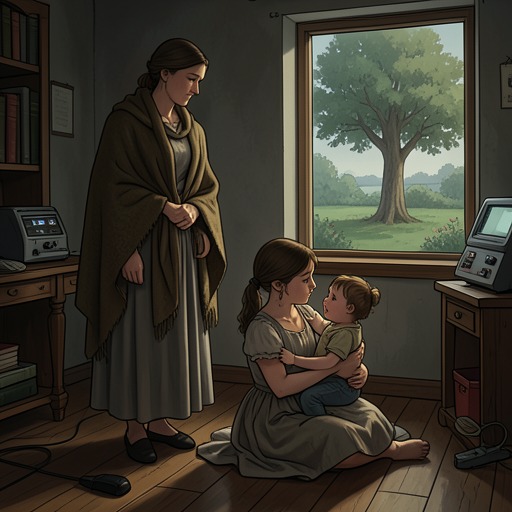
As a young child, Susanna appears in close physical and domestic detail. During her first summer, Agnes feeds her at the table, securing her in a cushioned chair with a shawl. Susanna watches the spoon travel from bowl to mouth, announces her first small sounds, and reveals four bluish-white teeth in her lower gum. Agnes repeats her sounds and studies her daughter’s ears, brows, and dark hair with an absorbed tenderness. When Susanna takes the spoon decisively, food splatters the table, her face, and Agnes’s skirt: the scene joins the mother’s almost boundless admiration to the ordinary mess of caring for a small child.
Agnes’s attention to Susanna also has an anxious edge. During a later pregnancy, Agnes detects an unfamiliar smell and fears it might signal danger to her daughter. She presses her face to Susanna’s warm neck and searches for the source, while Susanna calls for her mother and wraps her short arms around Agnes’s shoulders. Agnes finds only familiar scents: the floral note of Susanna’s skin, her warm hair, and traces of bedding and food. The moment ends with Agnes lifting her daughter and thinking about the new baby she carries, whom she imagines Susanna will love as a companion and ally. Mother and daughter are bound here by touch and closeness, but the episode also shows how readily a mother’s fear can turn ordinary sensations into a search for hidden threat.
A Watchful Older Sister
Susanna’s place in the family is especially visible in her relationship with Hamnet. When he drifts away from a task, she sometimes pulls his ear to bring him back to the present. Later, as he hurries to find help for Judith, Susanna is out with Mary, carrying the family’s gloves. Mary has taken her along to deliver the goods, and Susanna bears a basket containing gloves made of deer, kid, and squirrel skin, some lined with wool and some embroidered. Hamnet passes them without noticing. Mary complains that he does not look customers in the face when they greet him; Susanna responds by rolling her eyes, then lets her attention slip toward a patch of sky between the roofs. Her gesture quietly distinguishes her from her grandmother’s concern with manners and business.
Susanna’s watchfulness extends beyond the family. She notices that a woman speaking with Mary looks around to see whether anyone will catch her in conversation with the wife of a disgraced glove-maker. She has seen former friends cross the street to avoid Mary, and she connects the change to the fine imposed on her grandfather for failing to attend church. Some neighbors no longer bother to pretend to be polite. Susanna watches Mary block one woman’s way rather than let her pass without speaking. These details make the family’s social isolation part of Susanna’s daily experience, not merely an adult explanation of its causes; knowing what she sees leaves her inwardly burned and marked.
Agnes’s Absence and Susanna’s Resentment
At almost fourteen, Susanna returns to find the fire out and no one at home. Agnes had promised to come back soon, but has not. Susanna’s frustration gathers around the objects in the room—the dishes, the herbs and flowers hanging from the beams, Judith’s corn-husk doll, and the jug by the hearth. She opens a window for air, only to close it against the street’s smell of horses, excrement, and decay. She listens for a sound upstairs, hears nothing, and sits in the chair Agnes keeps for visitors who arrive, often at night, to speak in whispers about pain, dreams, illness, love, and omens.
Those visitors also make Susanna an unwilling intermediary. People approach her in the market or street to ask how Agnes knows what they need, what is wrong with them, or what their hearts conceal. Susanna has learned to recognize the curious, suspicious expression that precedes these questions. She tries to prevent them, changes the subject to their families, the weather, or the harvest, and, when pressed, says she has no idea what they mean. Her irritation is directed not only at being questioned but at the assumption that she shares her mother’s abilities or can explain them. She wants to be treated as herself, rather than as an extension of Agnes’s herbs, remedies, and reputation.
Susanna’s resentment is complicated by dependence and concern. She imagines Agnes out in the fields, wading through ponds, collecting plants, climbing fences, and getting mud on her boots, while other mothers remain at home buttering bread or serving stew. The contrast is exasperated and comic, but it also records the cost of Agnes’s absences to a daughter left waiting. When Susanna’s own household is unsettled by illness and uncertainty, her mother’s failure to be where she said she would be becomes more than a general complaint.
The Absent Father and the Plague
William Shakespeare’s letters bring Susanna news of a different kind of absence. He writes about contracts and long working days, crowds throwing rotten things at performances they dislike, rehearsals, lost costumes and props, fires, damaged stages, broken carts, difficult journeys, and the money he is saving. His accounts of theatrical work sit alongside practical requests about land and houses in Stratford, expressions of affection, and his longing to return and kiss each family member. For Susanna, the letters make London both a place of hardship for her father and the reason he is not at home.
She secretly wishes the plague would reach London. If it does, the playhouses will close by order of the queen and public gatherings will be forbidden, giving William a chance to spend months with his family. Susanna knows her wish is not a good one; after praying, she wants the epidemic to come, then becomes angry with herself, and still wants it. The contradiction brings her longing into focus: she desires her father’s return even at a cost she understands should not be desired. She wonders whether Agnes might want the same thing, but cannot know.
Imagination and Adult Conflict
Susanna’s imaginative life gives her a way to picture what she cannot control. Shortly before her second birthday, she sits in a basket on the floor and rows with wooden spoons, imagining a fast, zigzagging river. She sees the ducks and swans paddling beneath the water while the adults around her remain in an ordinary room. In the middle of this game, she imagines her father’s dark head disappearing beneath the river’s brown-green surface. The image frightens her; then she sees him standing still before Mary, who has stopped sewing and is angrily confronting him.
The river game and the remembered confrontation meet in Susanna’s attention without becoming the same thing: she watches a scene of adult anger through the language of her own play. Mary takes William by the arm and demands that he stay in Stratford, where he belongs with Agnes and the children and should be present for the birth of the next child. Agnes, pregnant and calm, does not support Mary’s appeal. She says she cannot see why William should be held against his will. A squirrel climbs up Agnes’s sleeve and nestles near her hair; after stroking its tail, Agnes lets it escape through the open shutters. Susanna sees both the argument and this small, incongruous action. The scene captures her position within the family: close enough to witness its decisions and tensions, but still a child interpreting them through vivid images, observation, and feeling.