Joan
HamnetJoan is Agnes’s stepmother and the practical authority at Hewlands, where the power to run a household is also the power to decide who may belong in it. A hard-working caretaker who becomes a widow and remains on the farm under the terms of a will, she rules its daily labor while guarding its resources and boundaries. Her treatment of Agnes turns those responsibilities into a sustained conflict over discipline, marriage, inheritance, and the care of children.
Background and place at Hewlands
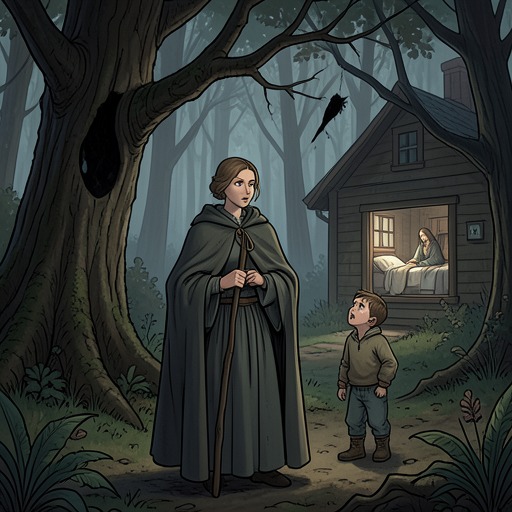
Joan first enters Agnes’s life after Agnes’s mother dies. The villagers seek someone capable of taking over the farm’s domestic work: a neighbor recommends her unmarried sister, a young woman already accustomed to looking after younger siblings and pigs. Joan is hired to manage the house, care for the children, tend the fire and cooking pot, and, in the villagers’ view, bring the bereaved children into line. The arrangement makes her a caregiver by necessity and gives her authority over Agnes before any bond of trust has formed.
That authority is exercised through work and punishment rather than tenderness. Joan cuts Agnes’s hair with a knife because she has no time to tend it every day. She throws Agnes’s matching reed dolls into the fire as devil’s playthings; when Agnes burns her fingers trying to rescue them, Joan laughs and treats the injury as deserved. She also beats Agnes with a shoe for leaving without permission, and the same punishment follows other domestic or behavioral transgressions. Agnes responds by learning to be quick and inconspicuous, to move through rooms without attracting notice, and to conceal what she does. The narrative thus links Joan’s household discipline to Agnes’s early knowledge of secrecy and resistance.
Household authority and its limits
Joan’s command of Hewlands rests on a complicated inheritance. The farmer leaves the farm to Bartholomew, while the will allows Joan to remain in the house and govern the household. A widow for a year by the time this arrangement is described, she organizes the division of labor: Bartholomew is responsible for the flocks and fields with the boys, while she directs the kitchen, poultry yard, and garden with the girls. They are to inspect the land together once a week. Joan distrusts Bartholomew’s judgment, believing he does not see beyond what is immediately in front of him, and insists on retaining control of domestic work.
The scale of that work is concrete and relentless. Joan oversees pigs and chickens, milks cows, prepares food for the men working the fields and for the shepherd, and attends to the younger children. She also manages baking, preserving woodland fruit, brewing, mending clothes and stockings, cleaning floors and stairs, washing dishes, and airing beds. The household includes her own children as well as Agnes and Agnes’s brother, whom she has had to take in; the narration describes the burden in terms of six children, or eight when the stepchildren are counted. This crowded, labor-intensive household helps explain Joan’s vigilance over its members and resources, but it does not soften the force with which she enforces her authority.
Her power is real but conditional. When she orders Agnes out of the house for good, she gathers the girl’s few belongings—a couple of shirts, a spare wrap, an apron, a wooden comb, a Hole-pierced stone, and a belt—and throws the bundle at her feet. Bartholomew intervenes, asserting that their father left the house to him and that Agnes may stay. Joan is forced to confront the distinction between governing the household and owning it: the will gives her a right to remain, but Bartholomew’s inheritance gives him a competing claim over who can live there.
Agnes’s courtship and expulsion
Joan also treats marriage as an extension of household management. When she finds Agnes walking with her Latin tutor, she rejects the possibility of their marriage on grounds of age, status, and money. She invokes the tutor’s father’s debts and damaged standing in the town, argues that even years of teaching her children would not repay what he owes, and insists that Agnes should instead marry a prosperous farmer. Agnes’s father left her a dowry, Joan points out, and she considers a poor young tutor an unsuitable match. Her preference is not presented as a passing objection: Joan has already imagined Agnes’s future as a marriage that secures her maintenance and fits the farm’s interests.
Agnes openly refuses that future and affirms that she wants the tutor. The dispute becomes physical after Joan discovers Agnes’s pregnancy while Agnes is milking a cow. Joan pulls her from the stool, searches her clothing, and feels the swelling of her abdomen. She spits insults at Agnes; Agnes pushes her against the cow and runs, but Joan catches her by the hair and holds her down. The confrontation makes the conflict over marriage bodily and immediate: the pregnancy exposes the relationship Joan had tried to prohibit, and Joan answers the disclosure with violence and expulsion rather than negotiation.
Bartholomew’s intervention is therefore more than a gesture of sympathy. By declaring Agnes may remain, he challenges Joan’s attempt to turn domestic authority into an absolute right of exclusion. The evidence shows Joan’s dismissal and his assertion of ownership, but does not establish the full terms on which the dispute is resolved. Later, Agnes says that Joan would never accept her returning to Hewlands with Susanna. The farm remains a place Agnes knows intimately, yet Joan’s rule makes it unavailable as a secure home.
Fear, suspicion, and family conflict
Joan’s relationship with Agnes is marked not only by punishment but by suspicion. Early in Agnes’s childhood, Joan complains that the girl unnerves her: twice Joan wakes to find Agnes standing beside her bed and holding her hand; she also discovers tied twigs with a chicken feather in her pocket and ivy leaves beneath her pillow. The village women are unsure whether to believe the stories. They notice, however, that Joan develops spots and chilblains, that her spinning thread tangles and breaks, and that her bread fails to rise. The narrative leaves the cause uncertain, placing Joan’s account beside the villagers’ hesitation and the question of how a very young child could have brought about such misfortunes.
Years later, when some monthly cloths go missing from the laundry, Joan searches through the household’s clothes and checks whether the stored cloths are all present. She then confronts the girls at the washing, gripping one daughter’s arm and pressing her abdomen while the child cries out. She checks another girl as well, imagining that someone may have made one of her daughters pregnant and vowing retaliation against whoever had taken her away. Finding the girls’ bellies flat, she briefly wonders whether she has been feeding them poorly, then dismisses the suspicion. This episode shows Joan’s protective impulse, but also its coercive form: fear for her daughters becomes invasive physical scrutiny, and the missing cloths turn domestic order into a search for concealed sexual danger.
Agnes’s later plea to Mary gives the estrangement a lasting consequence. When Agnes fears she may die, she asks that the children not be left in Joan’s care and insists that Mary promise not to let her stepmother take them. Mary promises. The scene does not establish that Joan actually attempts to claim the children; it does establish how completely Agnes distrusts her as a possible caregiver, even at a moment when the children’s future is uncertain.
Continuing influence and narrative significance
Joan’s authority continues to shape family decisions after Agnes has left Hewlands. When Agnes considers returning there with Susanna, she rules it out because Joan would never accept the arrangement. In another episode, Bartholomew receives a letter from Agnes’s husband asking him to act on his behalf in making a purchase. Joan is eager to know what the letter says and suspects that the man may be asking for money after failing in London. She warns Bartholomew not to lend anything, urging him to consider the farm, the children, and his brothers and sisters, and repeats her longstanding judgment that Agnes’s husband is worthless. Her concern for the household’s resources and her hostility toward her son-in-law are inseparable.
The novel gives Joan substantial practical competence: she keeps a large household functioning, allocates labor, and understands the obligations attached to property and kin. Yet the same competence becomes a means of control. Her domestic care does not erase the blows, humiliation, or threat of exclusion that Agnes remembers; nor does Agnes’s fear make Joan’s labor and economic precarity disappear. Joan’s character is built from that tension. At Hewlands, authority is neither abstract nor secure: it is enacted in kitchens, yards, laundry, inheritance clauses, and decisions about who may stay. Through Joan, the farm becomes both a working household that depends on women’s labor and a contested home whose boundaries are enforced against Agnes.