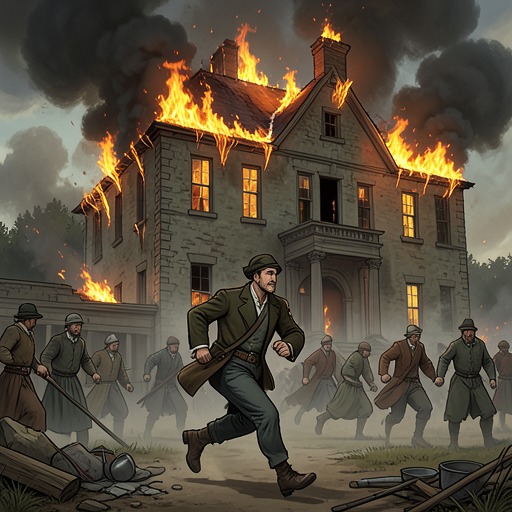
The Derby Brothers and Brook Higgs Set a Fire
HarvestThe fire set by Christopher and Thomas Derby and Brooker Higgs turns an attempted prank against the master’s Doves into a destructive blaze, then into a public effort to blame strangers. Its consequences extend beyond the loss of the stable, dovecote, hay, and birds: the villagers’ wish to preserve their harvest holiday helps keep the truth unspoken, while suspicion shifts toward newcomers at the edge of the fields.
Causes and Plan
The event follows the harvest, when the villagers have finished gathering the barley and expect the familiar sequence of a rest day, a communal meal, and Gleaning Day. The previous evening, Christopher and Thomas Derby and Brooker Higgs go to The Woods rather than returning home with the other villagers. They are unmarried men in a village with few unmarried women, and, unlike their neighbors, they have eaten Fairy Caps. The narrator links that experience to their scheme for retaliating against birds they regard as thieves.
The men’s immediate target is the master’s Doves, which they believe have been feeding on village bread and ale. Their plan is not to burn the buildings or kill the birds: they intend to make smoke that will drive the Doves away. For this, they use a Moonball, a dry, hollow fungus that can carry fire from one place to another. The narrator knows that it is also suitable for taking fire into the master’s yards while people are asleep, a detail that gives the prank a dangerous material means even though its stated purpose is limited.
The Fire and Its Immediate Effects
Before first light, the men push the smoldering Moonball into the loft. There, dry chaff and litter brought in by the nesting Doves provide combustible material. The smolder becomes a fire, which spreads through the stable structure and reaches that summer’s hay. The men have not intended the full result, but their effort to unsettle the birds instead sets the stable and dovecote alight. The fire kills many of the Doves and destroys hay intended as winter feed.
The blaze brings Charles Kent to the stable yard, where he watches from beyond the heat beside his rescued mare. He is already bereaved: he wears the sleeveless garment woven by his wife during the winter of her death. The fire therefore damages more than working buildings and stored feed; it confronts him with another loss and a threat to his household’s peace. Christopher and Thomas Derby and Brooker Higgs respond by making themselves conspicuous among those trying to put it out. They carry water and use spades against the flames, appearing eager to demonstrate their loyalty to Charles Kent even as they conceal their part in starting the fire.
Suspicion Turns Toward the Newcomers
Brooker Higgs takes a leading role in organizing the search for whoever caused the fire. He rejects an accidental explanation, including the possibility that a hayrick overheated, and points to the absence of lightning, nearby burning farm waste, or a candle in the stable. He also directs attention to a blackened ricking ladder that had been leaned against the stable wall to reach the dovecote. According to the narrator’s account, the men had likely meant to steal Doves to eat; the ladder is thus a concrete connection between their activity and the fire, though Brooker Higgs uses it to support his call for a culprit elsewhere.
The accusation moves away from the villagers and toward the newcomers whose smoke is visible beyond the fields, near the woods. Charles Kent says the newcomers will be visited after the buildings are safe, so that their answers can be tested. His response is cautious rather than a declaration of guilt: he recognizes that suspicion has a direction but has not yet established who caused the fire. The episode shows how an accusation can be redirected even while the physical evidence remains close to the people who set the blaze.
Walter Thirsk’s Silence
Walter Thirsk knows that the Moonball was dry and could carry flame, and recognizes that he should report this or warn Brooker Higgs. He decides not to speak. A Moonball, he reasons, is not proof; nor is the men’s unconvincing performance enough to establish their guilt. He also senses that the villagers would rather let the disturbance subside so that they can keep the rest day, eat veal, drink ale, and choose their Gleaning Queen. Their reluctance is not simply a failure to notice the danger: they do not want to sacrifice the holiday or treat the loss of hay and Doves as more important than the villagers’ sons.
Thirsk’s silence has a practical cause as well. He has severely burned his left hand while trying, with John Carr, to move a burning bale toward the line of water buckets. Charles Kent shows concern for him, but the injury leaves him unable to work as usual and concerned with treating his own wound. Thirsk returns home to prepare a poultice and must watch events from there. The fire’s immediate aftermath therefore ends not with an exposure or a settlement, but with an injured witness withholding what he knows and a community prepared to investigate the newcomers instead.