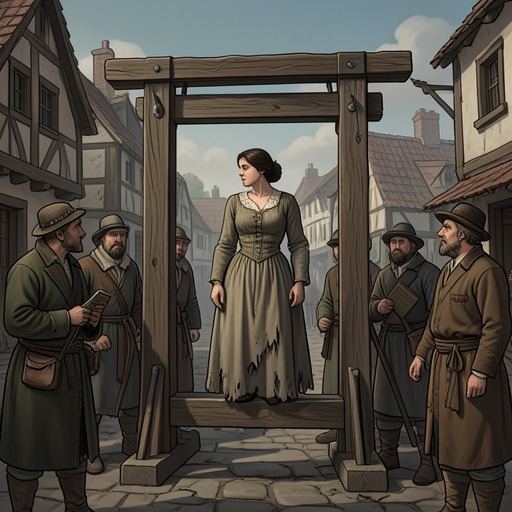
Walter Tries to Help the Older Man in the Stocks
HarvestWalter Thirsk’s attempt to help the older prisoner in the pillory turns a private recognition of cowardice into a test of practical aid. He approaches the bound men at night, imagines sheltering them, and tries to find the older man a place to rest his feet. But the effort ends in failure and postponement: Walter leaves the prisoners in the rain, having made a plan for morning rather than giving relief now.
The prisoners in the storm
Walter sees the men before they notice him. Their arms are pinioned and their necks caught in the pillory; they are sodden, unable to defend themselves, and, as he judges it, can harm him only with a backward kick. The rain makes their punishment feel unrelenting. He watches without announcing himself, in a night so quiet that even the trees seem to hold their breath, and the pillory becomes the fixed point of an otherwise dark village.
The scene’s stillness gives Walter time to imagine a different structure around the punishment. If he possessed a wizard’s or god’s power, he thinks, he would build the church gate above the pillory and give it a canopy. The vision does not remove the prisoners or the punishment; it pictures the simplest possible intervention, keeping the rain off. That imagined shelter sharpens the contrast between what Walter wishes he could provide and what he can actually do with one injured hand in the dark.
From silence to attempted aid
Earlier that day Walter had persuaded himself that the villagers should hold their tongues and allow the newcomers to absorb the blame. At the pillory, he recognizes that this was not merely prudence. He names it to himself as a failure of courage and honesty. His change of judgment matters because he does not present himself as an uninvolved observer: although he did not take part in drawing bows, shaving heads, or marching the prisoners to the pillory, he knows he failed to speak in their defense.
Walter approaches and introduces himself as Walt, explaining that he was absent when the men drew their bows and was not among those who punished them. He wants them to understand that he should not be counted with their accusers. Yet the prisoners do not answer. The younger man briefly lifts his chin, then lets his head drop, apparently exhausted by its weight; the shorter man shifts on his stretching toes. Their silence leaves Walter’s explanation unanswered, while their posture makes the older man’s physical discomfort unmistakable.
The failed search for a perch
Walter wants to find something for the older man to stand on and take pressure off his feet. There is no log to hand: the nearest fallen timber lies beyond the fields, too far away to fetch in the storm. A pile of roughly prepared stones for the church stands only about twenty paces from the pillory, and at first Walter thinks one might serve. But lifting it aggravates his injured, weeping hand. The crust over the wound may have torn; he cannot see the damage, but feels the pain, drops the stone, and tries to roll it with his good hand. The ground is too rough and the stone too square. Tipping and toppling it does not bring it closer in any useful way.
The objects available at his cottage offer no easy substitute. His oak bench is too heavy for him to carry alone. A chest and smaller coffer are too flimsy to support even a short man, while both kegs are full and too heavy to move. Walter briefly imagines lying on the sodden ground so that the older prisoner could stand on his back, but this is not a workable solution. His own hand has to be protected if he is to work again, and the materials that might help are either inaccessible, unmanageable, or unsafe.
Deferral and its cost
Walter decides that he cannot help before morning. He reasons that the older man has already spent most of the day on tiptoe and surely can endure the night; the injured hand needs care, and the burden at the pillory is not his alone. These considerations are real, but they also follow his earlier temptation to treat the newcomers’ suffering as something others can answer for. His departure therefore carries the unresolved tension between acknowledging responsibility and acting on it.
He plans to call on John Carr at first light so they can share the work of moving a stone or carry opposite ends of the bench. Alternatively, Walter can find boys and send them looking for a log. None of these plans brings a perch to the older prisoner that night. The men have still not exchanged a word with him when he walks back into the downpour, suddenly embarrassed. The episode ends not with successful relief but with a postponed obligation: Walter has recognized his failure to speak, attempted a limited repair, and left the consequences of his inability—and his delay—beside the pillory.