Kent Announces the Village’s Conversion to Sheep Farming
HarvestCharles Kent’s announcement that The Village is to be reorganized around sheep farming turns a harvest feast into the first public glimpse of enclosure. He presents the change as a shared path to security and leisure, but Philip Earle’s charts and Walter Thirsk’s recognition of what the plan entails expose its cost: common land, familiar labor, and a subsistence economy are to give way to fenced pasture and wool. The proposal is not yet an accomplished transformation, but the speech makes the threat legible before Kent names it plainly.
Maps and the Announcement
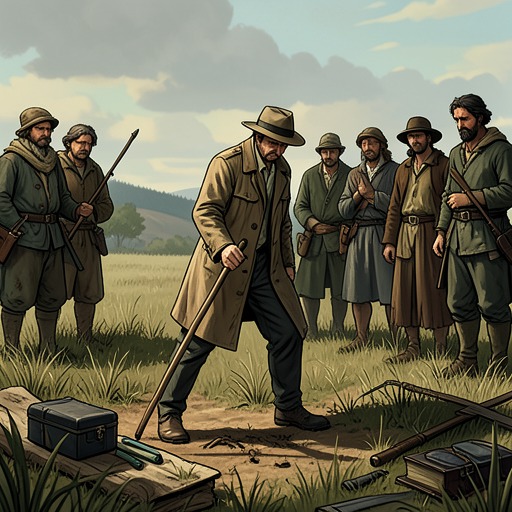
The announcement comes at a communal feast, when veal and ale have made the villagers more inclined to trust their host. Charles Kent introduces Philip Earle, whom the villagers know as Mr. Quill, as the mapmaker he has hired to survey their common ground and land. The work is to support petitions to the courts. Kent describes the resulting organization as beneficial to everyone, while Earle unfolds a working chart and invites the villagers to see their world from the imagined height of birds and stars.
The charts make the announcement visible before they make it comprehensible. To the villagers, Earle’s geometry and squares reduce a lived landscape to lines, without the life they know in it. A second chart is presented as their future. Kent confirms that their tomorrows will take this shape, but pauses before explaining exactly what it means. His hesitation matters: he offers an image of change before openly naming the policy, leaving Walter to read the map against the land and the master’s past promises.
The Plan Beneath the Dream
Walter understands the proposal as enclosure: walls and hedges, ditches and gates will close and engross the fields. The common land will be cleared, trees cut down, and the village redirected from its established provision of grain, meat, and other farm produce toward wool. For Walter, the implications are not abstract. He recognizes that the new boundaries would place a halter around village life and that the shift would reorder the community’s relationship to its fields.
Charles Kent does not initially state the decisive word. Instead, he frames the plan as a dream in which his friends and neighbors need no longer labor through the year under the uncertainty of harvest. He recalls the risks familiar to the villagers: unreliable sun and rain, wind flattening crops, mildew spoiling them, cattle struck by murrain, and crows taking grain. Wool, he argues, grows without sunlight and is not spoiled by changing seasons or wind. His sales pitch turns the vulnerabilities of arable farming into evidence for the reliability of sheep.
The promised future is one of shepherding rather than plowing, shearing rather than reaping. Kent imagines villagers sitting at home weaving yarn into cloth, with looms replacing oxen and the work of preparing broadcloth, fustian, worsted, and twill replacing the risks of cultivation. The finished garments would travel beyond the village to noble wearers. This is an account of a new economy as well as a new land use: the villagers’ labor would continue, but its products, rhythms, and destination would change. Walter recognizes the concealed destination in the contrast between the sheaf and the flock: “The sheaf is giving way to sheep.”
Harvest Labor and the Stakes of Change
The proposal gains force because it is made against the reality of the harvest. The barley crop has been uneven: shaded and neglected slopes produced short, weak plants, while the higher field promised better grain. The village needs enough harvest to last the year, and the work is collective. Children weed, stronger workers use sickles and scythes, women bind sheaves, and older people build stooks. Their customary division of labor is practical and communal, shaped by scarcity as much as by sociability.
Harvest also gathers the community in a shared space, with common ditches and collective hopes. Work proceeds alongside gossip, joking, and the sounds of tools moving together. Kent’s plan therefore threatens more than a particular crop. Its enclosed fields would challenge the arrangement through which villagers labor together and make use of the land. His promise of easier lives addresses real exhaustion and risk, but the existing harvest shows what that promise asks them to leave behind: their skills, their shared work, and the food their efforts are meant to secure.
A Persuasive Feast, an Unsettled Future
Kent’s manner helps contain the immediate reaction. He speaks after feeding the villagers and supplying the ale; by the time he has described his dream, they are no longer hungry and are too intoxicated to remain fully anxious. He suggests that the plans may still be five or ten years away, and for that evening the feast matters more than the future. The villagers can keep drinking rather than force an answer from him. Their temporary ease is not agreement, however. The plan has entered their awareness, even as its central term remains tactfully unspoken.
The evening’s music and dancing briefly restore a different image of communal life. Philip Earle sets his fiddle beside Thomas Rogers’s pipes, first echoing the piper and then taking over the tune. The music draws children and villagers into a dance that moves through circular and square patterns; during this collective revel, the village also anticipates choosing its Gleaning Queen. The contrast is sharp: Earle’s maps and music both shape patterns, but one translates land into parcels while the other brings people together in movement.
That fragile festivity breaks when Mistress Beldam appears at the barn gate, shorn and visibly humiliated. The villagers imagine, for a moment, welcoming her as their Gleaning Queen and repairing what has been done to her. But she backs away and leaves; the dancers cannot resume. The interruption does not constitute a direct consequence of Kent’s speech, but it darkens the feast at which his plan has been introduced. The evening ends without public resolution: the villagers have heard the future described as prosperity, recognized its concealed transformation, and returned to an uneasy present in which communal rites and customary life are already under strain.