The newcomers’ settlement on the commons
HarvestThe newcomers’ settlement on the commons is a deliberate claim to habitation, made through a rough shelter and a conspicuous hearth on shared land. The smoke announces both arrival and an appeal to custom, but the villagers’ response shows that a recognized claim is not the same as welcome: before the newcomers can become neighbors, their right to remain is challenged and their conduct put under suspicion.
Claiming a Place
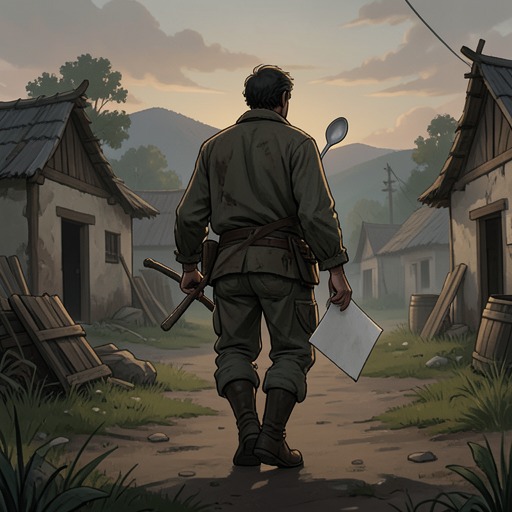
At first light, two twists of smoke rise from the land. One comes from the newcomers’ dwelling, newly put up on common ground among the woods and beyond the ditches marking the fields. The narrator stresses that no one had been there the previous day. With the reapers’ moon providing light, the newcomers have made a small hut of four rough walls and a roof, then lit a hearth. Their fire is damp; wet greenery has apparently been added so that its smoke will rise dark and unmistakable above the trees.
The smoke functions as a public declaration. The newcomers have built a place and laid a hearth, invoking a custom by which establishing a home and fire gives a person the right to stay. The narrator acknowledges the force of that claim, then immediately leaves its acceptance unresolved. The villagers will judge whether the custom applies here; the newcomers’ visible act stakes a right, but does not secure the community’s consent.
A Shelter Under Suspicion
When the villagers reach the clearing near The Bottom, the fire has gone out. The shelter they find is a poor and hurried construction: fallen timber has been woven into a square of uncut fencing, the walls are daubed with earth and leaves, and sacking serves as a roof. It is so low that its occupants seem expected to crawl rather than stand. To the locals, the structure looks less like a family home than a makeshift enclosure, and they doubt that it can establish a valid claim to the commons.
The dispute is not only about the hut. The villagers imagine that accepting the newcomers’ claim could open the common rights to anyone, even animals, and allow access to the land’s fowl, fruit, and firewood. Their suspicion takes a more immediate form in the remains beside the cold hearth: bird bones, gnawed clean. Christopher and Thomas Derby’s elder twin points to them as evidence that the strangers have eaten one of Charles Kent’s birds. John Carr examines the scraps and notices their dark feathers, short bones, and yellow beak, details that suggest a blackbird rather than a dove. The villagers nevertheless hold to the accusation that the newcomers have taken a dove. Suspicion proves more durable than the evidence that might qualify it.
The Village’s Answer
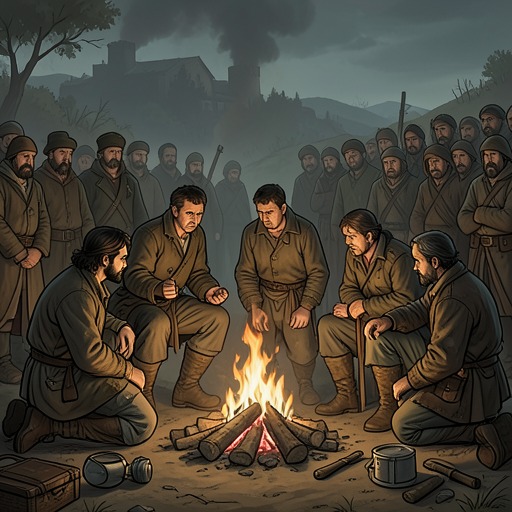
The settlement meets a community already bound together by labor, kinship, and shared dependence on the land. At harvest, the reduced population leaves no useful hand free: children weed among the grain, stronger workers reap, women bind sheaves, and older men build the stooks. The harvest is not merely a private yield but work organized around common expectations and hopes. Against that background, the newcomers’ claim to shared ground—and the villagers’ belief that they have taken a bird—feels like a challenge to the arrangements on which local subsistence depends.
The response is exclusion rather than negotiation. The villagers expect the newcomers to leave once they discover how unwelcome they are, and promise to walk them to the boundaries and set them on their way. Their offer to guide the strangers sounds helpful, but its purpose is to remove them from the land. The settlement thus exposes the gap between customary right and practical power: the newcomers can make a visible claim through house and hearth, while the established community can answer by controlling access and refusing hospitality.
A Wider Conflict Over Land
The villagers’ hostility is sharpened by their isolation. They are deeply rooted in the place and accustomed to a close-knit web of relatives; strangers are rare, and the community has little inclination to receive them. The newcomers’ hut is consequently read not as the beginning of a household but as an intrusion by people who may consume resources and disappear again. The villagers’ certainty about the supposed dove theft helps turn a contested claim into a moral charge against its claimants.
Later, the newcomers are described as people driven from their own commons by sheep, giving their arrival a history of displacement beyond the locals’ first suspicions. That later context makes the settlement an encounter between communities shaped by competing uses of land, not simply a disagreement over a flimsy hut. The newcomers use an established custom to seek a place to live; the villagers, defending their own customary economy, try to escort them out. The smoke that announces a new hearth therefore marks the beginning of a struggle over who may belong on the commons and who has the power to decide.