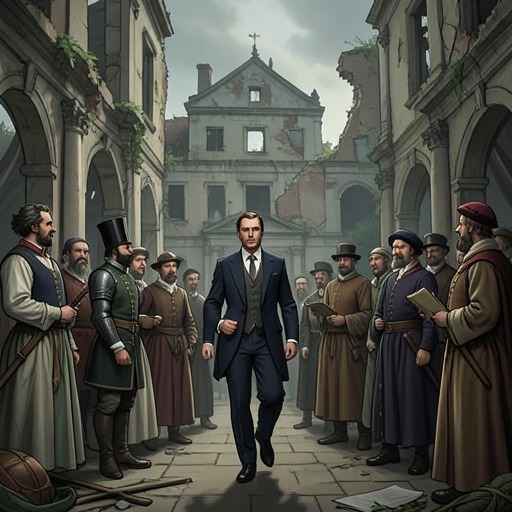
Kent Conceals Beldam’s Identity
HarvestKent Conceals Beldam’s Identity is a calculated act of protection amid an investigation that threatens to turn a horse’s death into a public demonstration of authority. When Young Edmund Jordan presses for the shawl’s owner and the person responsible for Willowjack, Charles Kent does not identify Mistress Beldam. Instead, he acknowledges that the garment belonged to Lucy Kent and supplies an alternative account in which an unknown intruder stole it. The maneuver keeps the suspected woman out of the inquiry while giving Young Edmund Jordan a story he can accept without openly retreating from his claims to justice.
The shawl and the withheld name
Young Edmund Jordan throws the shawl across a fence and asks Walter Thirsk to identify its owner. He addresses Walter as a villager he appears to trust, perhaps because Walter seems less stolid than the others. Walter answers that he has no name to give, and his evasion is carefully qualified: he can recognize the woman and describe her, but she has no known identity beyond the byname Mistress Beldam. He swears that he has never seen a neighbor wearing the shawl. The account makes his silence a form of concealment rather than simple ignorance; he knows whom he means, but will not provide the name Young Edmund Jordan wants.
Charles Kent also withholds the identification. Walter leaves the heavier decision to his master, who must recognize both the garment and the suspected culprit. In Walter’s judgment, Charles has already connected the woman who spat at Willowjack with the horse’s killing. The suspected act followed an earlier punishment: a member of the woman’s kin, possibly her father but not certainly, had been sent to the pillory by Charles Kent and left there to die. That history makes retaliation intelligible without proving the woman’s precise motive or making her responsibility for the horse’s death certain. Charles, who loved Willowjack, does not treat the killing as justified; nevertheless, Walter sees why the woman might regard herself as having grounds for anger.
Charles Kent’s alternative account
Rather than name the woman, Charles identifies the shawl as Lucy Kent’s. This is a limited disclosure, not a confession about who wore it: he explains that it had hung at the back of Lucy’s old loom until the previous evening. The garment’s quality also makes the claim useful to his account, since he argues that no cottager would have had either the means or the opportunity to acquire it. Its ownership is admitted; its passage into the suspected woman’s hands is left unexplained.
Charles then proposes an intruder as the missing link. A passing thief, he suggests, entered the Manor House but left because it was occupied by men who slept lightly. The intruder took Lucy’s shawl and may have used it while sleeping in a derelict building, intending either to sell it in a town or simply to keep warm. In the same story, he stole Willowjack because she was the finest mount available. Charles further speculates that the horse kicked or bit the thief, who then killed her in revenge. These details make the proposed stranger responsible for both the shawl’s disappearance and the horse’s death, while separating those acts from Mistress Beldam.
The account is presented as a performance that Charles develops while Young Edmund Jordan listens. He offers a plausible sequence, but the sequence is also conspicuously convenient: it gives the horse’s death a human culprit while placing that culprit beyond the village. Charles is prepared to bear responsibility himself rather than identify the woman. When Young Edmund Jordan accepts the explanation, Charles takes up the bloodied shawl and says he will have it washed and returned to its place on Lucy’s loom. The proposed return restores the garment to its household setting, as if its removal had been no more than a theft by a passing stranger.
Justice, inheritance, and control
Young Edmund Jordan’s response is shaped not only by the evidence but by what the accusation can do for his authority. As the new master of the place and its de facto magistrate, he has already unsettled the villagers’ homes and made threats and promises about obedience. Walter understands that a public punishment could help enforce compliance in matters that include wool and fences. If Willowjack’s killer is a local woman, that display might serve Young Edmund Jordan’s purposes; if Charles’s stranger has come and gone, the proposed culprit offers no comparable local target. Pursuing the account too aggressively would also risk making him appear to have lost control of the inquiry.
Young Edmund Jordan therefore accepts Charles’s explanation reluctantly, without appearing to establish that it is true. He does not present himself as indifferent to justice; rather, he seeks another route to demonstrate it. He turns to the older man confined in the pillory, asking whether that prisoner was responsible for burning the farm buildings and slaughtering the doves. Charles dips his chin, but Walter notes that this is not quite an affirmative answer. The distinction matters: Charles does not clearly certify the prisoner’s guilt, even as the conversation moves toward charges against him.
Young Edmund Jordan also raises the prisoner’s alleged promise of revenge. Charles agrees that a threat was made in distress, then points out that a confined man could not have harmed Willowjack unless sorcery were involved. Young Edmund Jordan says he does not intend to blame the horse’s death on the prisoner without proof of sorcery, but insists that the man should be questioned. He proposes charges of sedition and incitement, naming Charles as his witness and invoking his own new authority to take the case to court. The inquiry thus shifts from the concealed woman and an absent thief to a captive whose prosecution can still make justice visible.
The concealment’s effect
The scene does not resolve who killed Willowjack through formal evidence. It shows Charles protecting Mistress Beldam by withholding her identity while offering Young Edmund Jordan a substitute explanation, and it shows the latter redirecting his attention toward a prisoner who can be tried. Walter’s narration distinguishes the confidence of the accusation from the uncertainty beneath it: the shawl belongs to Lucy, but the thief’s story is Charles’s construction; the prisoner is accused, but Charles’s response stops short of a clear confirmation.
Young Edmund Jordan then surveys the gathered villagers and calls Walter by name, apparently considering how useful he might be. The moment enlarges the stakes of the evasion. The investigation concerns more than identifying a culprit: it unfolds under a new authority impatient with the village’s customary way of life and intent on ending its disorder. Charles’s concealment frustrates one possible route to punishment, but it does not halt the demand for a public case. It protects one woman for the moment while leaving the village exposed to a different exercise of formal power.