Villagers Attack the Newcomers’ Home
HarvestVillagers Attack the Newcomers’ Home turns suspicion about the newcomers’ shelter into a collective confrontation, then changes its course when the villagers discover that a woman has been hidden inside. Near The Bottom, men arrive expecting to establish that the newcomers have stolen from the estate and to drive them away. They begin attacking the dwelling, but the armed men who emerge from the trees make the crowd confront the violence it is preparing to use. The woman’s appearance shifts the encounter from a contest of force to a moment of shame and restraint.
Suspicion and the Approach
The confrontation follows the newcomers’ construction of a makeshift home from fallen timber, earth, leaves, and sacking. Its roughness invites the villagers to question whether it is substantial enough to establish a right to remain on the common land. Some expect the newcomers to leave after encountering the community’s hostile welcome; others propose guiding them to the boundaries and sending them on. That expectation makes the shelter seem temporary to its opponents, even as the newcomers’ presence raises a question about who may claim a place to live.
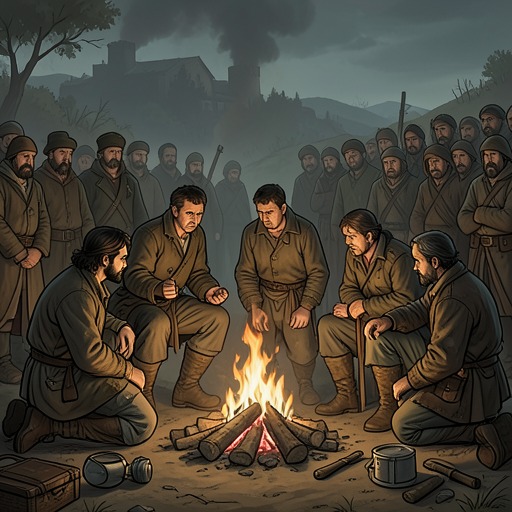
At dawn, an open hearth had sent up smoke from the clearing, but by the time the villagers and Charles Kent arrive, the fire has gone out and the ashes and twigs have been cleared away. Philip Earle follows with his parchment book, ready to make notes and mark shapes. Bird bones on the ground appear to confirm the suspicion that the newcomers have taken one of Charles Kent’s birds. Christopher Derby points to the remains, while John Carr examines them and observes features that, to him, suggest the bird may have been a blackbird rather than a dove. The others do not accept that possibility. The bones thus become less a settled proof than a surface onto which the crowd projects its existing accusation: the belief in theft holds even when the evidence can be read another way.
The Shelter Becomes a Battleground
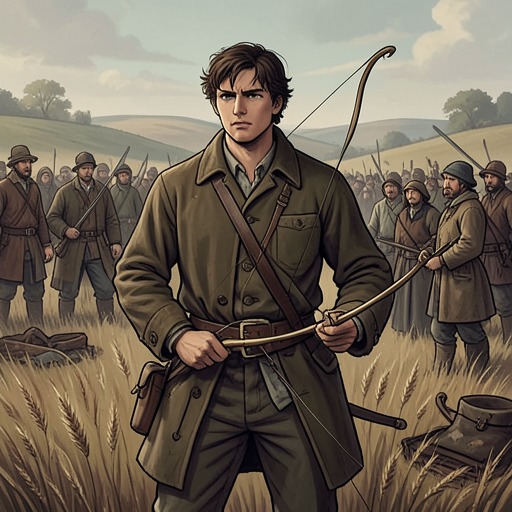
No one answers when the newcomers are called out to account for themselves. Brooker Higgs strikes the roof with a stick, apparently expecting the flimsy structure to collapse at once. The roof gives way, but the timber walls prove sturdier than they look. Other men step forward with heavier tools, and the attempt to demolish the shelter is about to continue when two strangers emerge from the trees: a younger man and an older man, probably his father. Both have longbows drawn. Their weapons give the crowd a reason to hesitate, but they also heighten the threat. The strangers appear bewildered by the attack rather than openly seeking a fight.
The change in balance is immediate. Brooker Higgs, who has already damaged the shelter and is exposed near the front, retreats into the crowd. Christopher and Thomas Derby also withdraw from the foremost position. Women call their children closer and move back; Kitty Gosse reportedly faints. Other men turn their bodies away from the arrowheads while keeping their weapons. Charles Kent dismounts from Willowjack and stands behind her. The villagers recognize that the newcomers have bows, but they also count their own numbers: about twenty men, armed with sticks and some sickles, against two strangers. Their confidence in their numerical advantage does not calm the encounter. In the narrator’s account, the crowd is already close to violence, and the possibility that the two men will release their arrows makes the next few steps decisive.
The Woman’s Appearance Changes the Encounter
Philip Earle moves toward the strangers with open hands, apparently offering a diversion while some villagers edge forward. One of the bowmen turns his aim toward him and warns him away, but Philip does not retreat. Before the villagers can close in, a woman appears from the shelter. She had been concealed beneath its sacking roof while the two men were among the trees. The onlookers do not know what relationship, if any, connects the three newcomers.
The woman has been struck when Brooker Higgs’s stick brought down the roof. Her visible wound makes the consequences of the villagers’ actions impossible to ignore. What had seemed, to the men on either side, a confrontation between armed groups now carries a clear cost borne by someone inside the shelter. The village women call for restraint. The men let their weapons fall or hold them less firmly, and the advance stops. Philip Earle again refuses to keep his distance: he parts the branches at the entrance and helps the woman step into the light. His actions do not resolve the dispute over the newcomers’ presence, but they interrupt the immediate movement toward a wider assault.
Aftermath and Significance
The woman’s velvet shawl becomes a focus of attention as soon as she emerges. Its mauve fabric and silver thread appear unusually costly in the village, and even Lucy Kent has never owned one like it. Some villagers regard the garment as evidence that its wearer possesses something beyond her station; others envy its quality and imagine wearing it themselves. The shawl therefore complicates the crowd’s response: the woman is treated as a person injured in the attack, but she is also judged through assumptions about wealth, rank, and theft. The villagers’ suspicion has not disappeared; it has shifted toward the meaning of an unfamiliar object.
The episode’s decisive turn comes not from a formal settlement, but from the exposure of what the crowd’s assault had obscured. The men first approach the shelter as a place occupied by presumed thieves and arsonists; once its hidden occupant emerges injured, the crowd’s confidence gives way to hesitation and shame. The scene also preserves uncertainty: the alleged stolen bird is not conclusively identified, the newcomers’ kinship remains unknown, and the immediate restraint does not establish whether the family may stay. By ending the assault without resolving those larger questions, the event reveals how quickly a communal claim to defend its land can become violence against people whose circumstances it has not taken the time to understand.