The Older Newcomer Dies in the Stocks
HarvestThe eldest newcomer dies while confined in the pillory, transforming his punishment into a death for which the village and its leading men cannot easily disclaim responsibility. Walter Thirsk reconstructs the likely circumstances without an official inquiry: the man died sometime during the night, before Charles Kent encountered him and his son in the morning. His body is later carried to the Manor House, where the arrival of Young Edmund Jordan makes the death an immediate confrontation as well as a private reckoning.
Death in the Pillory
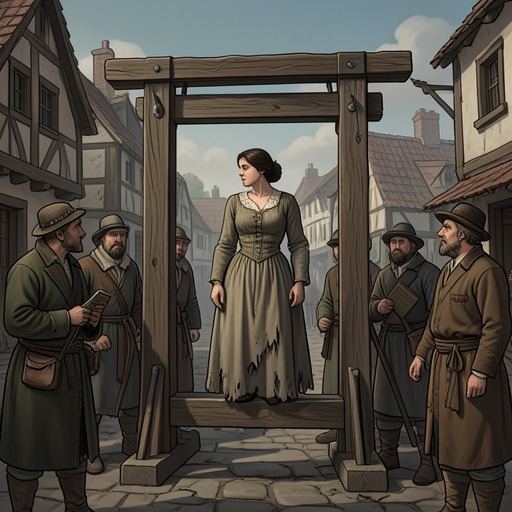
The death occurs between Walter’s visit to the pillory on a rain-soaked night and Charles Kent’s meeting with the two punished newcomers the following morning. By the time the body is found, a loose village pig has reached it and damaged one lower leg. The exact moment and cause of death are not witnessed. Walter’s central inference is that the father did not lift his head in defiance of Kent that morning: he was already dead.
The son, still fastened in the pillory, is alive and in a state of intense anger and despair. His wrists and throat are visibly bruised, and he appears to have struggled against the restraints. The difference between father and son is stark: one cannot respond to the punishment or to the people who come upon him; the other remains trapped beside him, unable to leave and furious at what has happened. The elder man’s death thus makes the violence of the confinement newly legible, even though the precise cause remains unknown.
An Uncertain Reconstruction
Walter sets out several possible explanations rather than claiming certainty. The older man may have slipped or toppled while standing on strained toes, perhaps because the rain made his footing unsafe. He may instead have suffered a sudden failure of the heart, or died while struggling. Walter hopes that death came suddenly and without awareness, but he cannot establish whether that was so. The pig’s damage to the body further obscures what happened after the man fell.
This account is explicitly a personal calculation, made without a constable, magistrate, doctor, priest, or undertaker. The remoteness of the community leaves the death outside the procedures that might identify its cause or assign responsibility. Walter recognizes that this absence is convenient for those who might be exposed by an official examination; at the same time, it leaves everyone with conjecture instead of a settled explanation. His conclusion about the timing is firm, but the physical cause remains unresolved.
Care and Complicity
Charles Kent, Philip Earle, and Walter try to tend the body, though none has the skill to repair the damage. Their work is limited: they clean and cover the wounds, arrange the man’s expression, and wrap him in baling cloth. These practical gestures cannot undo the death, but they mark a shift from punishment to care. Kent says a prayer quietly, and Walter, who describes prayer as unusual for him, joins him. Walter senses that Kent’s prayer may carry a plea for forgiveness, perhaps because Kent believes himself implicated.
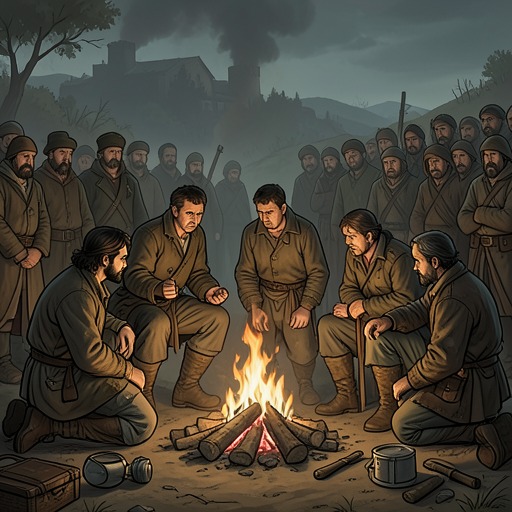
The men’s response does not erase their earlier role in the punishment. As they stand back from the body, Walter reads guilt on the faces of Kent and Philip Earle. He also imagines the wider circle of responsibility: villagers who used scythes and sticks against the newcomers may regret their actions, while those with pigs may hurry to check that their animals have not escaped. He speculates that Christopher and Thomas Derby and Brooker Higgs might feel remorse as well. The death is not presented as the act of one identifiable killer; it exposes a chain of actions and omissions in which many people may recognize themselves.
Public Consequences
The body is taken to the Manor House and placed on the porch bench. Walter and the others carry it there in their yellow gleaning cloths, with their clothes and hands bloodied from the effort. Their arrival coincides with Young Edmund Jordan’s first visit to the valley, accompanied by five men. Jordan is met not by the expected hospitality but by the burned remains of a barn and the corpse of the eldest newcomer. The death therefore confronts the incoming authority with the consequences of the village’s recent violence before he can settle into the estate’s ordinary business.
Walter’s account stresses that the dead man’s name is still unknown, yet the death already touches the whole community. His imagined wish that time might reverse, or that the body might breathe again, gives way to an awareness that the damage cannot be recalled. The event binds the pillory, the villagers’ assault, the newcomers’ confinement, and the arriving estate party into one unresolved reckoning. Its uncertainty does not lessen its consequence: without proof of precisely how the man died, the community is left with shared suspicion and guilt rather than an official judgment.